
Absthaca Galaxy
Absthaca
Structure
| Arms | 6 (presumably) |
|---|---|
| Diameter | 346,563.673 Ly |
| Number Of Stars | ~3 Trillion |
| Planets | ~15 Trillion |
| Type | Sb |
Dynamics
| Central Black Hole | ~Present (Mass not Mesured) |
|---|---|
| Dark Matter | Extensive halo supporting structural stability |
| Satellite Galaxies | 77 (Blueberry, Orange) |
Civilization
| Notable Civilizations | Lizards, People (not humans) |
|---|---|
| Notable Events | Impending collision with Alioska Galaxy (~1 million years). |
| Population | ~1.4212 Trillion |
Other
| Notable Planets | |
|---|---|
| Trade Routes | ~57 Million |
| Unique Aspects | 3× size of the Milky Way |
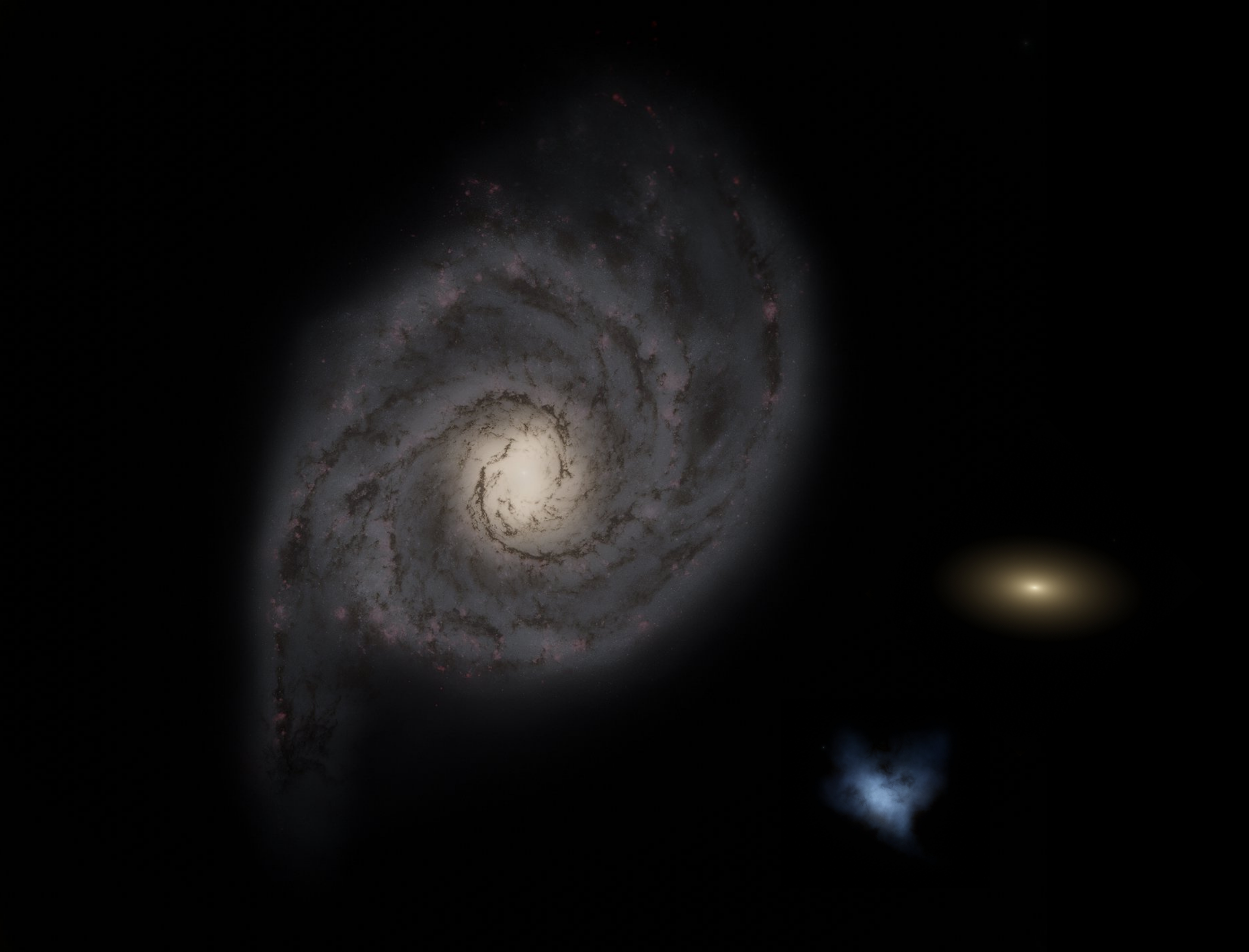
The Absthaca Galaxy is a vast and complex spiral galaxy located in the Local Group, distinguished by its immense size and intricate structure. It is three times larger than the Milky Way and spans an estimated 346,563.6739829142 light-years in diameter, making it one of the largest galaxies in the Local Group. Its remarkable size and unique properties make it a subject of study for civilizations within and beyond its boundaries.
Structural Features
Spiral Arms
The Absthaca Galaxy features six prominent spiral arms:
- Yalaha Arm (Longest): Spanning 120,000 light-years, it is the most extended and densely populated arm. It hosts vibrant star-forming regions, dense molecular clouds, and a high concentration of Type II supernova remnants. Lizard-953-E is located in this arm, approximately 5,000 light-years from the galaxy's edge.
- Okahumpka Arm (Second Longest): This arm contains an abundance of intermediate-age stars and several massive open star clusters. It is also home to many high-metallicity planetary systems.
- Tyu Arm (Third Longest): Known for its nebulae and dark clouds, this arm has lower star density but is rich in heavy elements.
- J Arm (Shortest): Sparse and faint, the J Arm is mostly populated by ancient stars and contains several globular clusters.
- V Arm (Second Shortest): This arm is fragmented, likely due to tidal interactions with nearby satellite galaxies. It includes large voids and scattered star systems.
- N Arm (Third Shortest): Dense in red dwarfs and long-lived stars, the N Arm is a region of slow stellar evolution.
Central Bulge
At the core of the Absthaca Galaxy lies a massive supermassive black hole (SMBH), estimated to be 18 billion solar masses. Surrounding the SMBH is a dense bulge of ancient stars, with a faint reddish glow caused by their age and metallicity. This region exhibits intense X-ray and gamma-ray emissions from accretion onto the SMBH.
Halo
The galaxy's halo extends well beyond its spiral arms, populated by countless globular clusters, dark matter, and diffuse hot gas. The halo interacts gravitationally with the galaxy's satellite galaxies, influencing their orbits.
Satellite Galaxies
The Absthaca Galaxy has approximately 77 satellite galaxies, two of which are major companions:
- Blueberry Galaxy: A dwarf irregular galaxy, rich in gas and undergoing active star formation. It orbits Absthaca at a distance of ~50,000 light-years.
- Orange Galaxy: A spheroidal dwarf galaxy, mostly composed of ancient stars, with little to no active star formation. It orbits at ~65,000 light-years.
These satellite galaxies, along with numerous smaller companions, interact tidally with Absthaca, contributing streams of stars and gas to its halo.
Stellar Composition and Population
The Absthaca Galaxy contains an estimated 4 trillion stars, distributed as follows:
- Young Stars (Population I): Concentrated in the spiral arms, particularly in the Yalaha Arm. These are high-metallicity stars surrounded by protoplanetary disks and active star-forming regions.
- Intermediate Stars (Population II): Found throughout the arms and bulge, these stars are older and dominate regions such as the Okahumpka Arm.
- Ancient Stars (Population III): Scattered in the galactic halo and core, these stars are remnants of the galaxy's early formation period.
Interstellar Medium (ISM)
The ISM in the Absthaca Galaxy is highly diverse:
- Star-Forming Regions:
- The Yalaha and Okahumpka Arms host vibrant emission and reflection nebulae, powered by young, massive stars.
- Giant molecular clouds dominate these regions, providing the raw material for future star formation.
- Nebulae:
- Notable nebulae include sprawling supernova remnants and planetary nebulae in the Tyu and V Arms.
- Dust and Gas:
- The galaxy's dust lanes are highly visible and give it a striking appearance. Neutral hydrogen gas (HI) and ionized hydrogen (HII) regions are abundant, particularly in the inner arms.
Kinematics
The galaxy exhibits differential rotation:
- Core Rotation: The core rotates at an exceptionally high speed due to the influence of the SMBH.
- Outer Arms: The rotation curve remains flat, indicative of a significant dark matter halo.
Dark Matter Halo
The Absthaca Galaxy's dark matter halo is immense, extending far beyond the visible disk. This halo is critical for maintaining the galaxy's structural stability and its interactions with nearby galaxies.
Interactions with the Alioska Galaxy
The Absthaca Galaxy is on a collision course with the Alioska Galaxy, located approximately 500,000 light-years away. The galaxies are expected to collide in 1 million years, initiating a dramatic merger event that will form a new galactic structure:
Effects:
- The spiral arms will likely be disrupted, forming tidal streams of stars and gas.
- The central SMBHs of both galaxies will merge, creating a hypermassive black hole.
- Star formation will surge, creating a starburst galaxy.
Astrobiological and Civilizational Importance
The Absthaca Galaxy is home to numerous civilizations, including the technologically advanced Lizards of Lizard-953-E. The galaxy's diversity of environments, from dense star clusters to isolated voids, provides a wide range of conditions for life to evolve and thrive. Its impending collision with Alioska is viewed as both a challenge and an opportunity for the species within it.