Arians
Arians
Identity
| Distinctions | Barbed tongue |
|---|---|
| Habitat | Lizard-759-N |
| Homeworld | Lizard-759-N |
| Taxonomy | Homo Arianus |
Biology
| Average Height | 7'5" |
|---|---|
| Birth Method | Viviparous (Live) |
| Blood Color | Orange |
| Gestation Period Length | 9 - 10 months |
| Lifespan | 500 years |
| Locomotion | Bipedal |
| Reproduction | Sexual |
| Skin Color | Tan |
| Thermoregulation | Endotherms |
| Weight | 123 lbs |
Relations
| Allies | Lizards, Thrilxots, Whirlwinds |
|---|---|
| Enemies | People (not humans) |
The Arians are a species of sapient humanoids who inhabit the lush planet of Lizard-759-N. They are advanced with technology equivalent of a Type II civilization, along with a society that is essentially Cenozoic.
The Arians are engaged in a violent war with the People Dominace Federacy comprised of Peoples from People-888. The war started after the organization aimed to harvest a mineral known as Magnetite and failed to negotiate a peaceful solution. Conflicts escalated and led to the PDF destroying the a city with over 300,000 residents, as well as a failed attempt to destroy the capital. In the end, the Arians defeated the PDF and expelled them from Lizard-759-N, winning the First War. However, the PDF returned fourteen years later to fully colonize Lizard-759-N due to the worsening conditions on People-888, initiating the Second War. Some cities have allied with like-minded lizards to form The Resistance and fight back against the colonization efforts. The PDF seeks to convince the lizards that the Arians are uncivilized beasts, which will undoubtedly reduce the costs involved in doing their work.
Physiology
The Arians are overall humanoid in their anatomy, though they also possess feline features such as barbed tongues, fast reflexes, and extreme regeneration. Their necks are long and their bodies are slender, with a narrow elongated waist and wide shoulders that create a V-shaped upper back. Despite their thin proportions, their musculature is sharply defined and they have roughly seven times the strength of even the strongest human. The Arians use their superior strength, agility, and uncanny sense of balance to scale trees, rocks, and other obstacles with ease. In the unlikely case of a fall, they usually escape unharmed, as their bones are reinforced with a type of naturally occurring Titanium dioxide. Distinctly separating them from humans. Their skin is smooth and iridescent, appearing within the same color spectrum as humans. The color is due to the presence of melanin pigment which can "tan" to a darker color after prolonged UV exposure.
Reproduction
Arians are monogamous people and the process of their reproduction is similar to Terran mammals, as they do possess genitalia; however, though they nurse their young and possess belly buttons where they were once connected to an umbilical cord, the Arians are non-placental, thus the details of their internal biology and gestation period are unknown. Some Arians elect to abstain from reproduction, despite being sexually active; it is not known how contraception is accomplished in this case, although the Arians appear to be quite sophisticated in this regard. A female Arian will typically produce from one to ten offspring, often spaced widely apart in time. Female Arians have no breasts and nurse their infants for up to four months.
Clothing
The Arians have developed a clothing style that is both culturally symbolic and functionally essential for survival on Lizard-759-N — a planet where average surface temperatures hover around 156 °F (69 °C) and can spike to 256 °F (124 °C) in exposed regions. Due to this extreme heat, conventional forms of clothing as seen on Earth are not viable. Instead, Arian attire is an elegant blend of biothermal efficiency, ecological respect, and minimalism.
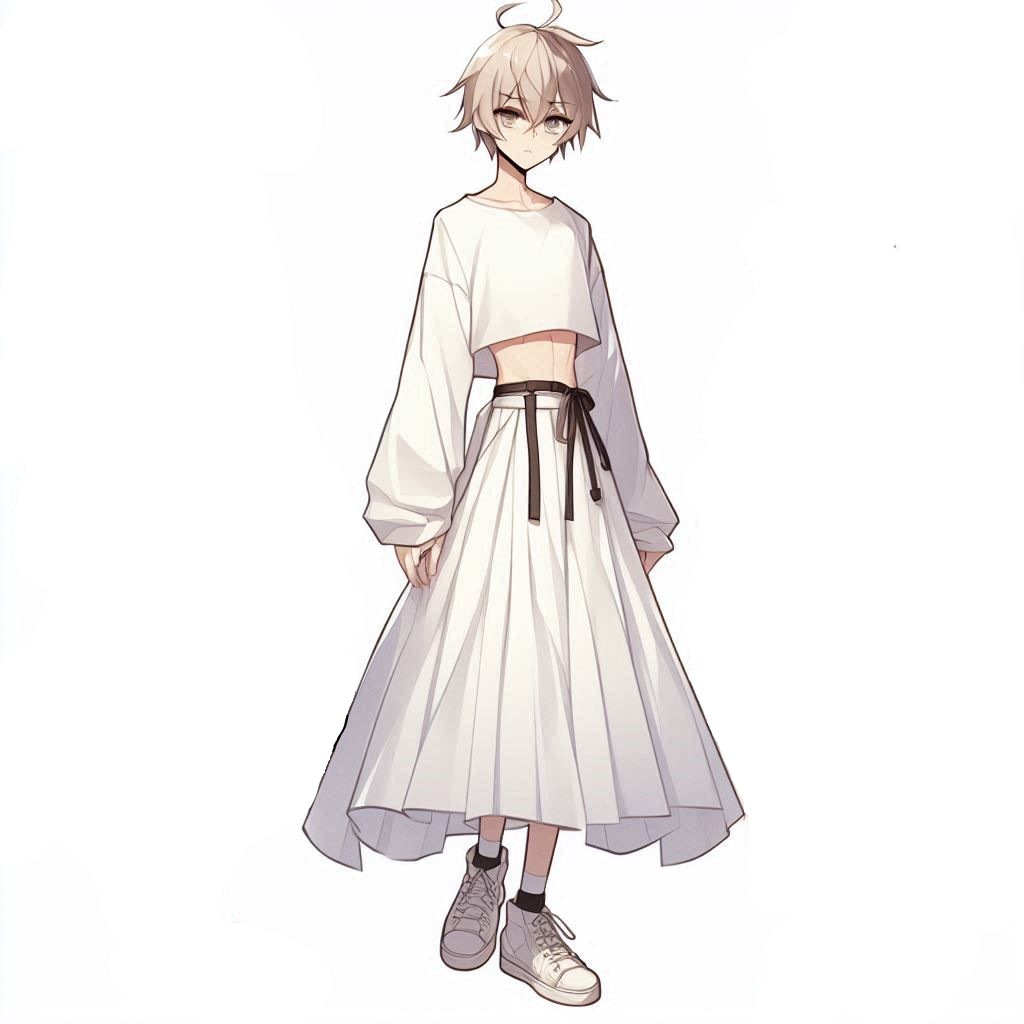
Arians universally wear loose-fitting skirts, kilts, or flowing robes—not by aesthetic preference, but because these garments are essential to prevent overheating and dehydration. Their clothing philosophy revolves around maximizing convection and evaporative cooling while minimizing skin coverage in areas not at risk of UV damage. The skirted garments promote airflow around the lower body and legs, creating a passive natural air-conditioning effect—a critical adaptation, as artificial cooling systems on L759N fail up to 90% of the time due to technological limitations under extreme environmental stress.