
Lizard-595
Lizard-595-N
Astrographical Info
| Age | 2 billion years |
|---|---|
| Axial Tilt | 20.32° |
| Class | Gas Giant |
| Diameter | 155,249 km |
| Gravity | 7.88 g (77.313981578 m/s²) |
| Mass | 3.678 jupiters |
| Suns | 1 |
Orbital
| Galaxy | Elkska Galaxy |
|---|---|
| Orbital Period | 2.43 years |
| Rotation Period | 9 hours |
| Semimajor Axis | 1.75 AU |
| System | Lizard-595 System |
Atmosphere
| Atmospheric Color | Yellow |
|---|---|
| Atmospheric Composition | H₂, He |
Other
| Affiliations | |
|---|---|
| Government | Stable (Lizards) |
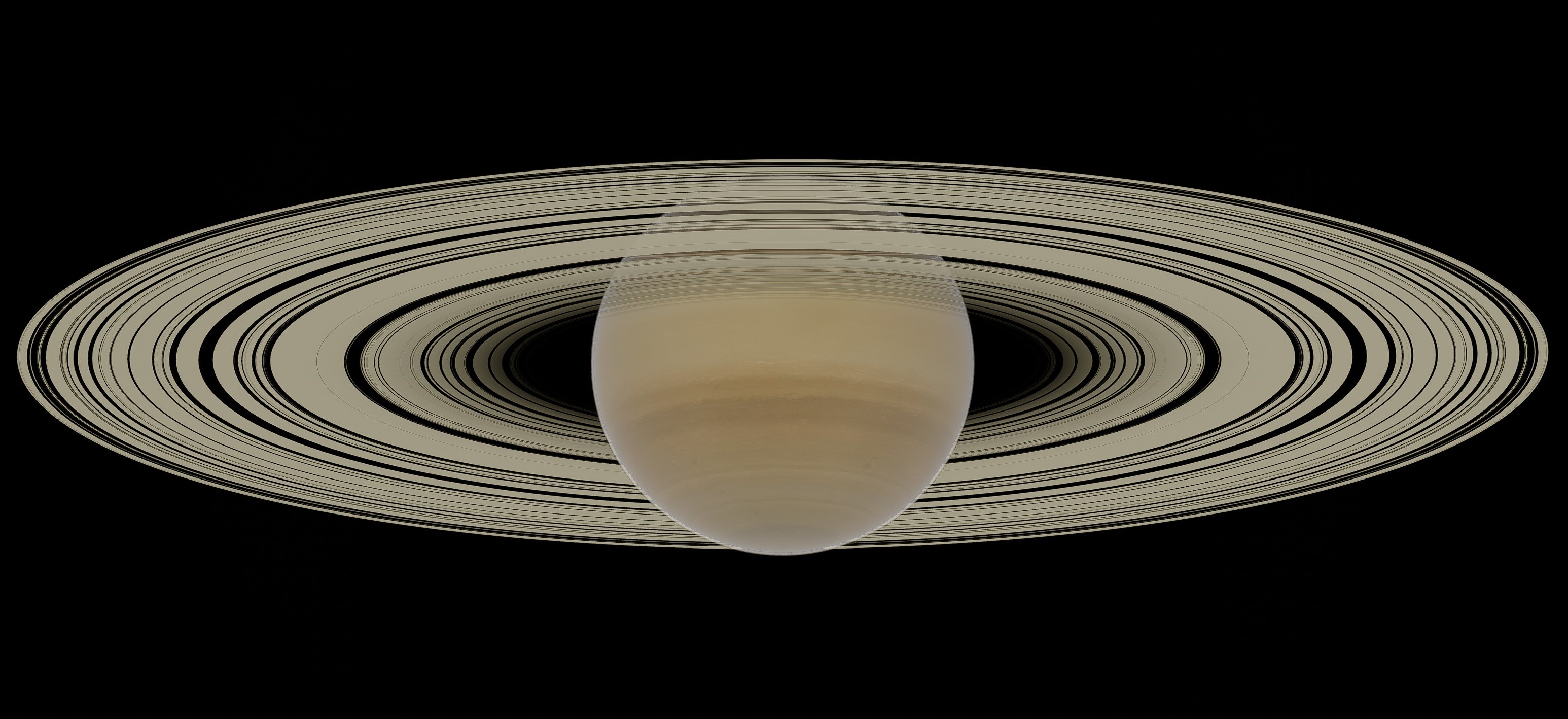
Lizard-595-N is the first of three gas giants and the fourth planet orbiting Lizard-595-A—known to humans as L595A within the Lizard-595 System. Slightly larger yet denser than Jupiter, Lizard-595-N has an enormous ring system and possesses fifty moons, the most prominent being Ipzamar.
The planet imposes intense gravitational and magnetospheric forces on Ipzamar, driving the moon’s extreme geological and morphological phenomena—referred to as flux concentrations. Iconic structures such as the vast stone arches are sustained by these interacting tidal and magnetic stresses; absent these forces, such formations would not persist.
Structurally, Lizard-595-N bears resemblance to Saturn, though it's rings are smaller than Lizard-595-N's. Unlike Saturn, which resides in the cold outer Solar System, Lizard-595-N orbits Lizard-595-A at roughly Mars–Sun separation. Formation in a comparatively high-temperature region resulted in a composition enriched in helium and heavier elements, yielding greater density for its size. It also contains a proportionally larger liquid metallic hydrogen layer, an iron-rich core, and generates a substantially stronger and more expansive magnetic field.
Astrophysical Description
In terms of appearance, Lizard-595-N is like a larger, yellower Saturn, with less noticeable bands. Despite being slightly larger than Saturn, Lizard-595-N is considerably more massive, with a diameter of 96,467.2562 miles. In nine and seven hours, its core and magnetic field rotate. In terms of latitude, the visible surface features rotate more slowly, from 10.1 to 10.6 hours. While Lizard-595-N's banding is not as striking as Jupiter's, it is more noticeable than Saturn's.
Lizard-595-N appears to be a typical gas giant with a typical composition. Like most planets, it started condensing from the primordial stellar nebula. Lizard-595-A's system happened to be very rich in the heavier elements, particularly iron. Also, having formed closer to its sun, it has far less hydrogen because the higher temperature increased the speed of the lightest gas atoms preferentially, allowing them to escape the star's vicinity. The stellar wind also contributed to removing the lighter elements, blowing them farther outward.
Auroral activity is near-continuous and intense enough to be visible in daylight. When magnetic flux tubes form and link to various satellites, they too display brilliant auroral bands in the moons' polar regions where the tubes' flux joins the global ones.
As with all gas giants (especially gas giants close to the parent star, as with Lizard-595-N), this planet is surrounded by a lethal halo of charged particles (the radiation belts around Lizard-595-N are more energetic than the belts surrounding Jupiter); the innermost moonlets of Lizard-595-N have reported radiation in excess of 5,600 rem per day (Io receives 3,200 rem per day), which is aggravated due to the higher metallicity in the planets' internal composition. Ipzamar resides just outside the main radiation belts of Lizard-595-N, except for a week, when rotating along the night side of Lizard-595-N. At that time, the planet is shrouded at night in a shimmering aurora and receives a scourge of radiation.
Lizard-595-N and it's rings can be seen in the sky on Ipzamar. Depending on where the moons are in their orbits, Ipzamar may also have two or even three moons in its sky at once. Depending on L595A's position, Ipzamar and the other large moons cast dark shadows on Lizard-595-N and it's rings.
Atmosphere
Because it formed in a higher-temperature environment, Lizard-595-N has much less hydrogen and more helium in its atmosphere than most gas giants: sixty-three percent hydrogen and thirty-seven percent helium, compared to Saturn's ninety-one percent and six percent. Since helium is about twice as dense as hydrogen, Lizard-595-N is much more massive than Saturn, and jupiter and thus has increased gravitational compression sufficient to produce a liquid metallic hydrogen center twice as large. The remaining point zero one percent of the atmosphere is mainly composed of the gasses methane, ammonia, hydrogen sulfide, and water vapor.
There are minor amounts of compounds that are chemically reactive and therefore require a continual renewal mechanism. These compounds include acetylene, carbon monoxide, ethane, germane, methyl acetylene, phosphine, and propane. They are produced by high-temperature chemical reactions deep in the planet's interior, upper atmosphere energetic reactions from stellar ultraviolet photons, high-energy particles from the radiation belts, and atmospheric lightning discharges.
This chemical "stew" is stirred by convection currents and shearing-force winds produced by the planet's rapid rotation. The result is a brilliant display of an ever-changing pattern of colored cloud belts and rotating storms.
Internal Structure
Beneath the liquid droplet clouds that make up its visible "surface", Lizard-595-N's atmosphere gradually thickens as its temperature and pressure build up from gravitational compression. When the pressure reaches about two megabars (approximately 29,000,000 pounds per square inch, which is almost two million times Earth's sea level atmospheric pressure) and the temperature reaches about 6,000 K (10,340 °F, slightly hotter than the surface of the Sun), hydrogen undergoes a phase change to its metallic form. The size of the liquid metal portion is about three-quarters of the planet's total diameter. This feature is common to all but the smallest gas giants.
Continuing downward, there is a central core of molten iron, surrounded by a thin "jacket" of lighter, rockier material. Large amounts of iron are not commonly found in gas giants as they have mainly rocky cores.
Lizard-595-N has an intense internal heat source that results from the gravitational energy released during the contracting of the gases from which it is formed. Additionally, as hydrogen and helium were compressed, they changed from gases to liquids. This released their latent heat (also called the "heat of vaporization", which is the amount of energy it takes to evaporate a liquid into a gas). Finally, some of the helium that dissolved in the metallic hydrogen core condensed out & moved downwards, converting its gravitational potential energy into heat via friction processes.
Satellite System
Lizard-595-N has fifty moons. Yivzar is the innermost moon, followed by Xadorix. The third and fourth moons are Nixamar and Niccolum, and the fifth is Septario. The sixth is Ipzamar.
Since Lizard-595-N's orbit lies in L595A's habitable zone, planet or moon-sized celestial bodies may have liquid surface water and therefore support life, as was the case with Ipzamar.
The fourty-four other moons are small distant moonlets, no bigger than Japan.