Lizard-557-Y
Lizard-557-N

Astrographical Info
| Axial Tilt | 27° |
|---|---|
| Class | Gas Giant |
| Diameter | 173,783 km |
| Gravity | 3.36 g |
| Mass | 1.96 jupiters |
| Suns | 1 |
Orbital
| Galaxy | Elkska Galaxy |
|---|---|
| Orbital Period | 14.5 years |
| Rotation Period | 9.7 hours |
| Semimajor Axis | 5.134 AU |
| Solar Day | 9.7 hours |
| System | Lizard-557 System |
Atmosphere
| Atmospheric Composition | H2, He, O2 |
|---|---|
| Atmospheric Pressure | 2 atm |
| Temperature | 84℉ |
Surface
| Moons | 97 |
|---|---|
| Sea Composition | H2O, C4H10 |
| Water State | Liquid |
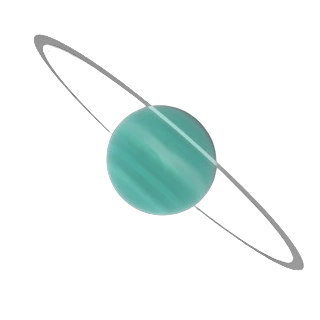
Lizard-557-N (Lizardian name: Neta meaning "the great pentagon") is the third of the four gas giants and the sixth planet orbiting the star Lizard-557-A (L557A by the Lizards) in the Lizard-557 System. Slightly larger and denser than Jupiter, Lizard-557-N has enormous rings and has ninety-seven moons.
Lizard-557-N exerts a considerable gravitational and magnetic influence on the inner moons which contributes to the dramatic geological and morphological elements on their surfaces, called flux concentrations.
Lizard-557-N is extremely similar to Saturn, but much bigger. But unlike that planet, which is located in the outer reaches of the Solar System, Lizard-557-N orbits Lizard-557-A at a distance comparable to Jupiter's orbit around the Sun. Because Lizard-557-N formed in a higher-temperature environment than Saturn, it is composed of a much larger proportion of helium and other heavier elements and has a greater mass for its size. It also has a proportionally larger metallic hydrogen core, an iron central body, and produces a far stronger and more extended planetary magnetic field.
Physical Description
Visually, Lizard-557-N resembles a larger version of Saturn, with less prominent bands and a larger pentagonal vortex storm.
At 107983.75 miles in diameter, Lizard-557-N is larger than Saturn and considerably more massive. Its magnetic field, and thus its core, rotates in 9.7 hours. The visible surface features rotate more slowly, ranging from 10.1 to 10.6 hours, depending on latitude. Lizard-557-N has more prominent banding than Saturn, although nowhere near as spectacular as Jupiter. Still, Lizard-557-N has a vortex storm far exceeding Saturn's "Hexagon" in size and turbulence. It also has an unusual internal structure and complex magnetic interactions with its inner satellites.
Lizard-557-N appears to be an unusual gas giant with a strange composition. Unlike almost all gas giants, it started condensing from the primordial stellar nebula. Lizard-557-N's system happened to be very rich in the heavier elements, particularly iron. Also, having formed closer to its sun, it has far less hydrogen because the higher temperature increased the speed of the lightest gas atoms preferentially, allowing them to escape the star's vicinity. The stellar wind also contributed to removing the lighter elements, blowing them farther outward.
Auroral activity is near-continuous and intense enough to be visible in daylight. When magnetic flux tubes form and link to various satellites, they too display brilliant auroral bands in the moons' polar regions where the tubes' flux joins the global ones.
As with all gas giants (especially gas giants close to the parent star, as with Lizard-557-N), this planet is surrounded by a lethal halo of charged particles (the radiation belts around Lizard-557-N are far more energetic than the belts surrounding Jupiter); the innermost moonlets of Lizard-557-N have reported radiation in excess of 6,792 rem per day (Io receives 3,200 rem per day), which is aggravated due to the higher metallicity in the planets' internal composition. Kilppe resides just outside the main radiation belts of Lizard-557-N, except for a week, when rotating along the night side of Lizard-557-N. At that time, the planet is shrouded at night in a shimmering aurora and receives a scourge of radiation.
Lizard-557-N can be seen in the sky on any of its moons. Depending on where the moons are in their orbits, a single moon may also have two or even three moons in its sky at once. Depending on L557A's position, Kilppe and the other large moons cast dark shadows on Lizard-557-N, like beauty marks.
Atmosphere
Because it formed in a higher-temperature environment, Lizard-557-N has less hydrogen and more oxygen and helium in its atmosphere than most gas giants: sixty-five percent hydrogen, twenty percent oxygen, and fifteen percent helium, compared to Saturn's ninety-one percent and six percent. Since helium is about twice as dense as hydrogen, and oxygen is sixteen times, Lizard-557-N is considerably more massive than Saturn and thus has increased gravitational compression sufficient to produce a solid silicate center thirty times as large. The remaining point five percent of the atmosphere is mainly composed of the gasses methane, ammonia, nitrogen, and water vapor.
There are minor amounts of compounds that are chemically reactive and therefore require a continual renewal mechanism. These compounds include acetylene, carbon monoxide, ethane, germane, methyl acetylene, phosphine, and propane. They are produced by high-temperature chemical reactions deep in the planet's interior, upper atmosphere energetic reactions from stellar ultraviolet photons, high-energy particles from the radiation belts, and atmospheric lightning discharges.
This chemical "stew" is stirred by convection currents and shearing-force winds produced by the planet's rapid rotation. The result is a brilliant display of an ever-changing pattern of colored cloud belts and rotating storms, like the Great Pentagon.
The lower atmosphere lacks visible clouds, resulting in high optical clarity. Upper cloud decks, composed of ammonia and methane ices, are confined to higher altitudes. The sky appears in a soft orange hue (#F3AB49) due to Rayleigh scattering and absorption by aerosol hazes in a nitrogen-methane dominated atmosphere, with an optical depth of approximately τ ≈ 5 in the visible spectrum. This scattering preferentially removes shorter wavelengths, similar to observations on Titan.
Surface
Lizard-557-N's atmosphere extends down 28,438 km, with the solid surface emerging at a depth comparable to the scale of ice giant interiors, such as those modeled for Uranus and Neptune. Surface gravity is estimated at approximately 3.3 times Earth's, consistent with a planetary mass around 1.96 Jupiter masses and a density profile derived from core accretion formation scenarios in protoplanetary disks.
Ambient surface temperature is 28.8 °C (84 °F), maintained by a combination of geothermal heat flux and greenhouse effects from atmospheric constituents, primarily methane and ethane. Pressure at the surface is around 2 atmospheres, shifting the phase diagrams of hydrocarbons to allow liquid stability at these temperatures. The planet is assumed to exhibit tidal locking or a resonant spin-orbit ratio (e.g., 3:2), influencing thermal distribution and volatile cycling.
Surface Features
-
Green Ooze Fields: Areas where viscous hydrocarbon gels, consisting of polymeric alkanes and alkenes formed through upper-atmosphere photochemistry, seep from porous tan silicate rocks. These materials are non-reactive and neutral in composition.
-
Ooze Trees: Inorganic crystalline structures composed of silicon carbide and fullerene aggregates, coated in phosphorescent hydrocarbons. These form through self-assembly processes near hydrothermal vents, exhibiting fractal geometry and green luminescence from quantum effects.
-
Butane Lakes: Pools of liquid butane (C₄H₁₀) with a yellow-green coloration from suspended particulate ooze. Liquidity is sustained by elevated pressure and dissolved impurities, forming eutectic mixtures. These features participate in evaporation-condensation cycles driven by orbital resonance.
Habitability Considerations
The environment supports potential habitability in hydrocarbon solvents rather than water, with redox gradients from geothermal sources possibly enabling methanogenic metabolisms. Prebiotic chemistry may occur via cosmic ray-induced reactions, analogous to processes inferred on Saturn's moon Titan. The magnetosphere provides shielding from stellar radiation, contributing to surface stability.
Interior
Beneath the surface, temperature and pressure build up from gravitational compression. When the pressure reaches about two megabars (approximately 29,000,000 pounds per square inch, which is almost two million times Earth's sea level atmospheric pressure) and the temperature reaches about 6,000 K (10,340 °F, slightly hotter than the surface of the Sun), Silicon undergoes a phase change to its metallic form. The size of the liquid metal portion is about three-quarters of the planet's total diameter. This feature is common to all but the smallest gas giants.
Continuing downward, there is a central core of molten iron, surrounded by a thin "jacket" of rockier material. Large amounts of iron are not commonly found in gas giants as they have mainly rocky cores.
Lizard-557-N has an intense internal heat source that results from the gravitational energy released during the contracting of the gases from which it is formed. Additionally, as ethane and other hydrocarbons were compressed, they changed from gases to liquids. This released their latent heat (also called the "heat of vaporization", which is the amount of energy it takes to evaporate a liquid into a gas). Finally, some of the silicon that dissolved in the iron core condensed out & moved downwards, converting its gravitational potential energy into heat via friction processes.
Magnetosphere
Lizard-557-N's rotation and its internal heat sources produce circulating convection flows in its liquid center. These flows carry entrained electric currents that generate an extremely powerful magnetic field. The liquid iron core at the center of the liquid metallic silicon exerts a synergistic effect and intensifies the magnetic field far beyond those produced by conventional gas giants. This magnetic field rotates with the planet. It serves to trap charged particles (electrons, protons, and ionized atoms and molecules) into various radiation belts that encircle the planet.
Satellite System
Lizard-557-N is said to have Ninety-seven moons. Olgof is the innermost moon, followed by Frankust. The third and fourth moons are Sulliven, and Jot, and the fifth is Kilppe.
Nomust is one known moon, and Vanta orbits beyond Nomust, although their exact placements are unknown.
The two outer moons are known to orbit in a different direction from all the others.
In addition to the ninety-seven moons orbiting Lizard-557-N, there is a large and a small planetoid at the gas giant's L4 and L5 Lagrangian points respectively. These co-orbital asteroids are called L557-L4 and L557-L5.
Since Lizard-557-N' orbit lies in L557A's habitable zone, planet or moon-sized celestial bodies may have liquid surface water and therefore support life, as was the case with Kilppe, and Lizard-557-N itself.
Trivia
- In the files of the Lizardian King's drawer, it is mentioned about 1 in 200 Inhabitants feel extremely uneasy and sick when viewing Lizard-557-N due to its intense size and enormous ring system, inducing feelings of megalophobia, as if one planet is about to be dropped on another.