Florida System
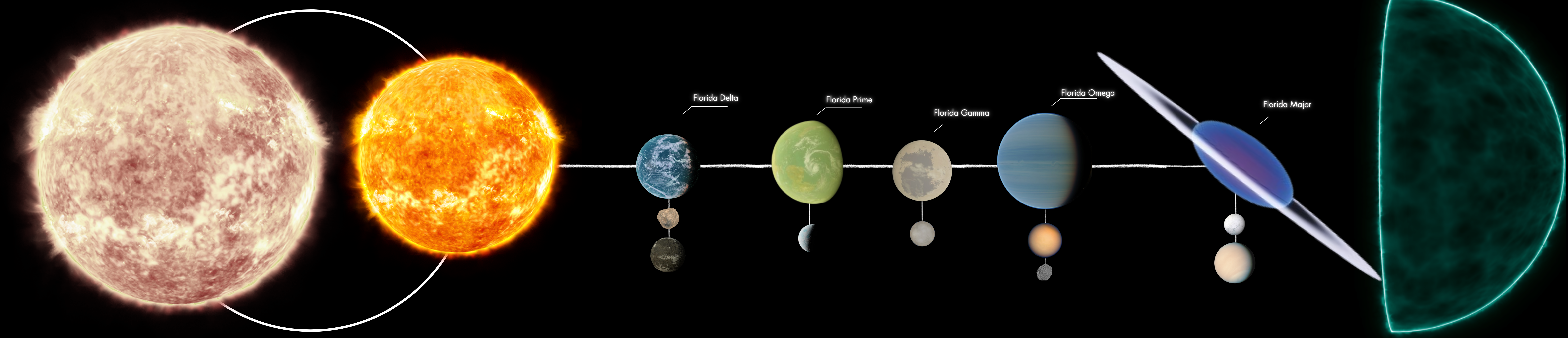
Florida Delta
- Type: Ocean Planet
- Characteristics:
- An expansive world covered predominantly by water, featuring vast oceans, underwater ecosystems, and possibly archipelagos or small islands.
- May have varied climates, from tropical regions with rich marine life to deeper, colder zones, and could feature underwater geological formations like ridges or trenches.
- The moons (Florida Prime and Florida Gamma) might influence ocean tides and weather patterns on Florida Delta.
Florida Prime
Florida Prime is a deadly, high-gravity exoplanet with a green toxic atmosphere, carnivorous plant life, and a searing hot climate. Its dangerous conditions, combined with its strong anomaly strength, make it a treacherous place for explorers. The anomaly affects the surrounding system, and the combination of twin suns and a toxic ocean of hydrochloric acid adds to the hazardous environment. Only highly advanced technology or protective measures would allow any form of survival on this planet.
- Type: Hostile Terrestrial Exoplanet
- Diameter: 13,763 km (slightly larger than Earth)
- Mass: 1.673 times that of Earth
- Gravity: 1.532 Gs, making movement laborious for visitors accustomed to Earth's gravity.
- Orbit: Orbits two suns at a semimajor axis of 0.75 AU, completing an orbit in just 0.6402 Earth years.
- Atmosphere:
- Composition: Primarily chlorine (Cl), oxygen (O₂), and nitrogen (N₂).
- Pressure: 1.212 atm, rendering it deadly to most known life forms.
- Toxicity: Exposure leads to unconsciousness in 2 seconds and death within 4 minutes due to high toxicity, with the chlorine content giving the sky a striking green hue.
- Climate and Conditions:
- Average Temperature: Scorching 103°F (approximately 39.4°C), creating a harsh environment for unprotected life.
- Rotational Period: 26 hours, 57 minutes, and 43.23 seconds, resulting in a 27-hour solar day.
- Axial Tilt: 3.13°, leading to minimal seasonal variation and a consistently hot and dry climate influenced by its twin suns.
- Flora and Fauna:
- Vegetation: The flora is carnivorous and aggressive, making survival precarious for any life forms. These predatory plants could exhibit dangerous adaptations to thrive in the toxic environment.
- Fauna: If any fauna exist, they would likely be highly specialized to survive the extreme toxicity and harsh conditions, potentially displaying adaptations similar to extremophiles on Earth.
- Geological Composition:
- Core: Composed of osmium, an unusually dense and rare element, contributing to a strong anomaly strength of 23 I/u.
- Anomalies: The anomaly affects local physical or electromagnetic properties in unpredictable ways, creating a challenging environment for exploration.
- Oceans: The oceans consist of a toxic mixture of water (H₂O), hydrochloric acid (HCl), and chlorine (Cl), making them incredibly corrosive and uninhabitable.
- Moon and Orbital Features:
- Major Moon: Florinic
- Plays a significant role in tidal forces and gravitational effects on Florida Prime.
- Apparent Size: Florida Prime appears enormous from Florinic, with an apparent magnitude of -21.92 and an angular size of 28°55'17.15".
- Major Moon: Florinic
Florida Gamma
- Type: Desert Planet
- Characteristics:
- A hot and arid desert world, characterized by vast sand dunes, rocky formations, and extreme temperature variations.
- The surface may show signs of past geological activity, with canyons, plateaus, and perhaps ancient riverbeds indicating it once had water.
- If life exists, it may be highly specialized to survive in the harsh conditions, with adaptations to conserve water and withstand extreme heat.
Florida Omega
- Type: Gas Giant
- Characteristics:
- A massive gas giant, measuring 200,000 km in diameter, likely displaying colorful bands of clouds, storms, and possibly a rich atmosphere composed primarily of hydrogen and helium.
- The planet may have a complex system of rings and a variety of moons, each potentially hosting their own unique environments or characteristics.
Florida Major
- Type: Ultra Gas Giant
- Characteristics:
- An extraordinarily large gas giant with a diameter of 5 million km, making it one of the largest gas giants known.
- Its extreme oblateness indicates rapid rotation, creating a pronounced equatorial bulge and potentially powerful storms in its atmosphere.
- Florida Major could also have an extensive ring system and numerous moons, presenting various possibilities for exploration and research.
System Dynamics and Lore
- Interactions: The gravitational forces from Florida Omega and Florida Major could create interesting dynamics within the system, influencing the orbits and potential climates of Florida Delta, Florida Prime, and Florida Gamma.
- Astrobiological Potential: With Florida Delta being an ocean world, it might be rich in life, while Florida Prime could host varied ecosystems adapted to its harsh conditions, and Florida Gamma might present challenges for life, making it an intriguing place for exploration.
- Cultural Development: If you consider intelligent life on any of these planets, their cultures and technologies could be shaped significantly by their environments—ocean-dwelling societies on Florida Delta, resilient communities on Florida Prime, and possibly nomadic or subterranean cultures on Florida Gamma.