
Earth
Earth
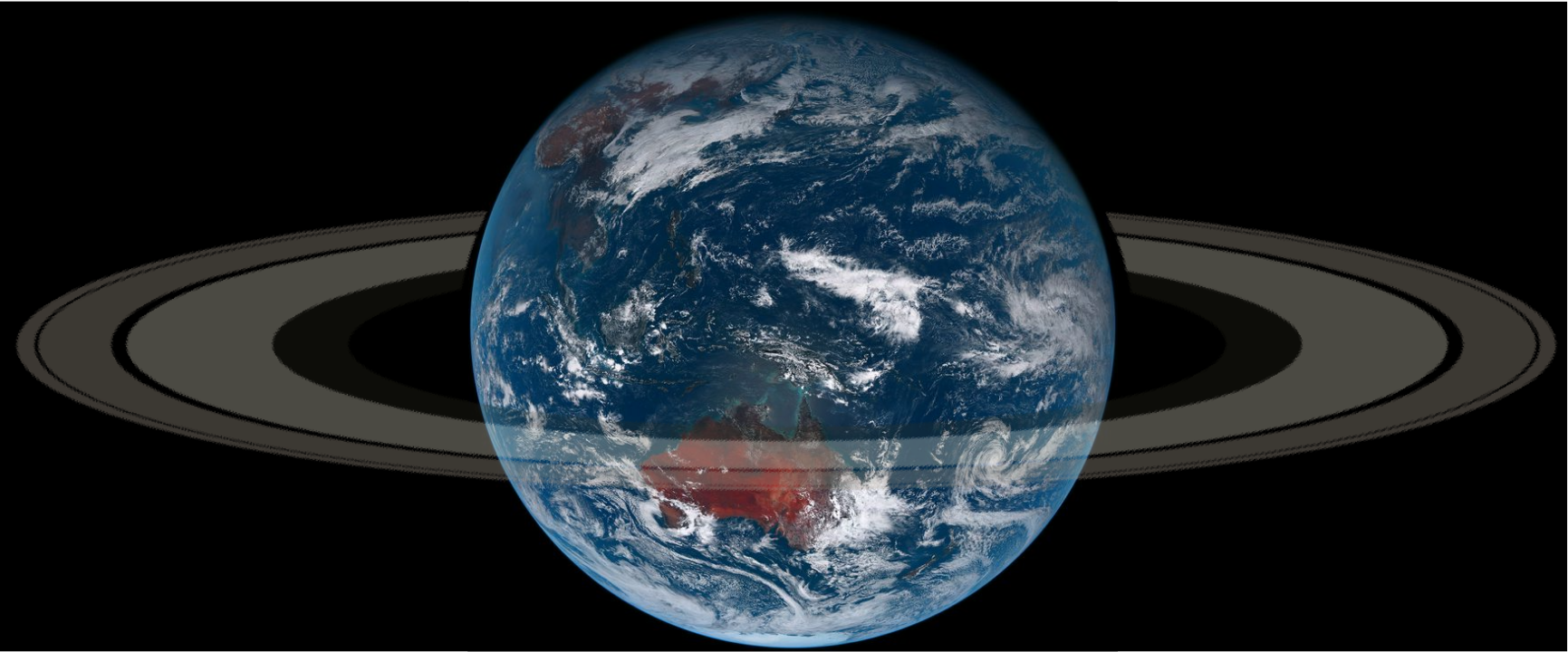
drag to rotate · scroll / pinch to zoom
Astrographical Info
| Age | 4.56x10⁹ |
|---|---|
| Axial Tilt | 23.2° |
| Class | Terrestrial Planet |
| Diameter | 12,756 Km |
| Gravity | 1 g (9.80665 m/s²) |
| Mass | 1⨁ |
| Suns | 1 |
Orbital
| Orbital Period | 1 Year |
|---|---|
| Rotation Period | 23h 54m |
| Semimajor Axis | 1 AU |
| Solar Day | 24h |
| System | Solar System |
Atmosphere
| Atmospheric Color | Blue |
|---|---|
| Atmospheric Composition | N₂, O₂, Ar |
| Atmospheric Toxicity | Breathable |
| Atmospheric Pressure | 1 atm |
| Greenhouse Eff | 54℉ |
| Temperature | 32℉ (0℃) |
Surface
| Major Moons | Moon |
|---|---|
| Moons | 1 |
| Sea Composition | H₂O, NaCl |
| Terrain | Deserts, Mountains, Beaches, Forests, Jungles |
| Water State | Liquid |
Other
| Anomaly Strength | 1 I/u |
|---|---|
| Apparent Mag | -7m00s |
| Apparent Size | 28°55'17.15" |
| Climate | Temperate |
| Esi | 1.000 |
| Government | Stable |
| Languages Spoken |
|
| Other Notes | Also Called the Living Planet |
| Phase | 0.993 |
| Primary Core Element | Iron |
Earth is the third planet from the Sun and the only astronomical object known to harbor life. This is enabled by Earth being a water world, the only one in the Solar System sustaining liquid surface water. Almost all of Earth's water is contained in its global ocean, covering 70.8% of Earth's crust. The remaining 29.2% of Earth's crust is land, most of which is located in the form of continental landmasses within one hemisphere, Earth's land hemisphere. Most of Earth's land is somewhat humid and covered by vegetation, while large sheets of ice at Earth's polar deserts retain more water than Earth's groundwater, lakes, rivers and atmospheric water combined. Earth's crust consists of slowly moving tectonic plates, which interact to produce mountain ranges, volcanoes, and earthquakes. Earth has a liquid outer core that generates a magnetosphere capable of deflecting most of the destructive solar winds and cosmic radiation.
Earth has a dynamic atmosphere, which sustains Earth's surface conditions and protects it from most meteoroids and UV-light at entry. It has a composition of primarily nitrogen and oxygen. Water vapor is widely present in the atmosphere, forming clouds that cover most of the planet. The water vapor acts as a greenhouse gas and, together with other greenhouse gases in the atmosphere, particularly carbon dioxide (CO2), creates the conditions for both liquid surface water and water vapor to persist via the capturing of energy from the Sun's light. This process maintains the current average surface temperature of 14.76 °C, at which water is liquid under atmospheric pressure. Differences in the amount of captured energy between geographic regions (as with the equatorial region receiving more sunlight than the polar regions) drive atmospheric and ocean currents, producing a global climate system with different climate regions, and a range of weather phenomena such as precipitation, allowing components such as nitrogen to cycle.
Earth is rounded into an ellipsoid with a circumference of about 40,000 km. It is the densest planet in the Solar System. Of the four rocky planets, it is the largest and most massive. Earth is about eight light-minutes away from the Sun and orbits it, taking a year (about 365.25 days) to complete one revolution. Earth rotates around its own axis in slightly less than a day (in about 23 hours and 56 minutes). Earth's axis of rotation is tilted with respect to the perpendicular to its orbital plane around the Sun, producing seasons. Earth is orbited by one permanent natural satellite, the Moon, which orbits Earth at 384,400 km (1.28 light seconds) and is roughly a quarter as wide as Earth. The Moon's gravity helps stabilize Earth's axis, and also causes tides which gradually slow Earth's rotation. As a result of tidal locking, the same side of the Moon always faces Earth.
Earth, like most other bodies in the Solar System, formed 4.5 billion years ago from gas in the early Solar System. During the first billion years of Earth's history, the ocean formed and then life developed within it. Life spread globally and has been altering Earth's atmosphere and surface, leading to the Great Oxidation Event two billion years ago. Humans emerged 300,000 years ago in Africa and have spread across every continent on Earth with the exception of Antarctica. Humans depend on Earth's biosphere and natural resources for their survival, but have increasingly impacted the planet's environment. Humanity's current impact on Earth's climate and biosphere is unsustainable, threatening the livelihood of humans and many other forms of life, and causing widespread extinctions.
Atmosphere
The atmospheric pressure at Earth's sea level averages 101.325 kPa (14.696 psi), with a scale height of about 8.5 km (5.3 mi). A dry atmosphere is composed of 78.084% nitrogen, 20.946% oxygen, 0.934% argon, and trace amounts of carbon dioxide and other gaseous molecules. Water vapor content varies between 0.01% and 4% but averages about 1%. Clouds cover around two thirds of Earth's surface, more so over oceans than land. The height of the troposphere varies with latitude, ranging between 8 km (5 mi) at the poles to 17 km (11 mi) at the equator, with some variation resulting from weather and seasonal factors.
Earth's biosphere has significantly altered its atmosphere. Oxygenic photosynthesis evolved 2.7 Gya, forming the primarily nitrogen–oxygen atmosphere of today. This change enabled the proliferation of aerobic organisms and, indirectly, the formation of the ozone layer due to the subsequent conversion of atmospheric O2 into O3. The ozone layer blocks ultraviolet solar radiation, permitting life on land. Other atmospheric functions important to life include transporting water vapor, providing useful gases, causing small meteors to burn up before they strike the surface, and moderating temperature. This last phenomenon is the greenhouse effect: trace molecules within the atmosphere serve to capture thermal energy emitted from the surface, thereby raising the average temperature. Water vapor, carbon dioxide, methane, nitrous oxide, and ozone are the primary greenhouse gases in the atmosphere. Without this heat-retention effect, the average surface temperature would be −18 °C (0 °F), in contrast to the current +15 °C (59 °F), and life on Earth probably would not exist in its current form.
Weather and climate
Earth's atmosphere has no definite boundary, gradually becoming thinner and fading into outer space. Three-quarters of the atmosphere's mass is contained within the first 11 km (6.8 mi) of the surface; this lowest layer is called the troposphere. Energy from the Sun heats this layer, and the surface below, causing expansion of the air. This lower-density air then rises and is replaced by cooler, higher-density air. The result is atmospheric circulation that drives the weather and climate through redistribution of thermal energy.
The primary atmospheric circulation bands consist of the trade winds in the equatorial region below 30° latitude and the westerlies in the mid-latitudes between 30° and 60°. Ocean heat content and currents are also important factors in determining climate, particularly the thermohaline circulation that distributes thermal energy from the equatorial oceans to the polar regions.
Earth receives 1361 W/m2 of solar irradiance. The amount of solar energy that reaches Earth's surface decreases with increasing latitude. At higher latitudes, the sunlight reaches the surface at lower angles, and it must pass through thicker columns of the atmosphere. As a result, the mean annual air temperature at sea level decreases by about 0.4 °C (0.7 °F) per degree of latitude from the equator. Earth's surface can be subdivided into specific latitudinal belts of approximately homogeneous climate. Ranging from the equator to the polar regions, these are the tropical (or equatorial), subtropical, temperate and polar climates.
Further factors that affect a location's climates are its proximity to oceans, the oceanic and atmospheric circulation, and topology. Places close to oceans typically have colder summers and warmer winters, due to the fact that oceans can store large amounts of heat. The wind transports the cold or the heat of the ocean to the land. Atmospheric circulation also plays an important role: San Francisco and Washington DC are both coastal cities at about the same latitude. San Francisco's climate is significantly more moderate as the prevailing wind direction is from sea to land. Finally, temperatures decrease with height causing mountainous areas to be colder than low-lying areas.
Water vapor generated through surface evaporation is transported by circulatory patterns in the atmosphere. When atmospheric conditions permit an uplift of warm, humid air, this water condenses and falls to the surface as precipitation. Most of the water is then transported to lower elevations by river systems and usually returned to the oceans or deposited into lakes. This water cycle is a vital mechanism for supporting life on land and is a primary factor in the erosion of surface features over geological periods. Precipitation patterns vary widely, ranging from several meters of water per year to less than a millimeter. Atmospheric circulation, topographic features, and temperature differences determine the average precipitation that falls in each region.
The commonly used Köppen climate classification system has five broad groups (humid tropics, arid, humid middle latitudes, continental and cold polar), which are further divided into more specific subtypes. The Köppen system rates regions based on observed temperature and precipitation. Surface air temperature can rise to around 55 °C (131 °F) in hot deserts, such as Death Valley, and can fall as low as −89 °C (−128 °F) in Antarctica.
Upper atmosphere
Thermal energy causes some of the molecules at the outer edge of the atmosphere to increase their velocity to the point where they can escape from Earth's gravity. This causes a slow but steady loss of the atmosphere into space. Because unfixed hydrogen has a low molecular mass, it can achieve escape velocity more readily, and it leaks into outer space at a greater rate than other gases. The leakage of hydrogen into space contributes to the shifting of Earth's atmosphere and surface from an initially reducing state to its current oxidizing one. Photosynthesis provided a source of free oxygen, but the loss of reducing agents such as hydrogen is thought to have been a necessary precondition for the widespread accumulation of oxygen in the atmosphere. Hence the ability of hydrogen to escape from the atmosphere may have influenced the nature of life that developed on Earth. In the current, oxygen-rich atmosphere most hydrogen is converted into water before it has an opportunity to escape. Instead, most of the hydrogen loss comes from the destruction of methane in the upper atmosphere.
Life on Earth
Earth is the only known place that has ever been habitable for life. Earth's life developed in Earth's early bodies of water some hundred million years after Earth formed.
Earth's life has been shaping and inhabiting many particular ecosystems on Earth and has eventually expanded globally forming an overarching biosphere. Therefore, life has impacted Earth, significantly altering Earth's atmosphere and surface over long periods of time, causing changes like the Great Oxidation Event.
Earth's life has over time greatly diversified, allowing the biosphere to have different biomes, which are inhabited by comparatively similar plants and animals. The different biomes developed at distinct elevations or water depths, planetary temperature latitudes and on land also with different humidity. Earth's species diversity and biomass reaches a peak in shallow waters and with forests, particularly in equatorial, warm and humid conditions. While freezing polar regions and high altitudes, or extremely arid areas are relatively barren of plant and animal life.
Earth provides liquid water—an environment where complex organic molecules can assemble and interact, and sufficient energy to sustain a metabolism. Plants and other organisms take up nutrients from water, soils and the atmosphere. These nutrients are constantly recycled between different species.
Extreme weather, such as tropical cyclones (including hurricanes and typhoons), occurs over most of Earth's surface and has a large impact on life in those areas. From 1980 to 2000, these events caused an average of 11,800 human deaths per year. Many places are subject to earthquakes, landslides, tsunamis, volcanic eruptions, tornadoes, blizzards, floods, droughts, wildfires, and other calamities and disasters. Human impact is felt in many areas due to pollution of the air and water, acid rain, loss of vegetation (overgrazing, deforestation, desertification), loss of wildlife, species extinction, soil degradation, soil depletion and erosion. Human activities release greenhouse gases into the atmosphere which cause global warming. This is driving changes such as the melting of glaciers and ice sheets, a global rise in average sea levels, increased risk of drought and wildfires, and migration of species to colder areas.