Florida Prime
Florida Prime
Astrographical Info
| Age | 9.32132•10⁹ |
|---|---|
| Axial Tilt | 3.13° |
| Class | Terrestrial Exoplanet |
| Diameter | 13,763 Km |
| Gravity | 1.532 G (15.0237878 m/s²) |
| Mass | 1.673 M⨁ |
| Suns | 2 |
Orbital
| Orbital Period | 0.6402 Years |
|---|---|
| Rotation Period | 26Hr 57m 43.23s |
| Semimajor Axis | 0.75 AU |
| Solar Day | 27Hr |
| System | Florida System |
Atmosphere
| Atmospheric Color | Green |
|---|---|
| Atmospheric Composition | Cl, O₂, N₂ |
| Atmospheric Toxicity | Unconscious in 2 Seconds Causing Death in 4 minutes |
| Atmospheric Pressure | 1.212 atm |
| Greenhouse Eff | 0° |
| Temperature | 103℉ |
Surface
| Major Moons | Florinic |
|---|---|
| Moons | 1 |
| Sea Composition | H₂O, HCl, Cl |
| Terrain | Swamp |
| Water State | Liquid |
Other
| Affiliations |
|
|---|---|
| Anomaly Strength | 23 I/u |
| Apparent Mag | -21m92 |
| Apparent Size | 28°55'17.15" |
| Climate | Humid |
| Esi | 0.756 |
| Government | Defunct |
| Languages Spoken |
|
| Other Notes | Flora is Carnivorous |
| Phase | [NULL] |
| Primary Core Element | Osmium |
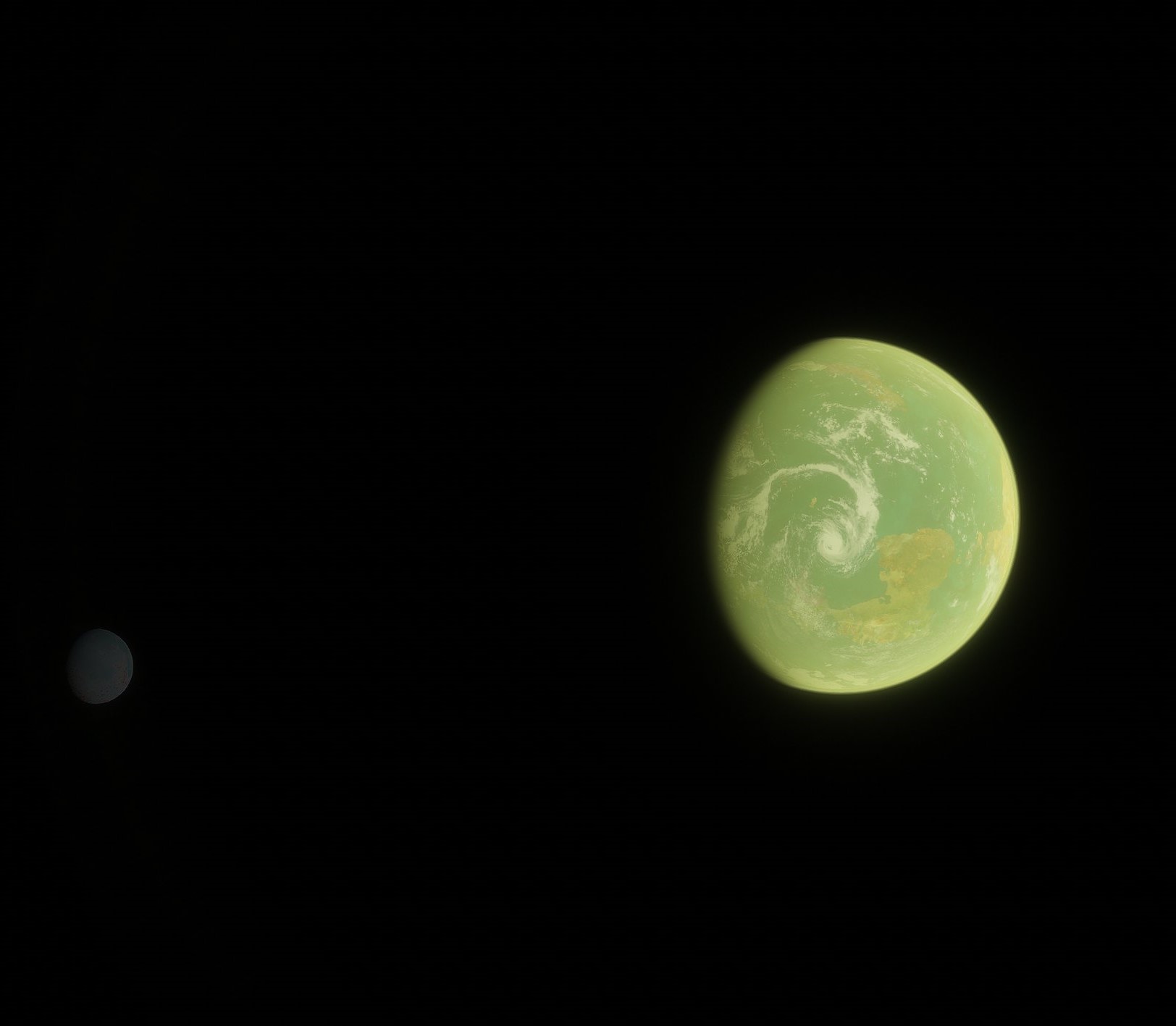
Florida Prime is a hostile terrestrial exoplanet with a diameter of 13,763 km, slightly larger than Earth. Its mass, 1.673 times that of Earth, leads to a gravity of 1.532 Gs, making movement more laborious for visitors used to Earth's gravity. Located within the Florida System, Florida Prime orbits two suns at a semimajor axis of 0.75 AU, completing an orbit in just 0.6402 Earth years.
Atmosphere
The planet's green-tinged atmosphere is composed primarily of chlorine (Cl), oxygen (O₂), and nitrogen (N₂), with an atmospheric pressure of 1.212 atm. However, this atmosphere is deadly to most known life forms. Exposure renders a person unconscious in 2 seconds and results in death within 4 minutes due to its high toxicity. The atmosphere's toxicity and chlorine content give the sky a striking green color.
Climate and Conditions
Temperatures average a scorching 103°F, creating a harsh environment for unprotected life. The planet's rotational period is 26 hours, 57 minutes, and 43.23 seconds, giving it a 27-hour solar day. With an axial tilt of only 3.13°, Florida Prime experiences minimal seasonal variation, which combined with its twin suns, leads to a consistently hot and dry climate.
Flora and Fauna
The planet's flora is carnivorous, making survival on the surface even more precarious. Vegetation is likely aggressive and predatory, adding another layer of danger to this hostile world.
Geological Composition
Florida Prime has an osmium core, an unusually dense and rare element, contributing to its strong anomaly strength of 23 I/u. This anomaly affects local physical or electromagnetic properties in unpredictable ways. Oceans and seas consist of a toxic mixture of water (H₂O), hydrochloric acid (HCl), and chlorine (Cl), making them incredibly corrosive and uninhabitable.
Moon and Orbital Features
Florida Prime has one major moon, Florinic, which plays a significant role in its tidal forces and other gravitational effects. The planet's apparent size from Florinic is large, with an apparent magnitude of -21m92 and an angular size of 28°55'17.15", making the planet appear enormous from its moon's surface.
Summary
Florida Prime is a deadly, high-gravity exoplanet with a green toxic atmosphere, carnivorous plant life, and a searing hot climate. Its dangerous conditions, combined with its strong anomaly strength, make it a treacherous place for explorers. The anomaly affects the surrounding system, and the combination of twin suns and a toxic ocean of hydrochloric acid adds to the hazardous environment. Only highly advanced technology or protective measures would allow any form of survival on this planet.
Florinic
Florinic, the major moon orbiting Florida Prime, presents one of the most visually striking landscapes in its entire star system. The surface is a surreal blend of swirling colors, making it resemble the texture and aesthetic of mint toothpaste. This unique appearance is created by the interaction of various geological and chemical processes that have shaped Florinic over millennia. The moon's surface is primarily composed of two distinct regions: red, cratered highlands and smooth, blue-green lowlands. These contrasting colors form vast streaks and patches, twisting and spiraling across the surface as though an artist had applied swirling strokes of paint across a canvas.
The red areas are rich in metallic compounds and minerals, likely a result of ancient volcanic activity or asteroid impacts that exposed the moon's inner layers. These regions appear to shimmer in the light of the twin suns, giving the highlands a glowing, almost molten quality. Scientists believe that Florinic's red zones are dominated by osmium and other heavy metals, which give the moon its peculiar bright hues. The constant bombardment of micrometeors has carved out a chaotic topography, littered with craters of all sizes that overlap in a pattern of destruction stretching for hundreds of kilometers.
In stark contrast to the red zones are the smooth blue-green lowlands, which are largely free of craters and other surface disruptions. These areas likely consist of ice plains made of frozen chlorine and water compounds, which have given rise to the moon's distinct atmosphere, heavily laden with chlorine gas. This chemical combination has given the surface a soft, reflective sheen, similar to the glossy texture of toothpaste. These lowlands are believed to be created by cryovolcanism, where volatile chemicals beneath the surface are forced upwards, freezing instantly when exposed to the cold vacuum of space.
The interaction between these volatile compounds and the atmosphere creates spectacular weather phenomena. Chlorine storms rage across the moon's surface, with thick clouds of green gas swirling in vast spirals. When the storms subside, they leave behind shimmering deposits of chlorine crystals that add a reflective quality to the blue-green plains, making them almost luminescent under the light of the twin suns. The atmosphere itself takes on a greenish tint, a result of the high chlorine content, and it produces a stunning visual effect when viewed from space. Florinic's surface, from orbit, appears as a swirling marble of red and green hues, like a candy-coated celestial body drifting through the cosmos.
This extreme environment, however, is hostile to life. The toxic chlorine atmosphere is deadly to most known biological organisms, and prolonged exposure would lead to unconsciousness within seconds and death in just a few minutes. The moon's surface temperature is relatively mild, but its atmosphere makes it nearly impossible for life to develop in its current state. Even if life once existed on Florinic, it would have been driven to extinction by the chemical reactions that now dominate the moon's surface.
The craters themselves, etched into the surface like scars, offer a glimpse into Florinic's tumultuous history. Many of these craters are extremely old, indicating that Florinic has experienced periods of intense bombardment, possibly from fragments of nearby celestial bodies or debris from Florida Prime's orbital path. Some of the largest craters are filled with what appears to be frozen chlorine seas, locked in a perpetual state of frosty stillness due to the moon's distance from the suns and the lack of significant tectonic activity.
Despite the harsh conditions, Florinic's beauty is undeniable. Its vivid colors, contrasting terrains, and swirling chemical reactions make it a moon of mystery and fascination for scientists and explorers alike. The deep craters, red plateaus, and smooth blue-green lowlands tell the story of a celestial body that has endured both the violence of the cosmos and the quiet chemical transformation that continues to shape its landscape. In many ways, Florinic represents both the brutality and the beauty of the universe—an otherworldly reminder that even in the harshest conditions, nature can create something breathtaking.
The breathtaking visual of Florinic's mint toothpaste-like surface may deceive distant observers into thinking it is a serene and placid world, but beneath this unique facade lies a toxic, unforgiving environment. The moon serves as a reminder of the unpredictable and dangerous conditions present in many star systems, where stunning beauty can hide immense peril. For now, Florinic remains a largely unexplored enigma, with only the most advanced drones and probes sent to map its surface and uncover the secrets that lie beneath its swirling, deadly skies.
| Feature | Florida Prime | Lizard-953-E | Copper 9 |
|---|---|---|---|
| Class | Terrestrial Exoplanet | Terrestrial Exoplanet | Terrestrial Exoplanet |
| Diameter | 13,763 km | 22,967.96 km (3.6 Earth diameters) | Similar to Earth |
| Mass | 1.673 Earth masses | 4.33 Earth masses | Similar to Earth |
| Gravity | 1.532 G (15.02 m/s²) | 1.8937 G (18.57 m/s²) | ~1 G |
| Sun(s) | 2 | 1 | 1 |
| Moon(s) | 1 (Florinic) | 27 (including Neclite, Thietenia, Ulvarvis, Ruvohines, Zurn) | 1 |
| Orbit | 0.75 AU | 1.15 AU | N/A |
| Orbital Period | 0.6402 years | 1.121 years | N/A |
| Rotation Period | 26 hours, 57 minutes, 43 seconds | 12 hours, 48 minutes | Unknown |
| Axial Tilt | 3.13° | 4°19'01.40″ | Unknown |
| Temperature | 103°F (39.4°C) | 77.97°F (25.5°C) | Tundra climate, cold |
| Greenhouse Effect | Minimal | 32.94°F | Unknown |
| Atmospheric Pressure | 1.212 atm | 1.123 atm | Unknown |
| Atmospheric Composition | Chlorine, Oxygen, Nitrogen | Helium, Oxygen, Xenon, Propane | Oxygen and nitrogen dominant, unknown impurities |
| Atmospheric Toxicity | Immediate unconsciousness and death in 4 minutes; contains HCl and chlorine vapors | Breathable | Toxic regions with nanite acid, acidic rain |
| Atmosphere Color | Green | Blue | Grayish, post-apocalyptic haze |
| Surface | Swampy terrain, carnivorous flora, corrosive environments | Mountainous jungles, tropical climate | Snowy wasteland with frozen water |
| Water State | Liquid (with dissolved HCl and Cl) | Liquid | Frozen |
| Primary Core Element | Osmium | Copper | Unknown |
| Flora | Carnivorous plants with botulinum toxin, injects 2 mL, lethal | Lush tropical vegetation, adapted to high gravity | Limited or dead flora due to apocalyptic conditions |
| Fauna | Mimic predators with corrosive attacks; acidic bulls ramming at 80 km/h | Diverse, likely tropical, adapted to high gravity | Likely extinct or minimal, mostly drone-inhabited |
| Weather | Acid hypercanes with corrosive rain, high humidity, chlorine miasma | Tropical storms, humid | Acid rain in certain regions due to nanite contamination |
| Anomaly Strength | 23 I/u | 34.6 I/u | Unknown |
| Government | Defunct, colonized by Arynn's Lizards | Stable, Aarynn Aarynn Inc. | Defunct |
| Affiliation | The Lizards (Arynn) | Aarynn Aarynn Inc. | JCJenson, Worker Drones |
| Languages Spoken | English, Lizish, German, Dutch, Polish | English, Lizish, German, Dutch, Polish | English, possibly French and Russian |
| Hostility Level | Extreme: lethal flora and fauna, toxic atmosphere, corrosive acid storms, acidic bull attacks | Moderate: high gravity, thick atmosphere, tropical ecosystem | High: toxic atmosphere, acid rain, hostile drones |