Kerbin
Kerbin
drag to rotate · scroll / pinch to zoom
Astrographical Info
| Age | 4.57x10⁹ |
|---|---|
| Axial Tilt | 1.2° |
| Class | Terrestrial Exoplanet |
| Diameter | 12,756 KM |
| Gravity | 1 g (9.80665 m/s²) |
| Mass | 1 M⨁ |
| Suns | 1 |
Orbital
| Galaxy | Milky Way (Presumably) |
|---|---|
| Orbital Period | 1 Year(s) |
| Rotation Period | 24 Hr |
| Semimajor Axis | 1 AU |
| Solar Day | 24 Hr |
| System | Kerbol System |
Atmosphere
| Atmospheric Color | Blue |
|---|---|
| Atmospheric Composition | N₂ O₂ Ar |
| Atmospheric Toxicity | Breathable |
| Atmospheric Pressure | 1 Atm |
| Greenhouse Eff | 54℉ |
| Temperature | 0°C |
Surface
| Major Moons | The Mun and Minmus |
|---|---|
| Moons | 2 |
| Sea Composition | H₂O NaCl |
| Terrain | Mountains, Deserts, Beaches, Forests, Tundra |
| Water State | Liquid |
Other
| Affiliations | |
|---|---|
| Anomaly Strength | 0 I/u |
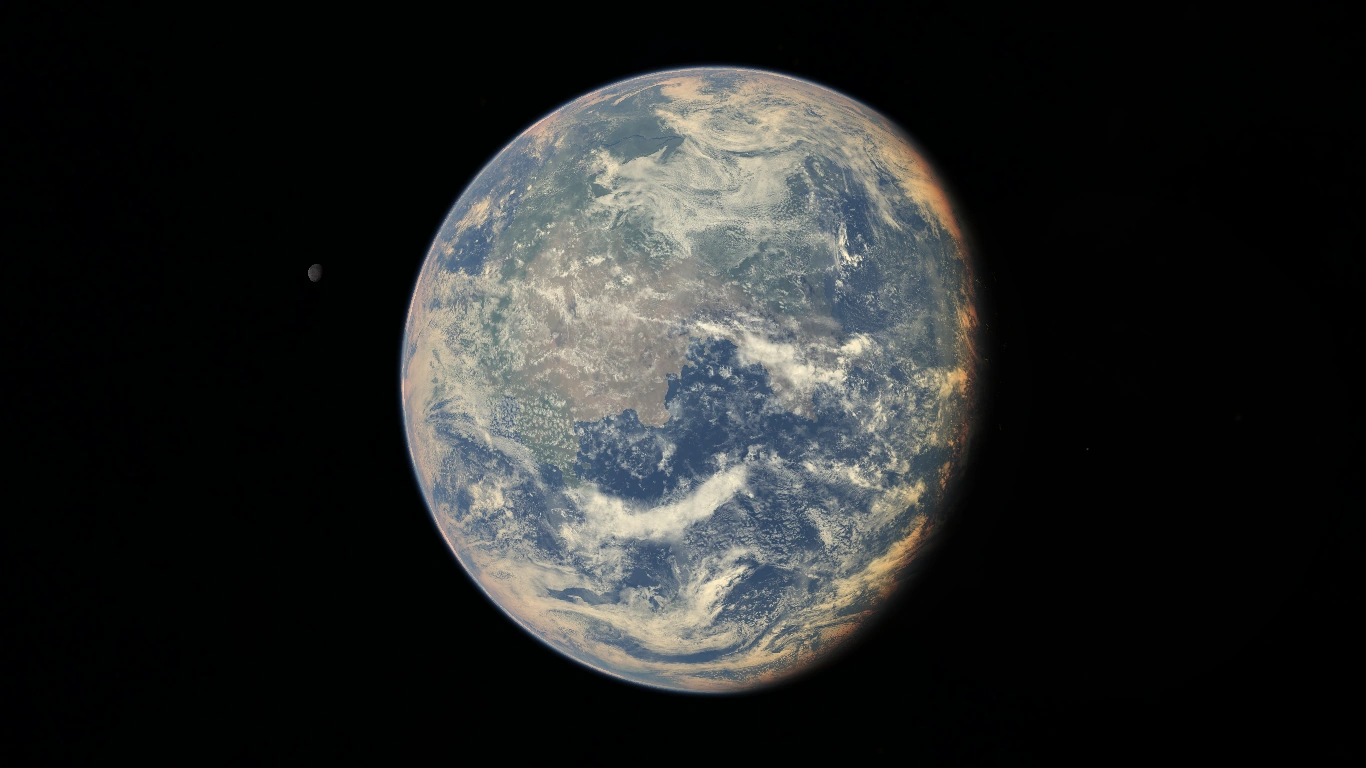
| Caption Image | Even as rockets and probes escape its atmosphere for deep space exploration, there is still much to appreciate about this vibrant world. Its vast oceans, deserts, forests, and plains coat the surface in lively beauty. Its moons, Mun and Minmus, swirl silently above it. Kerbalkind is fortunate to call this pale blue planet their home. |
| Climate | Temperate |
| Esi | 1.000 |
| Galactic Address | ⋰⋰⋱⋱⋮⋮⋱⋱⋰⋰⋮⋮⋱⋱ |
| Galactic Arm | Orion arm (Presumably) |
| Government | Stable |
| Languages Spoken |
|
| Other Notes | Home to the Kerbals |
| Phase | 0.751 |
| Primary Core Element | Iron (Presumably) |
| Xyzw Coordinates | 3333, 22332, 33333, 33323 |
Kerbin is the home planet of the Kerbals, the location of the Space Center and other facilities, and the main focus of Kerbal Space Program. It is also the Earth analog for the game but, unlike Earth, it has two moons instead of one. They are named the Mun and Minmus. It is the planet you start your game on, being home to the KSC, where you construct and launch your vehicles on.
Kerbin, the home planet in Kerbal Space Program, boasts two natural satellites: the larger Mun and the smaller Minmus. The Mun, resembling Earth's moon, is characterized by its gray, cratered surface, offering ample opportunities for exploration and scientific research. In contrast, Minmus is a unique celestial body with a mint-green hue and low gravity, making it an ideal location for mining operations and testing advanced rover technologies. Both moons orbit Kerbin in slightly eccentric orbits, providing players with diverse challenges and objectives for their space missions.
Kerbin is the third planet in orbit around the star Kerbol. It is the third largest celestial body that orbits Kerbol, following Jool and Eve. Jool's moon, Tylo has the same radius of Kerbin, though it may be classified as larger, as the highest point on Tylo is about 5 km higher than the highest point on Kerbin. However, Tylo has only 80% of Kerbin's mass.
Reaching a stable orbit around Kerbin is one of the first milestones a player might achieve in the game. With the introduction of version 1.0.3, attaining low Kerbin orbit requires a Δv of approximately 3400 m/s, though the exact amount depends on the efficiency of the ascent profile and the aerodynamics of the launch vehicle and payload. The only rocky planet that requires a higher Δv to attain orbit is Eve due to its dense atmosphere and higher gravity. Many interplanetary missions expend over half of their Δv in reaching Kerbin orbit. The velocity required to escape a body from a given altitude is always exactly the square root of two, times the velocity of a circular orbit around the body at that height.
Kerbin has a roughly equal distribution of liquid surface water and solid land, with polar ice caps and scattered deserts. Some of its mountains exceed 6 kilometers in height, with the tallest peak being 6767.4 m in altitude at the coordinates 46°21'32" E 61°35'53" N. The lowest point is almost 1.4 km deep and about 313° south-west of the Kerbal Space Center.
Craters
Terrain model centered on Kerbin's most pronounced craters Unlike other bodies in its system, Kerbin has few visible craters because its environment would erode craters from the few meteors that avoid the gravity or surface of its large moon and survive entry. Nevertheless, some geological formations indicate that bodies have violently collided with Kerbin: a planetary feature appears to be an impact crater, while a secondary rupture lies on the other side of the planet (made by the intense longitudinal, or P-wave earthquakes that ensue.) Both are in excess of 100 km diameter, and the main crater lies along the far-western coastline. The uplift is easily visible as a series of islands, and the feature has a central peak that pokes up through the water (also known as a rebound peak.) The other, and smaller of the two, is near the prime meridian in the northern hemisphere and is more easily missed, but its uplift rims are visible, and it also has a central rebound peak.
Kerbin has a thick, warm atmosphere with a mass of approximately 4.7×10¹⁶ kilograms, a sea level pressure of 101.325 kilopascals (1 atmosphere), and a depth of 70,000 meters. The atmosphere contains oxygen and can support combustion. Kerbin is one of the two celestial bodies (the other one being Laythe with a breathable atmosphere.
The average molecular weight of Kerbin air is 28.9644 g/mol, and its adiabatic index is 1.40. This suggests that Kerbin likely has an earthlike nitrogen-oxygen atmosphere. The air-fuel ratio of jet engines operating in Kerbin's atmosphere suggests that the percentage of oxygen is similar to that of Earth's atmosphere (about 21%).
Like all other atmospheres in the game, Kerbin's atmosphere fades exponentially as altitude increases. The scale height varies with altitude, which is a change from pre-1.0 versions of the game. The pressure-altitude profile is globally constant and independent of temperature. The following table gives the atmospheric pressure and density at various altitudes above sea level. Temperature-altitude profile is not globally constant, therefore neither is the density-altitude profile, however variance is slight.
| Altitude (m) | Pressure (Pa) | Pressure (atm) | Density (kg/m^3) |
|---|---|---|---|
| 0 | 101 325 | 1.000 | 1.225 |
| 2 500 | 69 015 | 0.681 | 0.898 |
| 5 000 | 45 625 | 0.450 | 0.642 |
| 7 500 | 29 126 | 0.287 | 0.446 |
| 10 000 | 17 934 | 0.177 | 0.288 |
| 15 000 | 6 726 | 0.066 | 0.108 |
| 20 000 | 2 549 | 0.025 | 0.040 |
| 25 000 | 993.6 | 0.010 | 0.015 |
| 30 000 | 404.1 | 0.004 | 0.006 |
| 40 000 | 79.77 | 0.001 | 0.001 |
| 50 000 | 15.56 | 0.000 | 0.000 |
| 60 000 | 2.387 | 0.000 | 0.000 |
| 70 000 | 0.000 | 0.000 | 0.000 |
Kerbin's atmosphere can be divided into three major layers, comparable to Earth's troposphere, stratosphere and mesosphere. In the lower and upper layers, temperature decreases as altitude increases, while the middle layer spans of a region of increasing temperature. The boundary between the lower and middle layers occurs at an altitude of about 16 km at low latitudes, and about 9 km at high latitudes. The boundary between the middle and upper layer occurs at an altitude of about 38 km.
Air temperatures vary with latitude and time of day. At the equator, sea level temperatures vary between a nighttime low of 32 °C and a daytime high of 41 °C. At the poles, the temperature varies between -35 °C and -30 °C. The globally averaged sea level temperature is approximately 13.5 °C. Since Kerbin has no axial tilt, there are no seasonal temperature variations.
The atmosphere of Kerbin is patterned after Earth's U.S. Standard Atmosphere (USSA), though with the vertical height scale reduced by 20%. Kerbin's "base" temperature and atmospheric pressure can be very closely approximated using the equations of the USSA, where Kerbin's geometric altitude, z, is converted to Earth's geopotential altitude, h, using the equation:
The base temperature is the temperature less latitudinal and diurnal adjustments; it is roughly equal to the global mean temperature.
Atmospheric flight
The thickness of Kerbin's atmosphere makes it well suited for aerobraking from a high-speed interplanetary intercept. The periapsis altitude required for a successful aerocapture depends on the spacecraft's drag characteristics, its approach velocity, and the desired apoapsis of the resulting orbit. For most conditions, a periapsis altitude of about 30 km should result in an aerocapture.
Parachutes perform well in Kerbin's dense air, allowing landings on both land and water to be accomplished without the aid of propulsion.
Because of the presence of oxygen, jet engines can operate in Kerbin's atmosphere. And, together with its thickness, Kerbin's atmosphere is ideally suited for aircraft flight.
Orbits
A synchronous orbit is achieved with a semi-major axis of 3 463.33 km. Kerbisynchronous Equatorial Orbit (KEO) (or geostationary), has a circularly uniform altitude of 2 863.33 km and a speed of 1 009.81 m/s. From a 70 km low equatorial orbit, the periapsis maneuver requires 676.5 m/s and the apoapsis maneuver requires 434.9 m/s. A synchronous Tundra orbit with eccentricity of 0.2864 and inclination of 63 degrees is achieved at 3799.7/1937.7 km. Inclination correlates with eccentricity: higher inclined orbits need to be more eccentric, while equatorial orbit may be circular, essentially KEO.
A semi-synchronous orbit with an orbital period of ½ of Kerbin's rotation period (2 h 59 m 34.7 s or 10774.7 seconds) is achieved at an altitude of 1 581.76 km with an orbital velocity of 1 272.28 m/s. A semi-synchronous Molniya orbit with eccentricity of 0.742 and inclination of 63 degrees can not be achieved, because the periapsis would be 36 km below the ground. The highest eccentricity of a semi-synchronous orbit with a periapsis of 70 km is 0.693 with an apoapsis of 3100.36 km.
The Hill sphere (the radius around the planet at which moons are gravitationally stable) of Kerbin is 136 185 km, or roughly 227 Kerbin radii.
Low Kerbin Orbit
Space near Kerbin is 70 to 249km, as found in science experiments, so LKO is 70 to 249km.
High Kerbin Orbit
Space high above Kerbin is 250 to ~84000km (end of SOI), as found in science experiments, so HKO is 250 to ~84000km