
Balto
Balto
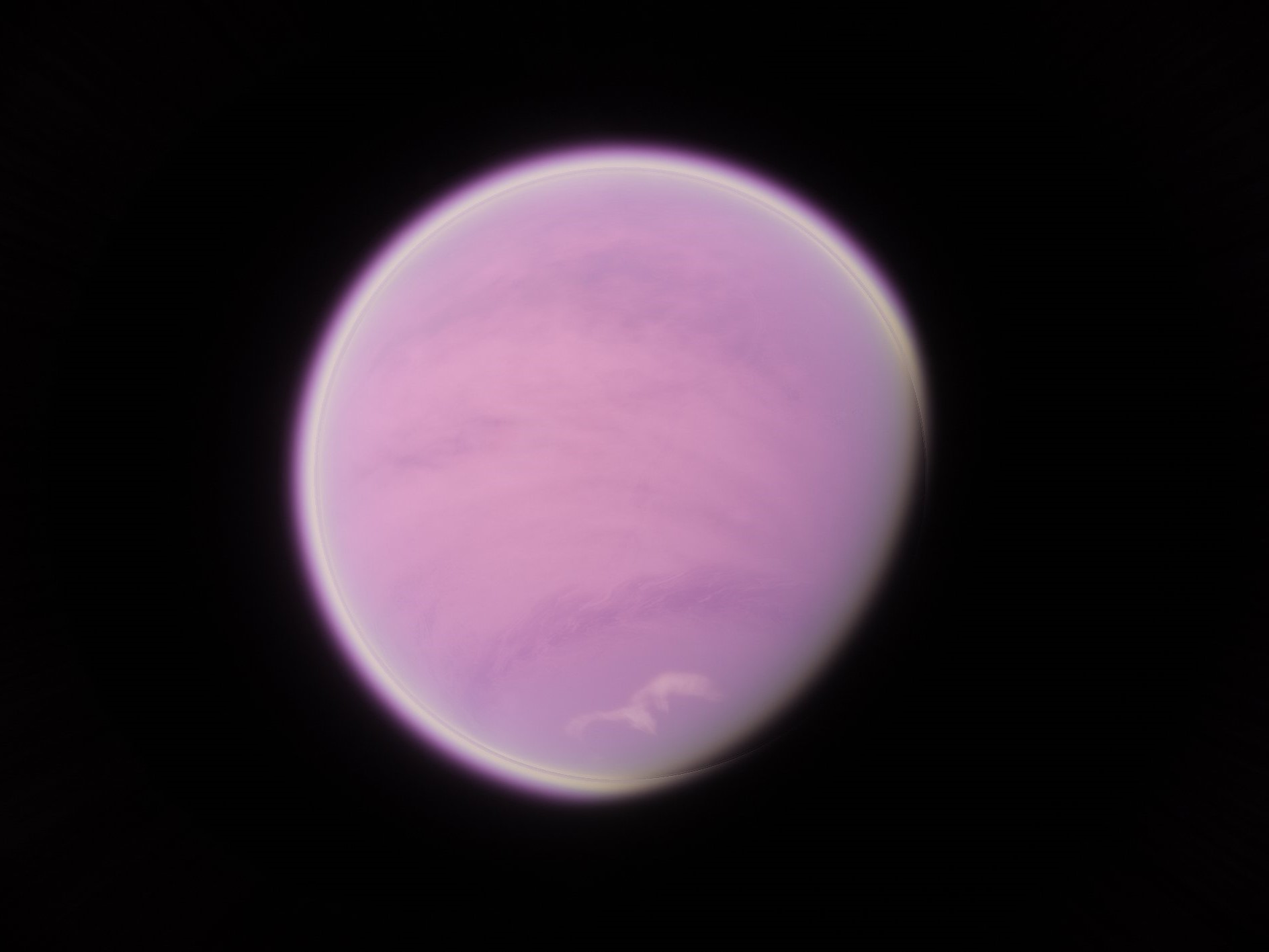
Astrographical Info
| Age | 6.402 Billion Years |
|---|---|
| Axial Tilt | 0° |
| Class | Terrestrial Exomoon |
| Diameter | 13,314 km |
| Gravity | 1.3 G's (12.748645 m/s²) |
| Mass | 1.422 Earths |
| Suns | 1 |
Orbital
| Galaxy | Absthaca Galaxy (Formerly) Elkska Galaxy (Current) |
|---|---|
| Orbital Period | 17 Days |
| Rotation Period | 17 Days |
| Semimajor Axis | 482,856 km |
| Solar Day | 17 Days (1:1) |
| System | Lizard-973 System |
Atmosphere
| Atmospheric Color | Pinksih-Purple |
|---|---|
| Atmospheric Composition | N₂, O₂, He, CO₂ |
| Atmospheric Toxicity | Breathable |
| Atmospheric Pressure | 0.9 atm (91.1925 kPa) |
| Greenhouse Eff | 0° |
| Temperature | 54°F (13.3 °C) |
Surface
| Sea Composition | H₂O |
|---|---|
| Terrain | Desert |
| Water State | Liquid (Present) |
This terrestrial exomoon of the massive gas giant Lizard-973-O, Balto, is a world of extremes and subtle balances. Its singular placement within its planetary system assures that it captures just the right amount of tidal heating from its parent body. This keeps the moon from turning into a frozen wasteland similar to its outer-system siblings and maintains a livable, though arid, climate.
Balto's surface is primarily a desert planet, with vast expanses of rocky terrain, sandy plains, and rugged valleys punctuated by sparse vegetation. The moon is dotted with isolated Lizardian civilizations, their cities built around oases or underground reservoirs, adapted to the moon's harsh conditions. The Lizardians use advanced technology to extract resources and survive in this challenging environment, blending seamlessly with the moon's natural beauty.
SD-B's Descent and Survival
When SD-B hijacked a Copper 9 Landing Pod and set course for Balto, she had no idea what she was getting herself into. The pod was never designed to penetrate the dense atmosphere of the exomoon and catastrophically failed during re-entry.
Re-Entry Chaos
Traveling at a blazing 57 km/s, the pod turned into a fireball as it entered Balto's thick purple-pink atmosphere. The dense atmosphere magnified the heat and melted three of the pod's four arms into molten slag. The hull exploded, breaking into pieces as the last arm hardly survived. SD-B jumped out of the pod mid-descent and barely cleared it from molten debris that would have maimed or destroyed her.
A Stranded Survivor
Down below, SD-B was deposited on the middle of Balto's huge desert expanse. With no form of shelter or supplies, she wandered across the rocky terrain under the diffused light of the exomoon's atmosphere. Extreme isolation was putting her endurance to the test, trudging through sandstorms and avoiding dangerous wildlife. For two grueling days, SD-B relied on her resilience and programming to survive. The absence of supplies pushed her systems to their limits, with energy reserves dangerously low.
Rescue by the Lizardians
It was not until the second day, however, that SD-B was finally discovered by the Lizardians, who tracked her streak of fire across the sky from her entry. A squad of Lizardian scouts riding advanced desert rovers came across her slumped in front of a rocky outcrop. Initially, they were cautious with the disassembly drone, before they realized that it was in no shape to do them harm. They took SD-B to a near city oasis and fixed her, then interrogated her. However strange and violent her coming was, the Lizardians recognized something in SD-B that they decided to make part of them.
A New Chapter on Balto
Balto became SD-B's new home of survival, adaptation, and rebirth. But as much as she had faced horrors in Copper 9, the challenges awaiting her in Balto were not any less acts of courage. The harsh deserts, few civilizations, and alien culture would force her to find her place among the Lizardians, who saw her both as a curiosity and as a potential ally.
Parent Planet: Lizard-973-O
- Type: Gas Giant
- Diameter: ~157,967 km (~13.3x Earth's diameter)
- Mass: ~1,200x Earth's mass
- Gravity at Cloud Tops: ~25.4 g (249 m/s²)
- Orbital Distance from Star: 3.27 AU (astronomical units)
- Orbital Period: ~5.9 Earth years
- Rings: A faint, dusty, and icy ring system extending 75,000 km from the planet's equator.
- Moons: 3 known satellites, Balto being the largest and only moon with a breathable atmosphere.
Parent Star: Lizard-973-A
- Type: A-type Main Sequence Star (Spectral Class: A6 V)
- Mass: ~2.1x the Sun's mass
- Radius: ~2.4x the Sun's radius
- Luminosity: ~8x the Sun's luminosity
- Surface Temperature: ~8,200 K (hotter than the Sun)
- Age: ~700 million years (younger and more active than the Sun)
- Gravity at Surface: 97.37 g (~954.83 m/s²)
- Color: White-blue, bathing the Lizard-973 system in intense light.
Lizard-973-A's intense radiation and high-energy solar wind are mitigated by Balto's strong magnetosphere, protecting its surface and atmosphere from erosion.