
Milky Way
Milky Way
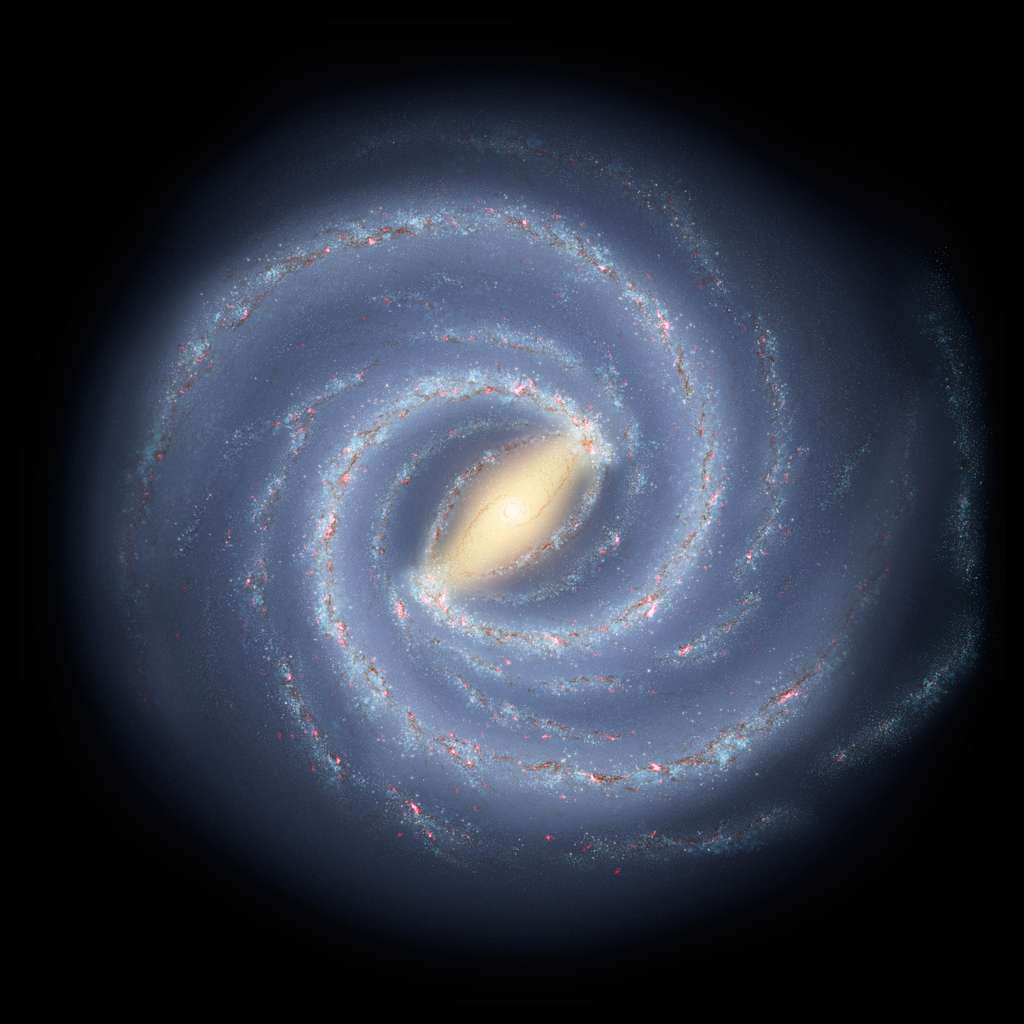
Structure
| Arms | 7 |
|---|---|
| Diameter | 26.8 ± 1.1 kpc (87,400 ± 3,600 ly) (diameter; D25 isophote) |
| Number Of Stars | 100–400 billion |
| Planets | No Other Planets in the Lizardian Empire |
| Type | Barred Spiral Galaxy |
Dynamics
| Central Black Hole | Sagittarius A* |
|---|---|
| Dark Matter | Present |
| Satellite Galaxies | 61 |
Civilization
| Notable Civilizations | None |
|---|---|
| Notable Events | Milky Way-Andromeda collision |
| Population | 0 |
Other
| Notable Planets | No Other Planets in the Lizardian Empire |
|---|---|
| Other Info | Dying Galaxy |
| Trade Routes | 0 |
| Unique Aspects | None |
The Milky Way is the galaxy that includes the Solar System, with the name describing the galaxy's appearance from Earth: a hazy band of light seen in the night sky formed from stars in other arms of the galaxy, which are so far away that they cannot be individually distinguished by the naked eye.
The Milky Way is a barred spiral galaxy with a D25 isophotal diameter estimated at 26.8 ± 1.1 kiloparsecs (87,400 ± 3,600 light-years), but only about 1,000 light-years thick at the spiral arms (more at the bulge). Recent simulations suggest that a dark matter area, also containing some visible stars, may extend up to a diameter of almost 2 million light-years (613 kpc). The Milky Way has several satellite galaxies and is part of the Local Group of galaxies, forming part of the Virgo Supercluster which is itself a component of the Laniakea Supercluster.
It is estimated to contain 100–400 billion stars and at least that number of planets. The Solar System is located at a radius of about 27,000 light-years (8.3 kpc) from the Galactic Center, on the inner edge of the Orion Arm, one of the spiral-shaped concentrations of gas and dust. The stars in the innermost 10,000 light-years form a bulge and one or more bars that radiate from the bulge. The Galactic Center is an intense radio source known as Sagittarius A*, a supermassive black hole of 4.100 (± 0.034) million solar masses. The oldest stars in the Milky Way are nearly as old as the Universe itself and thus probably formed shortly after the Dark Ages of the Big Bang.
Galileo Galilei first resolved the band of light into individual stars with his telescope in 1610. Until the early 1920s, most astronomers thought that the Milky Way contained all the stars in the Universe. Following the 1920 Great Debate between the astronomers Harlow Shapley and Heber Doust Curtis, observations by Edwin Hubble in 1923 showed that the Milky Way is just one of many galaxies.
Etymology and Mythology
In the Babylonian epic poem Enūma Eliš, the Milky Way is created from the severed tail of the primeval salt water dragoness Tiamat, set in the sky by Marduk, the Babylonian national god, after slaying her. This story was once thought to have been based on an older Sumerian version in which Tiamat is instead slain by Enlil of Nippur, but is now thought to be purely an invention of Babylonian propagandists with the intention to show Marduk as superior to the Sumerian deities.
In Greek mythology, Zeus places his son born by a mortal woman, the infant Heracles, on Hera's breast while she is asleep so the baby will drink her divine milk and become immortal. Hera wakes up while breastfeeding and then realizes she is nursing an unknown baby: she pushes the baby away, some of her milk spills, and it produces the band of light known as the Milky Way. In another Greek story, the abandoned Heracles is given by Athena to Hera for feeding, but Heracles' forcefulness causes Hera to rip him from her breast in pain.
Llys Dôn (literally "The Court of Dôn") is the traditional Welsh name for the constellation Cassiopeia. At least two of Dôn's children also have astronomical associations: Caer Gwydion ("The fortress of Gwydion") is the traditional Welsh name for the Milky Way, and Caer Arianrhod ("The Fortress of Arianrhod") being the constellation of Corona Borealis.
In Western culture, the name "Milky Way" is derived from its appearance as a dim un-resolved "milky" glowing band arching across the night sky. The term is a translation of the Classical Latin via lactea, in turn derived from the Hellenistic Greek γαλαξίας, short for γαλαξίας κύκλος (galaxías kýklos), meaning "milky circle". The Ancient Greek γαλαξίας (galaxias) – from root γαλακτ-, γάλα ("milk") + -ίας (forming adjectives) – is also the root of "galaxy", the name for our, and later all such, collections of stars.
The Milky Way, or "milk circle", was just one of 11 "circles" the Greeks identified in the sky, others being the zodiac, the meridian, the horizon, the equator, the tropics of Cancer and Capricorn, the Arctic Circle and the Antarctic Circle, and two colure circles passing through both poles.
Appearance
The Milky Way is visible as a hazy band of white light, some 30° wide, arching the night sky. Although all the individual naked-eye stars in the entire sky are part of the Milky Way Galaxy, the term "Milky Way" is limited to this band of light. The light originates from the accumulation of unresolved stars and other material located in the direction of the galactic plane. Brighter regions around the band appear as soft visual patches known as star clouds. The most conspicuous of these is the Large Sagittarius Star Cloud, a portion of the central bulge of the galaxy. Dark regions within the band, such as the Great Rift and the Coalsack, are areas where interstellar dust blocks light from distant stars. Peoples of the southern hemisphere, including the Inca and Australian aborigines, identified these regions as dark cloud constellations. The area of sky that the Milky Way obscures is called the Zone of Avoidance.
The Milky Way has a relatively low surface brightness. Its visibility can be greatly reduced by background light, such as light pollution or moonlight. The sky needs to be darker than about 20.2 magnitude per square arcsecond in order for the Milky Way to be visible. It should be visible if the limiting magnitude is approximately +5.1 or better and shows a great deal of detail at +6.1. This makes the Milky Way difficult to see from brightly lit urban or suburban areas, but very prominent when viewed from rural areas when the Moon is below the horizon. Maps of artificial night sky brightness show that more than one-third of Earth's population cannot see the Milky Way from their homes due to light pollution.
As viewed from Earth, the visible region of the Milky Way's galactic plane occupies an area of the sky that includes 30 constellations. The Galactic Center lies in the direction of Sagittarius, where the Milky Way is brightest. From Sagittarius, the hazy band of white light appears to pass around to the galactic anticenter in Auriga. The band then continues the rest of the way around the sky, back to Sagittarius, dividing the sky into two roughly equal hemispheres.
The galactic plane is inclined by about 60° to the ecliptic (the plane of Earth's orbit). Relative to the celestial equator, it passes as far north as the constellation of Cassiopeia and as far south as the constellation of Crux, indicating the high inclination of Earth's equatorial plane and the plane of the ecliptic, relative to the galactic plane. The north galactic pole is situated at right ascension 12h 49m, declination +27.4° (B1950) near β Comae Berenices, and the south galactic pole is near α Sculptoris. Because of this high inclination, depending on the time of night and year, the Milky Way arch may appear relatively low or relatively high in the sky. For observers from latitudes approximately 65° north to 65° south, the Milky Way passes directly overhead twice a day.
Size and mass
Size
The Milky Way is one of the two largest galaxies in the Local Group (the other being the Andromeda Galaxy), although the size for its galactic disc and how much it defines the isophotal diameter is not well understood. It is estimated that the significant bulk of stars in the galaxy lies within the 26 kiloparsecs (80,000 light-years) diameter, and that the number of stars beyond the outermost disc dramatically reduces to a very low number, with respect to an extrapolation of the exponential disk with the scale length of the inner disc.
There are several methods being used in astronomy in defining the size of a galaxy, and each of them can yield different results with respect to one another. The most commonly employed method is the D25 standard – the isophote where the photometric brightness of a galaxy in the B-band (445 nm wavelength of light, in the blue part of the visible spectrum) reaches 25 mag/arcsec2. An estimate from 1997 by Goodwin and others compared the distribution of Cepheid variable stars in 17 other spiral galaxies to the ones in the Milky Way, and modelling the relationship to their surface brightnesses. This gave an isophotal diameter for the Milky Way at 26.8 ± 1.1 kiloparsecs (87,400 ± 3,600 light-years), by assuming that the galactic disc is well represented by an exponential disc and adopting a central surface brightness of the galaxy (μ0) of 22.1±0.3 B-mag/arcsec−2 and a disk scale length (h) of 5.0 ± 0.5 kpc (16,300 ± 1,600 ly).
This is significantly smaller than the Andromeda Galaxy's isophotal diameter, and slightly below the mean isophotal sizes of the galaxies being at 28.3 kpc (92,000 ly). The paper concludes that the Milky Way and Andromeda Galaxy were not overly large spiral galaxies, nor were among the largest known (if the former not being the largest) as previously widely believed, but rather average ordinary spiral galaxies. To compare the relative physical scale of the Milky Way, if the Solar System out to Neptune were the size of a US quarter (24.3 mm (0.955 in)), the Milky Way would be approximately at least the greatest north–south line of the contiguous United States. An even older study from 1978 gave a lower diameter for Milky Way about 23 kpc (75,000 ly).
A 2015 paper discovered that there is a ring-like filament of stars called Triangulum–Andromeda Ring (TriAnd Ring) rippling above and below the relatively flat galactic plane, which alongside Monoceros Ring were both suggested to be primarily the result of disk oscillations and wrapping around the Milky Way, at a diameter of at least 50 kpc (160,000 ly), which may be part of the Milky Way's outer disk itself, hence making the stellar disk larger by increasing to this size. A more recent 2018 paper later somewhat ruled out this hypothesis, and supported a conclusion that the Monoceros Ring, A13 and TriAnd Ring were stellar overdensities rather kicked out from the main stellar disk, with the velocity dispersion of the RR Lyrae stars found to be higher and consistent with halo membership.
Another 2018 study revealed the very probable presence of disk stars at 26–31.5 kpc (84,800–103,000 ly) from the Galactic Center or perhaps even farther, significantly beyond approximately 13–20 kpc (40,000–70,000 ly), in which it was once believed to be the abrupt drop-off of the stellar density of the disk, meaning that few or no stars were expected to be above this limit, save for stars that belong to the old population of the galactic halo.
A 2020 study predicted the edge of the Milky Way's dark matter halo being around 292 ± 61 kpc (952,000 ± 199,000 ly), which translates to a diameter of 584 ± 122 kpc (1.905 ± 0.3979 Mly). The Milky Way's stellar disk is also estimated to be approximately up to 1.35 kpc (4,000 ly) thick.
Mass
The Milky Way is approximately 890 billion to 1.54 trillion times the mass of the Sun in total (8.9×10¹¹ to 1.54×10¹² solar masses), although stars and planets make up only a small part of this. Estimates of the mass of the Milky Way vary, depending upon the method and data used. The low end of the estimate range is 5.8×10¹¹ solar masses (M☉), somewhat less than that of the Andromeda Galaxy. Measurements using the Very Long Baseline Array in 2009 found velocities as large as 254 km/s (570,000 mph) for stars at the outer edge of the Milky Way.
Because the orbital velocity depends on the total mass inside the orbital radius, this suggests that the Milky Way is more massive, roughly equaling the mass of Andromeda Galaxy at 7×10¹¹ M☉ within 160,000 ly (49 kpc) of its center. In 2010, a measurement of the radial velocity of halo stars found that the mass enclosed within 80 kiloparsecs is 7×10¹¹ M☉. In a 2014 study, the mass of the entire Milky Way is estimated to be 8.5×10¹¹ M☉, but this is only half the mass of the Andromeda Galaxy. A recent 2019 mass estimate for the Milky Way is 1.29×10¹² M☉.
Much of the mass of the Milky Way seems to be dark matter, an unknown and invisible form of matter that interacts gravitationally with ordinary matter. A dark matter halo is conjectured to spread out relatively uniformly to a distance beyond one hundred kiloparsecs (kpc) from the Galactic Center. Mathematical models of the Milky Way suggest that the mass of dark matter is 1–1.5×10¹² M☉. 2013 and 2014 studies indicate a range in mass, as large as 4.5×10¹² M☉ and as small as 8×10¹¹ M☉. By comparison, the total mass of all the stars in the Milky Way is estimated to be between 4.6×10¹⁰ M☉ and 6.43×10¹⁰ M☉.
In addition to the stars, there is also interstellar gas, comprising 90% hydrogen and 10% helium by mass, [unreliable source?] with two thirds of the hydrogen found in the atomic form and the remaining one-third as molecular hydrogen. The mass of the Milky Way's interstellar gas is equal to between 10% and 15% of the total mass of its stars. Interstellar dust accounts for an additional 1% of the total mass of the gas.
In March 2019, astronomers reported that the virial mass of the Milky Way Galaxy is 1.54 trillion solar masses within a radius of about 39.5 kpc (130,000 ly), over twice as much as was determined in earlier studies, suggesting that about 90% of the mass of the galaxy is dark matter.
In September 2023, astronomers reported that the virial mass of the Milky Way Galaxy is only 2.06 x 10¹¹ solar masses, only a 10th of the mass of previous studies. The mass was determined from data of the Gaia spacecraft.
Contents
The Milky Way contains between 100 and 400 billion stars and at least that many planets. An exact figure would depend on counting the number of very-low-mass stars, which are difficult to detect, especially at distances of more than 300 ly (90 pc) from the Sun. As a comparison, the neighboring Andromeda Galaxy contains an estimated one trillion (1012) stars. The Milky Way may contain ten billion white dwarfs, a billion neutron stars, and a hundred million stellar black holes. Filling the space between the stars is a disk of gas and dust called the interstellar medium. This disk has at least a comparable extent in radius to the stars, whereas the thickness of the gas layer ranges from hundreds of light-years for the colder gas to thousands of light-years for warmer gas.
The disk of stars in the Milky Way does not have a sharp edge beyond which there are no stars. Rather, the concentration of stars decreases with distance from the center of the Milky Way. Beyond a radius of roughly 40,000 light years (13 kpc) from the center, the number of stars per cubic parsec drops much faster with radius. Surrounding the galactic disk is a spherical galactic halo of stars and globular clusters that extends farther outward, but is limited in size by the orbits of two Milky Way satellites, the Large and Small Magellanic Clouds, whose closest approach to the Galactic Center is about 180,000 ly (55 kpc). At this distance or beyond, the orbits of most halo objects would be disrupted by the Magellanic Clouds. Hence, such objects would probably be ejected from the vicinity of the Milky Way. The integrated absolute visual magnitude of the Milky Way is estimated to be around −20.9.
Both gravitational microlensing and planetary transit observations indicate that there may be at least as many planets bound to stars as there are stars in the Milky Way, and microlensing measurements indicate that there are more rogue planets not bound to host stars than there are stars. The Milky Way contains an average of at least one planet per star, resulting in 100–400 billion planets, according to a January 2013 study of the five-planet star system Kepler-32 by the Kepler space observatory. A different January 2013 analysis of Kepler data estimated that at least 17 billion Earth-sized exoplanets reside in the Milky Way.
In November 2013, astronomers reported, based on Kepler space mission data, that there could be as many as 40 billion Earth-sized planets orbiting in the habitable zones of Sun-like stars and red dwarfs within the Milky Way. 11 billion of these estimated planets may be orbiting Sun-like stars. The nearest exoplanet may be 4.2 light-years away, orbiting the red dwarf Proxima Centauri, according to a 2016 study. Such Earth-sized planets may be more numerous than gas giants, though harder to detect at great distances given their small size. Besides exoplanets, "exocomets", comets beyond the Solar System, have also been detected and may be common in the Milky Way. More recently, in November 2020, over 300 million habitable exoplanets are estimated to exist in the Milky Way Galaxy.
When compared to other more distant galaxies in the universe, the Milky Way galaxy has a below average amount of neutrino luminosity making our galaxy a "neutrino desert".
Structure
The Milky Way consists of a bar-shaped core region surrounded by a warped disk of gas, dust and stars. The mass distribution within the Milky Way closely resembles the type Sbc in the Hubble classification, which represents spiral galaxies with relatively loosely wound arms. Astronomers first began to conjecture that the Milky Way is a barred spiral galaxy, rather than an ordinary spiral galaxy, in the 1960s. These conjectures were confirmed by the Spitzer Space Telescope observations in 2005 that showed the Milky Way's central bar to be larger than previously thought.