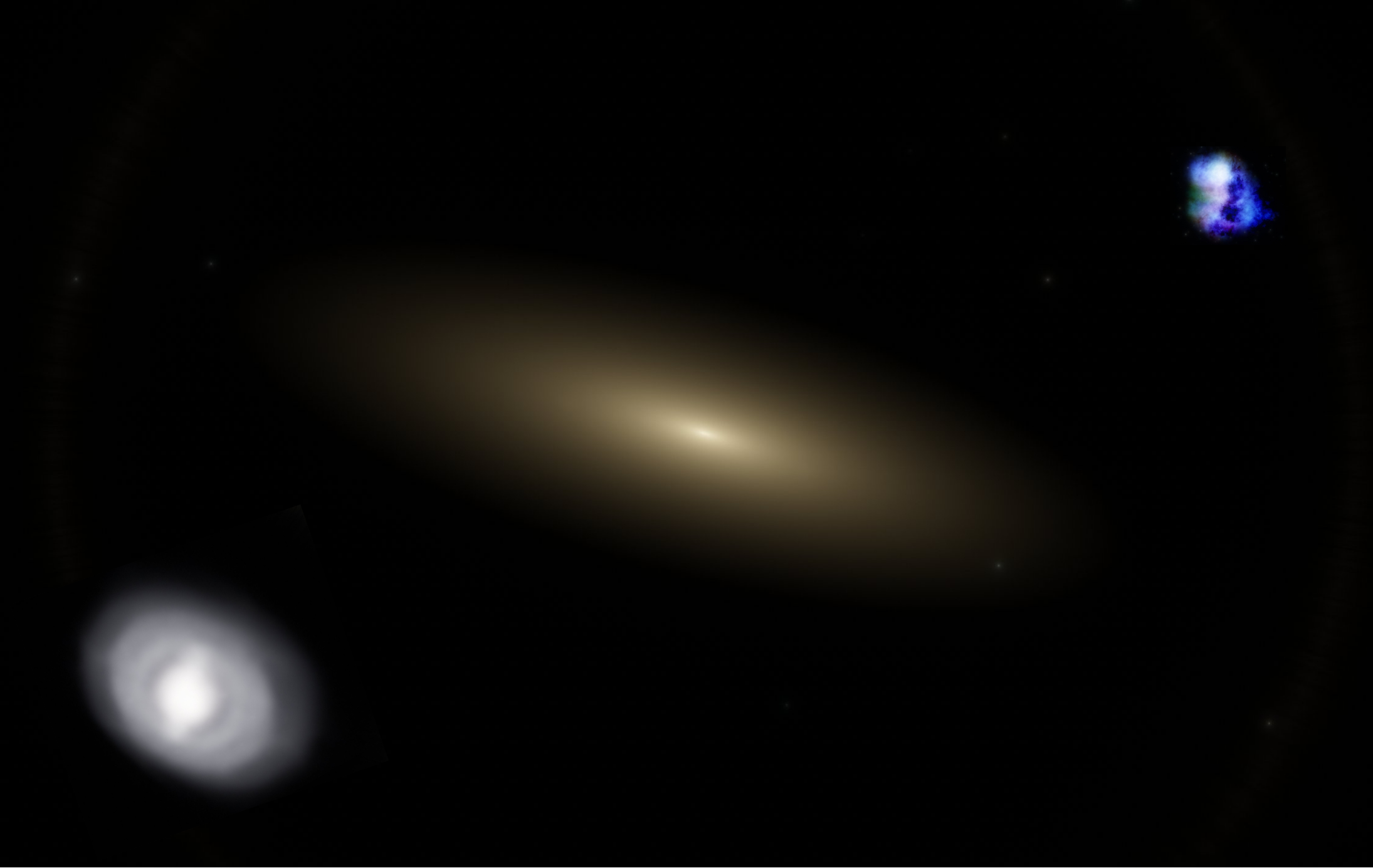
The Alioska Galaxy is a highly elongated spiral galaxy, with a central bulge and faint spiral arms that appear stretched or distorted.
Its core region is compact and bright, surrounded by tightly wound spiral arms that fan out unevenly.
The elongated shape is likely the result of gravitational interactions with nearby satellite galaxies or past collisions.
Central Region:
Dominated by a supermassive black hole (SMBH) named "Klystor", with an estimated mass of 4 billion solar masses.
The core glows intensely due to high rates of star formation and radiation from accreting matter around the SMBH.
Star Population:
Core Stars: Predominantly older, red and yellow stars, with some blue giants formed in recent bursts of star formation.
Outer Regions: Scattered star-forming regions with clusters of young, hot stars.
Galactic Disk:
Thinner and less dense compared to Absthaca, with significant regions of interstellar dust and gas.
Several star-forming nebulae and supernova remnants punctuate the disk.
Unique Features
The "Sausage Rift":
A massive dust lane cutting across the galaxy's elongated disk, giving it a segmented appearance.
Likely formed by a collision with a smaller galaxy, which left behind trails of dark matter and gas.
Nebula Clusters:
Auroran Belt: A sprawling region of gas clouds and bright nebulae, responsible for producing high-mass stars.
Xenon Veil: A mysterious cloud with high concentrations of rare gases, glowing faintly blue in the ultraviolet spectrum.
Outer Halo:
Surrounding the disk is a faint halo of globular clusters and older stars.
These clusters suggest a history of galactic mergers and accretion of smaller systems.
Energy Jets:
Faint, wide-angle plasma jets extending from the core, likely originating from Klystor.
These jets are less powerful than the Elkska Galaxy's beams but still reach up to 1 million light-years into intergalactic space.
Satellite Galaxies
The Alioska Galaxy has 15–20 satellite galaxies, including several dwarf galaxies and irregular systems:
IC-7712-B: A compact elliptical galaxy orbiting close to the Alioska core, heavily distorted by tidal forces.
NGC-132-B: A small spiral galaxy with evidence of ongoing star formation.
Krysolis Minor: An irregular galaxy with chaotic star distribution, thought to be in the process of merging with Alioska.
Significance
Cultural and Historical:
Alioska is considered the "younger sibling" of the Absthaca Galaxy, forming later in the cosmic timeline.
The Lizards refer to it as "The Sausage", a mix of humor and respect for its peculiar shape and contribution to the galactic ecosystem.
Scientific Mystery:
Its elongated structure and distorted spiral arms have made it a subject of intense study.
Scientists hypothesize that it has experienced at least two major collisions in the past billion years.
Stellar Richness:
While smaller than the Absthaca Galaxy, Alioska is dense with star-forming regions, making it a hotspot for young stellar systems and new planetary systems.
Strategic Role:
If included in the Lizardian Empire, Alioska could serve as a secondary hub or expansion zone, providing additional resources and strategic outposts.
Visual Appearance
From a distance, Alioska resembles a stretched, glowing spiral, with faint arms that curve unevenly outward.
Its core glows golden-white, surrounded by the bluish-purple haze of young stars and nebulae.
The dark rift slicing across its disk gives it a segmented, "sausage-like" appearance, adding to its visual uniqueness.