Harris
Harris
Astrographical Info
| Age | 743 x 10⁶ years |
|---|---|
| Axial Tilt | 29° |
| Class | Terrestrial Exoplanet |
| Diameter | 14,532 km |
| Gravity | 1.21 g (11.8660465 m/s²) |
| Mass | 1.576 Earths |
| Suns | 2 |
Orbital
| Galaxy | Elkska Galaxy |
|---|---|
| Orbital Period | 0.6403 years |
| Rotation Period | 16h4m |
| Semimajor Axis | 0.7 AU |
| Solar Day | 16h4m |
| System | Mkinta System |
Atmosphere
| Atmospheric Color | Blue |
|---|---|
| Atmospheric Composition | N2, O2 |
| Atmospheric Toxicity | Brethable |
| Atmospheric Pressure | 1.2 atm |
| Temperature | 65℉ |
Surface
| Major Moons | Eustis, Dora |
|---|---|
| Moons | 2 |
| Sea Composition | H2O |
| Terrain | Bayous, Swamps, and Bays. |
| Water State | Liquid |
Other
| Affiliations | |
|---|---|
| Climate | Humid |
| Government | Stable (Lizards) |
| Languages Spoken |
|
| Primary Core Element | Iron, Nickel |
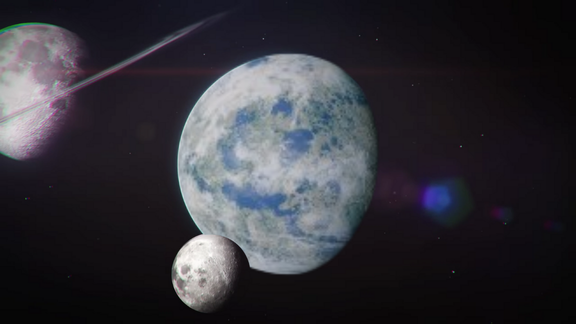
Harris, also known as Y7M-756, is a retrograde planet and is the largest planet of the Mkinta Star system. Is is also the second largest planet in the Mkinta System, just behind Griffin, one of the gas giants. This however is the second planet known in the Mkinta System to have a dense atmosphere and is even believed to have surface water.
Day-Night Cycle
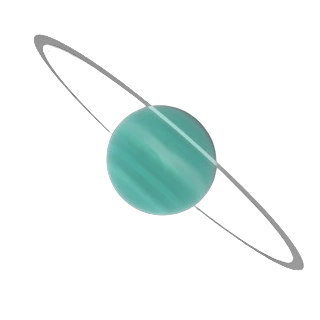
Harris receives significant light from Mkinta β (MKB). As a result, Harrian nights are never dark during half of the year, but instead are more like Earthly dusk. At the closest point in its orbit, MKB is about 2,300 times as bright as Earth's full moon; at its furthest point, it is still one hundred and seventy times as bright. During the other half of the year when MKB is in the daytime sky, many Harrian nights are illuminated by both Eustis' huge ring system and the reflected light from other nearby moon Dora. Truly dark nights are uncommon. Eustis occasionally eclipses MKB at night for about one hundred minutes, but the light reflected by the moon still keeps the night from being dark.
When MKB shares the daytime sky with MKA, at its closest it adds about half a percent to the total illumination. When the two stars are close together in the sky, the effect of MKB's more red light is unnoticeable. But, as they separate over the years, a red tint may be seen in areas shadowed from MKA's direct illumination. At its most distant, MKB is about 2,700 times dimmer than MKA and does not produce noticeable lighting effects. However, it still appears as a blindingly-bright tiny orange disk in the sky.
Because of its high axial tilt (29°), Harris exhibits considerable annual variation in the day-to-night ratio. In addition, its elliptical orbit produces seasonal temperature variations and a range in daytime illumination of about ten percent.
Atmosphere
The atmosphere of Harris is the only fully developed atmosphere of any terrestrial planet in the Mkinta System, and is also the densest of any terrestrial planet. The atmosphere is composed of 76% nitrogen and 24% oxygen, which makes it ~1.2 times more massive than Earth's atmosphere. The rest of the atmosphere is composed of trace gases including ethane, propane, carbon dioxide, and argon.
Composition
Harris' physical construction resembles Earth's: a liquid iron core, a plastic mantle, and a semi-rigid crust. Like Earth, it has two internal heat sources: the disintegration of radioactive isotopes, and energy from the gravitational collapse of its initial formation. There is an additional and much larger energy input from tidal forces; the nearest inner and outer moons pull on it in contest. This excess of energy drives continental drift at a much faster rate than Earth, causing the tectonic plates to fracture more extensively because of the increased stress. This explains the lack of large oceans on Harris, as well as its volcanism and geothermal activity.
Surface
The terrain on Harris differs somewhat from place to place, as do the lizard settlements that inhabit them. The humans have settled in the forest region. There are different ecosystems within each region, and many species are present over a much wider range of biomes than their name would suggest. The Harrian surface features forests, mountains, volcanoes, plains (savanna), and oceans.
Like on Earth, the forests of Harris contains a wide diversity of flora and fauna. The forests are full of bioluminescent life that glows in shades of red, orange, and yellow during the night.