
Laythe
Laythe
drag to rotate · scroll / pinch to zoom
Astrographical Info
| Age | 4.57x10⁹ |
|---|---|
| Axial Tilt | 0° |
| Class | Superoceanic Aquaria |
| Diameter | 10,625 km |
| Gravity | 7.84532 m/s2 (0.8 g) |
| Mass | 0.556 M⨁ |
Orbital
| Orbital Period | 3.2 Days |
|---|---|
| Rotation Period | ∞ |
| Semimajor Axis | 134000 KM |
| Solar Day | ∞ (1:1) |
Atmosphere
| Atmospheric Composition | N₂ O₂ |
|---|---|
| Atmospheric Pressure | 0.6 atm |
| Greenhouse Eff | 32℃ |
| Temperature | 10℃ |
Surface
| Sea Composition | H₂O |
|---|
Other
| Esi | 0.632 |
|---|---|
| Phase | Varies |
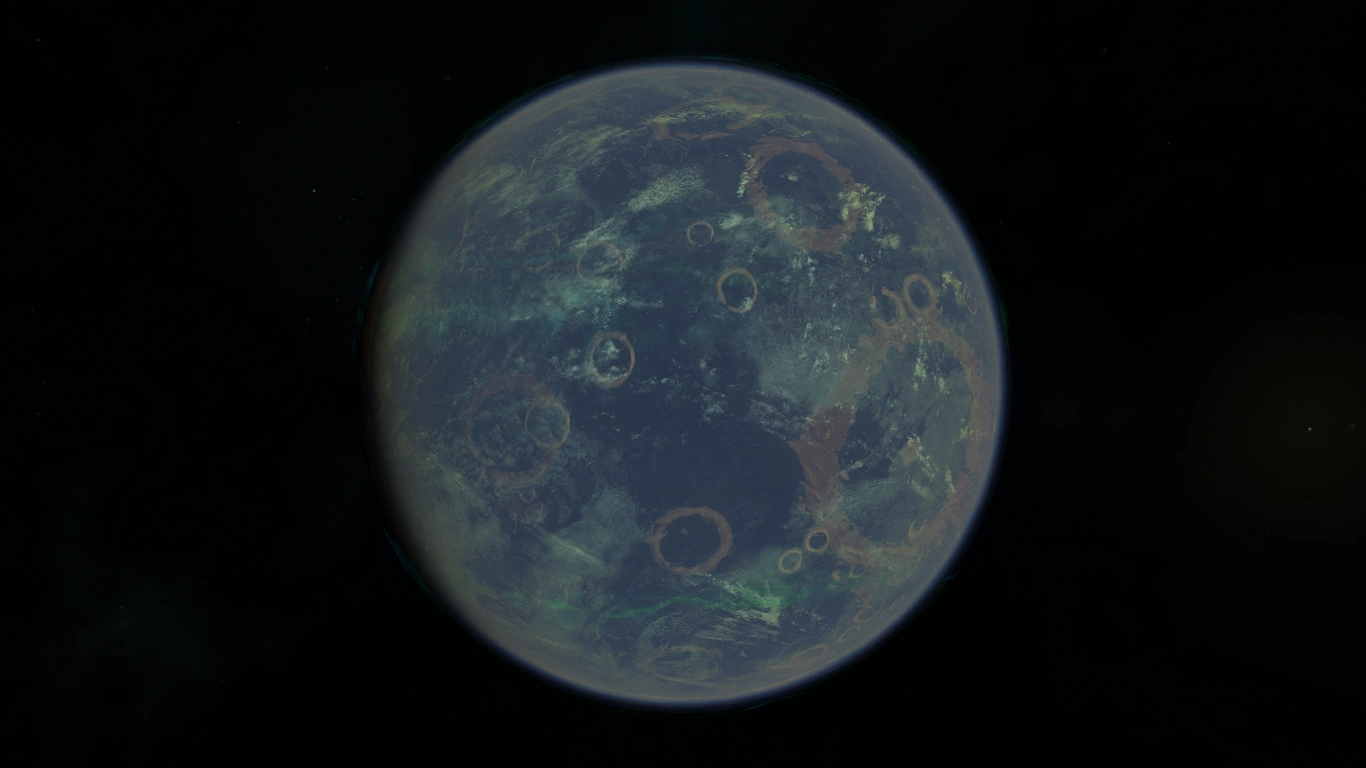
Laythe is the innermost of the five natural satellites of Jool. Although mostly covered in seas, Laythe has numerous rocky, sandy islands. Laythe is tidally locked to Jool. Synchronous orbits around Laythe are not possible, as they would lie outside of its SOI, at a radius of 5,186,399 meters. A circular archipelago prominent in surface maps of the moon suggests that Laythe suffered a massive impact in its distant past.
Achieving a stable orbit around Laythe from sea level requires a delta-V of ≈2900 m/s.
Laythe has no real-world analogue. In the real-world Jupiter system, the moons Ganymede, Europa and Io form a group with an orbital resonance just like KSP's Tylo, Vall and Laythe. But while Tylo and Vall have a certain resemblance to their real-life counterparts, Laythe is very unlike Io, which is dry, volcanic, and only has a tenuous atmosphere. Instead, Laythe's liquid ocean and dense atmosphere invite comparison with the Saturnian moon Titan, but Laythe is 3 times warmer in absolute temperature.
Although Laythe has liquid water on its surface, its polar regions have temperatures below zero degrees Celsius even outside its ice caps. This means Laythe's oceans must contain another compound which reduces its freezing point, most likely ionic, such as salt. Surface samples indicate that much salt is present on Laythe's surface. According to EVA reports, the air can be breathed by Kerbals. The air, however, does have a strange smell about it. It is therefore possible that there are also high concentrations of salt in the air, as well as on the surface, assuming that the salt is sodium chloride. The smell could also be sulfur, as Laythe is hinted to have high amounts of volcanic activity.
Atmosphere
Laythe has an atmosphere thick enough and warm enough to support liquid water on its surface. The atmosphere has a mass of approximately 2.4×10¹⁶ kilograms, a sea level pressure of 60.795 kilopascals (0.6 atmospheres), and a depth of 50,000 meters. Compared to the atmosphere of Kerbin, Laythe's atmosphere has 1/2 the mass and 3/5ths the surface pressure. The sea level pressure on Laythe is equivalent to that at an altitude of 3,287 m on Kerbin. The atmosphere contains oxygen ,can support combustion and is breathable by Kerbals. Laythe is the only moon in the game that has an atmosphere.
The average molecular weight of Laythe air is 28.9644 g/mol, and its adiabatic index is 1.40. These values suggest a compostion very similar to Kerbin, and to Earth — likely nitrogen and oxygen.
Like all other atmospheres in the game, Laythe's atmosphere fades exponentially as altitude increases. The scale height varies with altitude. The pressure-altitude profile is globally constant and independent of temperature. The following table gives the atmospheric pressure at various altitudes above sea level.
| Altitude (m) | Pressure (Pa) | Pressure (atm) |
|---|---|---|
| 0 | 60 795 | 0.600 |
| 2 500 | 47 153 | 0.465 |
| 5 000 | 34 495 | 0.340 |
| 7 500 | 24 914 | 0.246 |
| 10 000 | 17 786 | 0.176 |
| 15 000 | 9 351 | 0.092 |
| 20 000 | 4 782 | 0.047 |
| 25 000 | 2 671 | 0.026 |
| 30 000 | 1 507 | 0.015 |
| 40 000 | 363.5 | 0.004 |
| 50 000 | 0 | 0.000 |
The variation of temperature with height suggests the presence of an earthlike troposphere, stratosphere and mesosphere. The warm surface temperatures rapidly decrease as the alt
itude increases to 5 km. The stratospheric region, where temperature rises as altitude increases, spans the region between the altitudes of 10 km and 22 km.
Air temperatures vary with latitude and time of day. At the equator, sea level temperatures vary between a nighttime low of 9 °C and a daytime high of 15 °C. Mid-latitudes are only slightly cooler than the equatorial zone — at latitudes below 63°, the sea level temperature never drops below 0 °C. At the poles, the temperature varies between -26 °C and -24 °C. The globally averaged sea level temperature is approximately 9 °C. Since Laythe has no axial tilt, there are no seasonal temperature variations.
Laythe's surface temperatures are warmer than would be expected based on its distance from the sun. This suggests the possibility that Laythe generates its own heat, likely tidal heating. It could also be caused by a higher rate of greenhouse gases such as carbon dioxide or nitrous oxide than on Kerbin.
Atmospheric flight
The thickness of Laythe's atmosphere makes it suitable for aerobraking and the use of parachutes.
With proper aerobraking near Laythe and Jool, reaching Laythe may require the least Δv of all of Jool's moons. Another way is to approach Laythe directly, utilizing proper timing and making orbital adjustments on the way to Jool. Laythe's orbital period makes it an easy target to time and will have required less Δv on arrival (only 2000 m/s). As such, aerobraking on Laythe is less extreme than on Jool.
Landing on higher points of Laythe's surface has to be done with the help of retro-burns, as parachutes alone will not suffice to sufficiently lower a craft's velocity for landing.
Jet engines work in Laythe's atmosphere due to the presence of oxygen. However, the air-intake efficiency is lower there.
Oxygen
As previously mentioned, Laythe's atmosphere contains oxygen, enabling jet engines to function. Even though there is a lower concentration of oxygen than on Kerbin, plus an unknown trace gas, most likely ozone, this oxygen almost surely has to be generated somewhere on Laythe. Molecular oxygen is extremely unstable compared to other atmospheric gases, and is even capable of reacting with itself to form ozone under certain conditions. Because of this unstable molecular oxygen must constantly be replaced for it to remain in any meaningful quantity in an atmosphere. This fact, combined with Laythe's extremely high concentration of liquid water, indicates that there may be unicellular life on the moon. While it is possible that this is the case, it is also possible that the moon has a self-sustaining chemical process that constantly replenishes its oxygen reserves, such as double ionization of sulfur dioxide.