The Mun
Mun
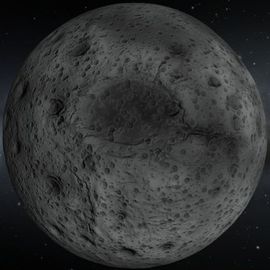
drag to rotate · scroll / pinch to zoom
Astrographical Info
| Age | 4.57x10⁹ |
|---|---|
| Axial Tilt | 0° |
| Class | Aquaria |
| Diameter | 3475 KM |
| Gravity | 0.165 G (1.62 m/s²) |
| Mass | 1 M☾ |
Orbital
| Orbital Period | 12.7 d |
|---|---|
| Rotation Period | ∞ |
| Semimajor Axis | 127000 Km |
| Solar Day | ∞ (1:1) |
Atmosphere
| Temperature | 32℃ |
|---|
Other
| Phase | varies |
|---|
Mun, also known as the Mun and sometimes written as Mün, is a relatively large moon orbiting Kerbin. It can be thought of as an analogue to Earth's own moon, which frequently is simply called "the Moon" (Latin: Luna).
It is gray in appearance with craters of various sizes and mountains exceeding 5029 m in height. The gravitational pull on the surface is 1.63 m/s², approximately 5/6 and 8.18 m/s² lower than that of Kerbin and about the surface gravity of Earth's Moon (1.624 m/s²). It is possible to land on the Mun or use it for gravity assists (gravitational slingshots) to outer bodies such as Minmus or into Kerbol orbit, though such maneuvers do not save very much fuel and are more imprecise. It is, however, useful for plane changes with proper timing.
New players should note that Mun (like the majority of celestial bodies in the game) has no atmosphere. That means parachutes do not work when descending to the surface.
There are anomalous geological formations that can be found on the surface of the Mun.
Synchronous orbit around the Mun is not possible, since it would have to occur at an altitude of 2 970.58 km, beyond the Mun's sphere of influence. However, putting your spacecraft just outside Mun's SOI and having the same semi-major axis would make it appear stationary. A normal 25 km orbit can be achieved using around 800 m/s delta V. With the 600 m/s provided by a jetpack Kerbals can fly to very low orbit if they use a very efficient ascent profile. This excludes flying over high obstacles early in the flight. A semi-synchronous orbit with half the rotation period of the Mun is possible at approximately 1797.41 kilometers.
Terrain
The Mun's terrain is rough, grey, and scarred by craters. Its low-lying areas tend to be darker in colour. The Mun also features canyons which can be hundreds of meters deep and a few kilometers long.
The Mun's highest points reach a maximum altitude of more than 7061 m near the south pole at 152.33° W and 82.52° S. This altitude permits 10× warp, allowing crashes with terrain while being in a seemingly stable orbit. Its lowest point, below -247 m, is on the northern hemisphere south-west of the large northern crater at 76.63° W and 35.32° N.
When terrain scatter is activated in the graphics settings, the Mun has rocks scattered on its surface. Like all terrain scatters, these rocks are strictly cosmetic and do not collide with ships or Kerbals.
The Mun is peppered with procedural impact craters making Mun landing more difficult. Previously the lowest point with an altitude of 0 m was on the east side of a large crater, at 35.42° E, 8.27° N.
The Hell Kraken has been encountered on the Mun, with objects being thrown out of Kerbin's sphere of influence upon reloading the craft.
Observation from Kerbin
The Mun's orbit keeps it directly above Kerbin's equator. Because the Mun is tidally locked to Kerbin with a perfectly circular, non-inclined orbit, exactly 50% of the Mun's surface (excluding areas on the edge obscured by the Mun's mountains) is ever visible from Kerbin.
Due to the Mun's non-inclined orbit, eclipses occur every time the Mun goes between the Sun and Kerbin. Due to graphic engine limitations, these solar eclipses currently do not make the sky black, or darken the land. However, solar panels will become blocked by the Mun in an eclipse and become useless for a short period of time.
A full Kerbolar eclipse can be observed while landed at KSC starting about Year 1, Day 351, 5h:40m, and ending (being partial again) somewhere around Year 1, Day 352, 0h:22m. Not sure of other occurences or locations, but this one at KSC is confirmed (unless game times and positions of bodies varies between players). A Kerbolar eclipse happens every synodic orbital period, or about 6 days 3 hours, somewhere on Kerbin's equator.
Although the game graphics depict Mun as totally covering the solar disk during an eclipse, based on the given diameters of Sun and Mun and their distances from Kerbin, Sun has a larger apparent size. For observers on and near Kerbin, solar eclipses would be annular.
Observation of Kerbin
Because Mun is tidally locked to Kerbin, Kerbin is only visible from 50% of the Mun's surface, and Kerbin never sets or rises as seen from the Mun. The Mun longitude for which Kerbin remains directly above in the sky (at the zenith is 47°26'10" East. The Mun's equator is coplanar with Kerbin's, so any location on the Mun's equator that faces Kerbin will also face Kerbin's equator. Kerbin is not tidally locked to the Mun, so any point on the Mun where Kerbin is not obscured by the Mun's landscape will be able to observe every point on Kerbin as Kerbin rotates. Kerbin's synodic rotational period with the Mun is 25617.909 seconds, or 1.18323 Kerbin solar days