Minmus
Minmus
Astrographical Info
| Age | 4.57x10⁹ |
|---|---|
| Axial Tilt | 0° |
| Class | Microaquaria |
| Diameter | 600 KM |
| Gravity | 0.491 m/s2 (0.05 g) |
| Mass | 0.1312 M☾ |
Orbital
| Orbital Period | 20.3D |
|---|---|
| Rotation Period | 3d4h22s |
| Semimajor Axis | 374000 KM |
| Solar Day | 3d4h34s |
Atmosphere
| Temperature | -69℃ |
|---|
Other
| Phase | Varies |
|---|
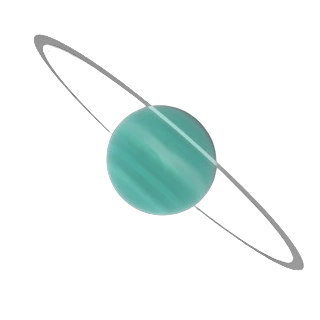
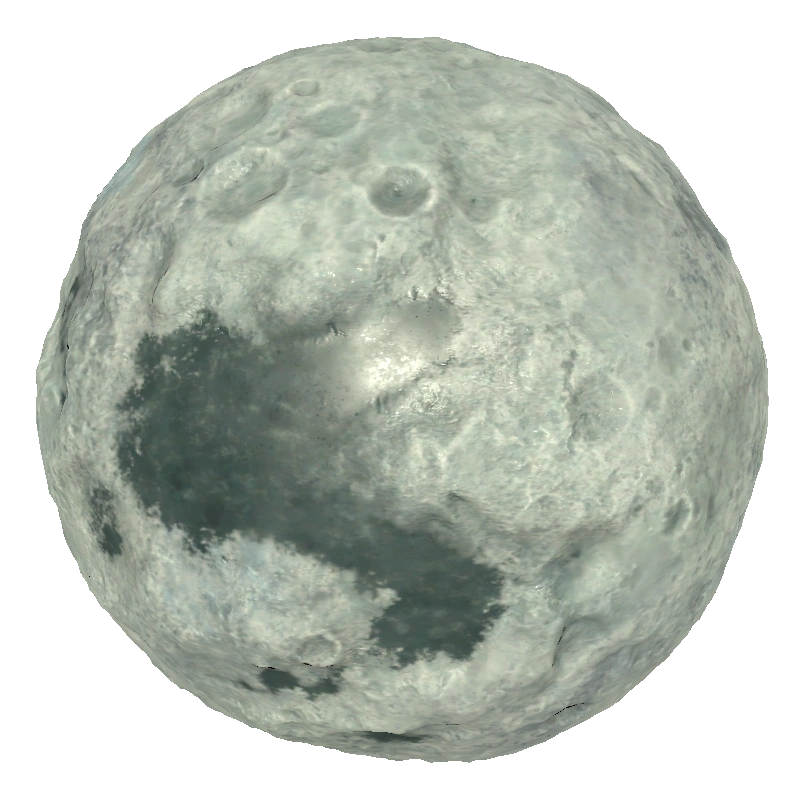
Minmus is the smallest moon of Kerbin. From the surface of Kerbin or the Mun, it is a cyan speck one or two pixels wide which appears to slightly oscillate vertically. This is a result of viewing its rotation from afar. Up close, it is of white in appearance with what seem to be icy buttes, large hills, and frozen lakes. The highest areas are over 5.7 km in altitude. It requires somewhat more delta-v to reach Minmus orbit than Mun orbit; however, given its very small gravity, it requires much less to land on the surface and return. This makes Minmus a primary source of Science in the early game after achieving an orbit of Kerbin.
Orbital characteristics
Minmus orbits Kerbin at a continuous altitude of 46,400,000 meters and takes approximately 920 m/s Δv to transfer to from low Kerbin orbit. The synodic period from Kerbin's surface is 14 days, 3 hours and 1 second (1,220,401 seconds). A synchronous orbit around Minmus is possible at an altitude of 357.94 km. The orbital speed around Minmus for an object with an altitude of 0 m is 171.5 m/s.
It is important to be careful when attempting to return to Kerbin from Minmus, as Minmus high orbit makes it very easy to escape Kerbin's sphere of influence entirely. It may seem that Minmus would make a convenient refueling station for vessels leaving the Kerbin system. However, Kerbins gravity is large enough that its Oberth effect gives considerable delta-V savings to craft leaving from low Kerbin orbit. Leaving Kerbin from Minmus orbit (which is very high) costs much more delta-V.
An efficient way to return to a lower Kerbin orbit from Minmus is to use a gravity assist around Mun. Plan the maneuver carefully, though, as one gravity assist will send a vessel into a lower energy orbit around Kerbin, but another can send the vessel along an escape trajectory!
Surface Temperature
Minmus' surface temperature reaches 14°C in the day, and -107°C at night.
Calculation of the expected surface temperature for Minmus, using received energy from Kerbol, with the Stefan-Boltzmann Law for the radiated power gives a temperature of -50 degrees Celsius. Whilst this is lower than the measured value, it lends support to the theory that Minmus is a captured comet. It could not have formed at its present location but has an albedo high enough to prevent catastrophic sublimation of its icy composition. A high salt content, if present, would also slow the sublimation process.
This value of temperature was calculated using: An emissivity of 0.9 (close to but lower than compacted ice), an albedo of 0.6 (close to but lower than the real ice moon Europa, and the luminosity of 3 yottawatts for Kerbol.
Topography
Minmus has very divergent elevations. Plateaus at around 5 km high are matched by "Flats" at datum altitude (0 m). Much of the surface is transitional lowlands and highlands. With version 0.23, there are now 9 biomes.
The various "Flats" are almost perfectly flat (great for landing) and believed to have once been the site of liquid lakes. Minmus also has some mesas, one of which is near Minmuss north pole, that are so high compared to Minmus sphere of influence that they count as "in orbit" according to the navigation tools. Unless the player manually switches the navball to Surface mode, this makes landing on these plateaus challenging, as the direction marker and speed will not automatically correct for the rotation of the surface.
For most landings which are not on a plateau or in a lake, the touchdown altitude is usually between 2000 m and 2500 m.
A kerbal jumping on this moon will make them ascend 12 m from the ground.