Ipzamar
Ipzamar
drag to rotate · scroll / pinch to zoom
Astrographical Info
| Age | 37 Million years |
|---|---|
| Class | Terrestrial Exomoon |
| Diameter | 12,074 km |
| Gravity | 0.93 g (9.1201845 m/s²) |
| Mass | 0.83 Earths |
| Suns | 2 |
Orbital
| Galaxy | Absthaca Galaxy (formerly) Elkska Galaxy (current) |
|---|---|
| Orbital Period | 7.4 days |
| Rotation Period | 7.4 days |
| Semimajor Axis | 756,322 km |
| Solar Day | 7.4 days (1:1) |
| System | Lizard-595 |
Atmosphere
| Atmospheric Color | Orange |
|---|---|
| Atmospheric Composition | N₂, O₂, CO₂, H₂S |
| Atmospheric Toxicity | Breathable |
| Atmospheric Pressure | 1.2 atm |
| Temperature | 65℉ |
Surface
| Sea Composition | H₂O |
|---|---|
| Terrain | Beaches |
| Water State | Liquid |
Other
| Affiliations |
|
|---|---|
| Anomaly Strength | 0 I/u |
| Climate | Tropical |
| Esi | 0.933 |
| Government | Stable (Whirlwinds) |
| Languages Spoken |
|
| Other Notes | Home to the Whirlwinds |
| Primary Core Element | Fe, Ni |
| Strength | 32 µT |
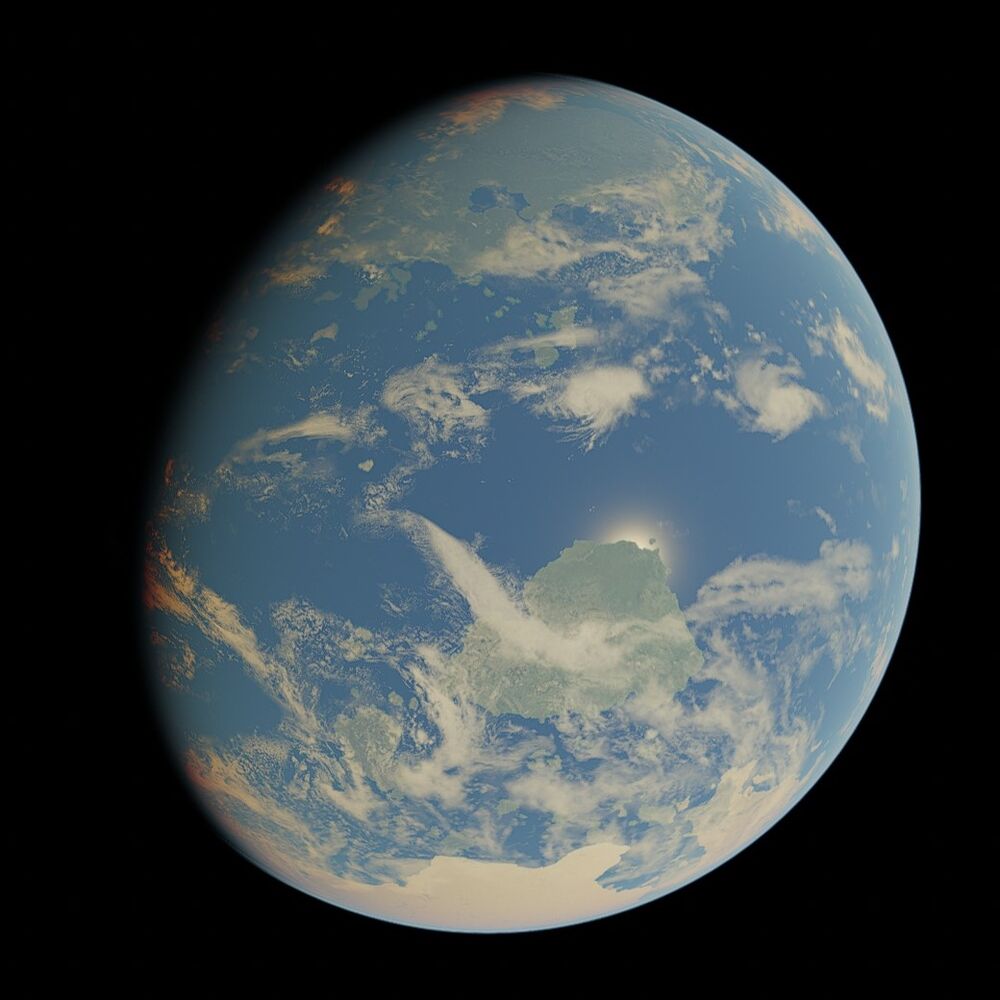
Ipzamar, also known as Whirlwind's Child by the Whirlwinds (Whirlwinds name: Yuoe'eveng), is an Earth-like habitable extrasolar moon from the Lizard-595 System, the closest star system to Thrilxots's own Solar System. It is the sixth moon of the gas giant Lizard-595, which orbits Lizard-595-A. It is located 4.423 light-years (26 trillion miles) from Lizard-755.
Despite being almost as large as Earth, Ipzamar is only a moon of a planet that has Sixty-Three other moons. However, due to the smaller mass, Ipzamar's gravity is 7% less than Earth's, although its atmosphere is much denser than Earth's due to the presence of heavier gases. Depending on the position of the various moons, two or even three moons can be seen at once in the sky of Ipzamar. This causes solar eclipses to happen on almost a daily basis. Ipzamar and its sister moons (like Yivzar) also cast large black shadows on Lizard-595.
Atmosphere
Ipzamar's atmosphere is a mixture of nitrogen, oxygen, carbon dioxide (>0.05%), xenon (>5.5%), methane, and hydrogen sulfide (>0.001%) and is about 20% denser than the atmosphere on Earth primarily due to the high percentage of Xenon; a heavy, colourless, odourless, and generally unreactive noble gas. The low concentration of carbon dioxide in the Ipzamaran atmosphere makes it breathable and safe to humans.
- Lower terminal velocity. Combined with Ipzamar's seven-percent lower gravity, a freely falling object's maximum speed is significantly less than on earth. A Whirlwind who happens to fall from flying has a good chance of surviving uninjured if they are over a forested area. Even over water, falling spread-eagled can reduce their speed sufficiently to allow an impact with the surface that will not knock them unconscious.
- The increased mass of the denser air means that more force is required to accelerate it as it is moved out of the path of a moving object. Lizards on Ipzamar experience this when they try to run – it feels like there is a wind blowing against them, even though the air is still. They are further hampered by the fact that the reduced gravity causes their boots to slip more readily on paved or smooth surfaces, giving them less traction to force their bodies forward. The Whirlwings compensate for this loss of frictional force by curling their large toes into the soft ground, and Ipzamaran six-legged animals use their many feet to gain a purchase on protruding rocks or small crevices.
- Flying Whirlwinds can take advantage of both the lower gravity, which reduces the weight of their body, and the increased air density, which requires more force to displace with the downward/rearward stroke of their wings, and thus gives the animals body more impetus with each flap, as well as using their long tails as a rudder to change directions quickly. The downside is that the denser air is harder to move through, and requires highly-efficient streamlining to achieve high flight speeds.
- Plants are subject to greater wind force, as the greater air density means that the moving air carries more kinetic energy and more momentum, and the plants, leaves, stems, branches, and trunks must all have a greater strength and/or flexibility to resist it.
Magnetosphere
Ipzamar possesses a liquid iron core, with circulating currents that produce a dipole field similar in structure to the Earth's. This fields shields the surface from cosmic rays of material ejected from Lizard-595-A, but unlike Earth, these intense magnetic fields are not as uniform, and concentrated iron deposits produce localized distortions to the worldwide field that can act as magnetic funnels. These anomalies can channel incoming particles ejected from the sun to the moon's surface. Any life-form unlucky enough to be caught in one of these areas during a stellar flare event, or CME (Coronal Mass Ejection) will be quickly irradiated with a lethal dose. Depending of the type and amount of radiation, death can occur instantly as brain tissue is ionized and effectively "shorts out," or be delayed for agonizing days or weeks as the tissue slowly necrotizes.
Ipzamar's global field also interacts with Lizard-595's much more extensive one. This can divert radiation trapped in the planet's magnetic field to the moon's surface - also with unpleasant results. Additionally, the configuration of these two fields produces a "magnetic flux tube" that links the polar areas of the planet and satellite with an electrical current flow of millions of amperes. This causes a gigantic increase in electrical activity on both bodies, with massive lightning storms and other electromagnetic-phenomena.
Interior
Ipzamar's physical construction resembles Earth's: a liquid iron core, a plastic mantle, and a semi-rigid crust. Like Earth, it has two internal heat sources: the disintegration of radioactive isotopes, and energy from the gravitational collapse of its initial formation. There is an additional and much larger energy input from tidal forces; the nearest inner and outer moons pull on it in contest with Lizard-595. This excess of energy drives continental drift at a much faster rate than Earth, causing the tectonic plates to fracture more extensively because of the increased stress. This explains the lack of large continents on Ipzamar, as well as its volcanism and geothermal activity.
Geology
Ipzamar's land-to-water ratio is greater than Earth's, but because the land area is broken up into a larger number of smaller continents, no land area is as far from the ocean as on Earth, and there are still frequent rivers and bays. The moderating influence of oceans reduces extremes in temperature. Polar ice caps that are smaller than Earth's exist. However, due to the exponentially higher greenhouse composition in the moon's atmosphere, which then causes a much higher global average temperature than Earth, there are no land masses in the polar areas, the Ipzamaran ice caps are currently free-floating.
Ipzamar is more volcanically active than Earth. There are vents both on the land and under the oceans. Many of the mountains and other surface features are of recent volcanic origin. Numerous hot springs and geysers dot the landscape, and there are several rivers that are almost boiling at the place where they erupt from underground aquifers. All of these serve to maintain the local concentrations of hydrogen sulfide gas deadly to humans, and Whirlwinds. Landforms are shaped extensively by the higher density atmosphere - dust grains carried by the wind are larger, and strike objects with greater energy. Exposed rock weathers more rapidly, creating more sedimentary material to be carried away by rivers.