Lizard-753-N
Lizard-753-N
Astrographical Info
| Age | 11.24x10⁹ |
|---|---|
| Axial Tilt | 34° |
| Class | Terrestrial Exoplanet |
| Diameter | 11,756 km |
| Gravity | 1.273 G (12.48386545 m/s²) |
| Mass | 1.2 M⨁ |
| Suns | 2 |
Orbital
| Orbital Period | 13.7 Days |
|---|---|
| Rotation Period | 23.67 Hr |
| Semimajor Axis | 0.029 AU (4,300,000 Km) |
| Solar Day | 23.67 Hr |
| System | Lizard-753 System |
Atmosphere
| Atmospheric Color | Blue |
|---|---|
| Atmospheric Composition | O₂, N₂, He |
| Atmospheric Toxicity | Breathable |
| Atmospheric Pressure | 0.97 atm |
| Greenhouse Eff | 34.23℃ |
| Temperature | 95.2℃ |
Surface
| Major Moons | Lucien, Sikaw |
|---|---|
| Moons | 2 |
| Sea Composition | H₂O, FeO₂ |
| Terrain | Forests |
| Water State | Liquid |
Other
| Affiliations | |
|---|---|
| Anomaly Strength | 44.7 I/u |
| Aphelion | 0.029 AU (4,234,000 Km) |
| Climate | Tropical |
| Esi | 0.852 |
| Galactic Address | ⋰⋰⋱⋱⋯⋯⋰⋰⋱⋰⋯⋰⋱⋰⋯ |
| Government | Defunct (Shapeshifters) |
| Languages Spoken |
|
| Other Notes | Strong Magnetic field |
| Perihelion | 0.029 AU (4,334,000 Km) |
| Phase | 0.993 |
| Primary Core Element | Neodynium |
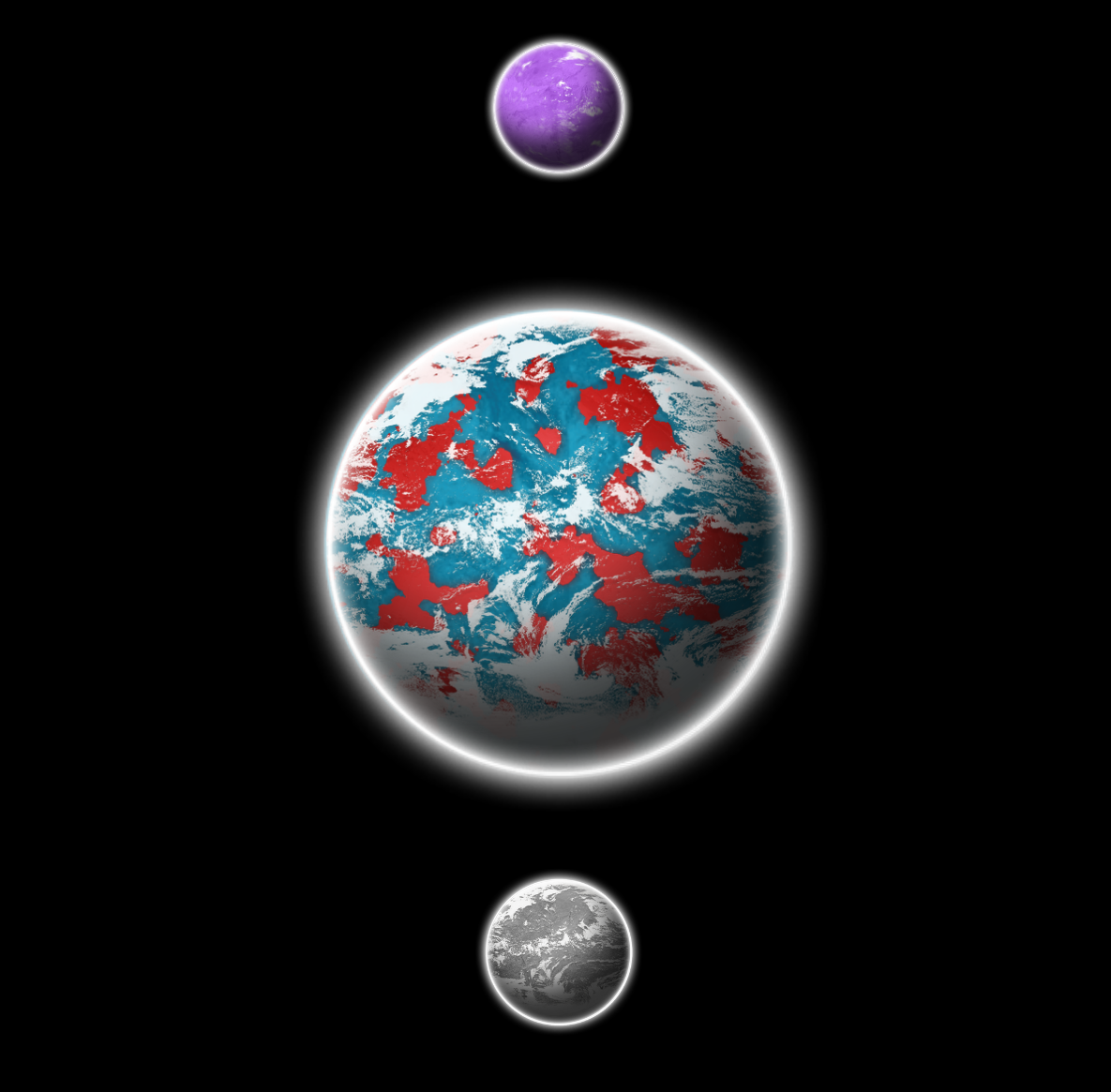
Planet Lizard-753-N is an extraordinary world, visually striking with its vibrant colors and unique physical properties. The planet's diameter is 11,756 km, making it slightly smaller than Earth, but it has a mass of 1.2 Earth masses due to its unusually dense neodymium core, which also generates an incredibly strong magnetic field. This powerful magnetic field shields the planet from harmful cosmic radiation, contributing to the preservation of its atmosphere and supporting the evolution of diverse ecosystems.
Geological and Atmospheric Features
Lizard-753-N's surface is a blend of vibrant, unusual colors, with its teal grass creating a striking contrast against the reddish hues of its oceans. The red water is caused by the presence of iron oxide (5.86%) dissolved in its oceans, giving the seas a rust-colored tint. This iron-rich water gives the oceans a distinctive appearance, unlike any other known world, and has led to the formation of unique ecosystems adapted to the planet's mineral-rich environment. The iron oxide is also present in various mineral formations on land, creating red-hued rock formations, cliffs, and deserts scattered across the continents.
The planet's atmosphere is composed primarily of oxygen, nitrogen, and trace gases, with a balance that supports life similar to Earth. The combination of a thick, oxygen-rich atmosphere and a powerful magnetic field allows for the flourishing of diverse flora and fauna despite the strong gravity, which is slightly more than Earth's. The strong magnetic field not only provides protection against solar winds but also creates stunning auroras that light up the skies in mesmerizing colors, especially near the poles.
Ecosystems and Landscape
The teal grass that carpets much of the planet's surface is a result of an unusual form of photosynthesis that relies on the planet's abundant minerals and sunlight. The plants have adapted to the higher levels of iron in the soil, taking on this vibrant color, which contrasts against the deep red of the waters and the iron-rich cliffs. The grass grows in vast plains, along with massive forests of tall trees, their leaves shimmering in hues of blue and green due to the unique biochemical processes that support their growth.
The land is shaped by towering mountain ranges, deep canyons, and massive volcanoes, some of which are still active due to the intense geothermal activity originating from the planet's neodymium core. The planet's gravity makes climbing and navigating these mountainous regions a physically challenging endeavor, with higher levels of endurance required for movement.
Seas and Oceans
Lizard-753-N's oceans are vast, stretching across much of the planet's surface, though they are heavily influenced by the iron oxide present. The red water is filled with microscopic iron-based lifeforms that thrive in this environment, creating a network of ecosystems that are unlike anything found on Earth. These lifeforms form the basis of the food chain, and larger marine creatures, some resembling terrestrial marine life but with metallic scales, inhabit the oceans. These creatures feed on the rich minerals in the water, which gives them a metallic sheen that glimmers in the planet's sunlight.
Magnetic Field and Climate
Lizard-753-N's strong magnetic field also plays a significant role in the planet's climate. The magnetic field disrupts the natural weather patterns, resulting in unique atmospheric phenomena such as swirling storms that are often accompanied by brilliant auroras visible across much of the planet. The storms are powerful but predictable, and some of the largest weather systems occur along the equator, where the magnetic field is strongest.
While the planet's environment may seem harsh, it is also highly resilient. The plants and animals have adapted to the high mineral content of the soil and water, creating ecosystems that thrive on the planet's unique geology and atmosphere.
Moons of Lizard-753-N
- Lucien Lucien, the larger moon, remains a barren, rocky body with a surface marked by ancient craters and impact sites. Its rich deposits of rare metals and minerals make it a valuable source for resource extraction. While uninhabited, Lucien plays an important role in the Lizard-753-N system due to its proximity and mineral wealth.
- Sikaw Sikaw, the smaller and more distant moon, is home to dense, misty forests and shallow seas. Despite its lush environment, the moon's surface remains mostly unexplored, as its thick, methane-rich atmosphere makes it a challenging location for colonization. However, the presence of geothermal vents and diverse bioluminescent life makes Sikaw a world of great scientific interest.
Lizard-753-N, with its rich iron-oxide seas, magnetic field, and unique ecosystems, is a world of fascinating contrasts. Its unusual colors and dynamic landscapes make it a planet like no other, while its moons add further intrigue to the system's overall mystery.