Lizard-718-NB
Lizard-718-NB
Astrographical Info
| Age | 1.32 Billion Years |
|---|---|
| Axial Tilt | 0° |
| Class | Terrestrial Exoplanet |
| Diameter | 16,157 km |
| Gravity | 1.66 g |
| Mass | 2.102 M⨁ |
| Suns | 1 |
Orbital
| Galaxy | Absthaca Galaxy (Formerly) Elkska Galaxy |
|---|---|
| Orbital Period | 33 Days |
| Rotation Period | ∞ |
| Semimajor Axis | ~470,000 km |
| Solar Day | ∞ (1:1) |
| System | Lizard-718 |
Atmosphere
| Atmospheric Color | Pastel Blue |
|---|---|
| Atmospheric Composition | SO₂, CO₂ |
| Atmospheric Toxicity | Unconscious in 20 seconds and death in 4 minutes |
| Atmospheric Pressure | 13 atm |
| Greenhouse Eff | 0° |
| Temperature | -77°C |
Surface
| Major Moons | Lizard-718-NA |
|---|---|
| Moons | 1 |
| Terrain | Snowy Wasteland |
| Water State | Present (frozen) |
Other
| Affiliations | |
|---|---|
| Bow Shock Distance | 12,004 km |
| Climate | Tundra |
| Galactic Address | ………⁘……… |
| Government | Defunct Lizards |
| Languages Spoken |
|
| Other Notes | Covered in Dense clouds and fog |
| Primary Core Element | Iron |
| Strength | 10 µT |
| Tail Length | 45,000 km |
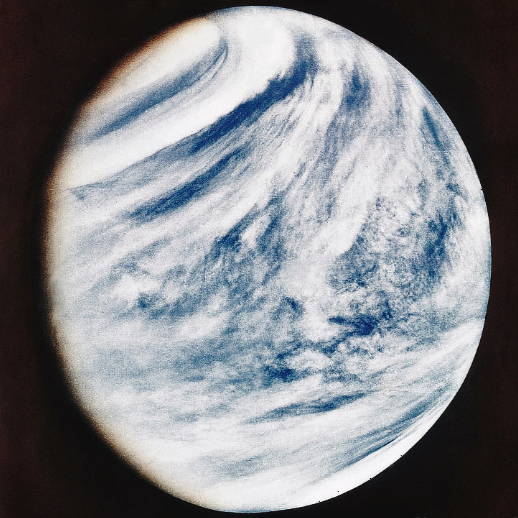
Lizard-718-NB is a planet within the Lizard-718-N binary system, orbiting the M0 V red dwarf star Lizard-718-A. It is a larger and more massive world than Earth, characterized by its Venus-like conditions, though it is notably colder and more inhospitable. The planet's surface is a vast, frozen wasteland covered in a thick layer of snow and ice, with temperatures averaging well below freezing, far colder than Earth's coldest regions. This extreme cold is due to a combination of the planet's distance from its star and its dense, toxic atmosphere.
The atmosphere of Lizard-718-NB is predominantly composed of sulfur dioxide (SO₂), carbon dioxide (CO₂), and trace amounts of other acidic gases, which render it highly poisonous and unbreathable for life forms such as lizards or humans. These gases contribute to an intense greenhouse effect, trapping heat on the planet's surface and creating extreme pressure, though the surface temperature remains perpetually low due to the overall lack of sunlight. The atmosphere's opacity also prevents much solar radiation from reaching the surface, with only minimal diffusion of light through dense cloud layers.
The planet's surface features include large ice plains, jagged mountainous terrain, and deep, frozen valleys. Snowstorms are common due to the instability of the atmosphere, which contains thick cloud cover and fluctuating thermal gradients. Despite the planet's inhospitable nature, its reflective properties—due to its snow and ice-covered surface—give it an apparent brightness five times greater than a full moon as viewed from Lizard-718-NA. This high albedo is the result of the icy landscape, which reflects much of the light from the system's red dwarf star.
Lizard-718-NB and Lizard-718-NA are in mutual orbit around each other, forming a gravitationally bound binary system. The two planets' proximity to one another creates complex tidal interactions, influencing their respective geophysical processes. The gravitational pull between the two planets, combined with the influence of Lizard-718-A, makes the system particularly dynamic.
This combination of extreme temperatures, toxic atmospheric composition, and significant orbital dynamics makes Lizard-718-NB a prime candidate for scientific study in planetary atmospheres and extreme environments, although its harsh conditions pose significant challenges to exploration.