Lizard-718-NA
Lizard-718-NA
Astrographical Info
| Age | 1.32 Billion Years |
|---|---|
| Axial Tilt | 0° |
| Class | Terrestrial Exoplanet |
| Diameter | 16,517 km |
| Gravity | 1.73 g |
| Mass | 2.223 M⨁ |
| Suns | 1 |
Orbital
| Galaxy | Absthaca Galaxy (Formerly) Elkska Galaxy |
|---|---|
| Orbital Period | 33 Days |
| Rotation Period | ∞ |
| Semimajor Axis | 0.12 AU |
| Solar Day | ∞ (1:1) |
| System | Lizard-718 |
Atmosphere
| Atmospheric Color | Yellow |
|---|---|
| Atmospheric Composition | SO₂, CO₂, H₂S |
| Atmospheric Toxicity | Crushed in 5 Seconds |
| Atmospheric Pressure | 118.431 atm (120 Bar) |
| Greenhouse Eff | 100°F |
| Temperature | 120°F |
Surface
| Major Moons | Lizard-718-NB |
|---|---|
| Moons | 1 |
| Sea Composition | H₂O |
| Terrain | Rusted-over Wasteland |
| Water State | Liquid |
Other
| Affiliations | |
|---|---|
| Bow Shock Distance | 73,342 km |
| Climate | Arid |
| Galactic Address | ………⋮……… |
| Government | Defunct Lizards |
| Languages Spoken |
|
| Other Notes | Has a Bug Problem |
| Primary Core Element | Iron |
| Strength | 45 µT |
| Tail Length | 450,000 km |
| Xyzw Coordinates | 325, 35621, 5224 |
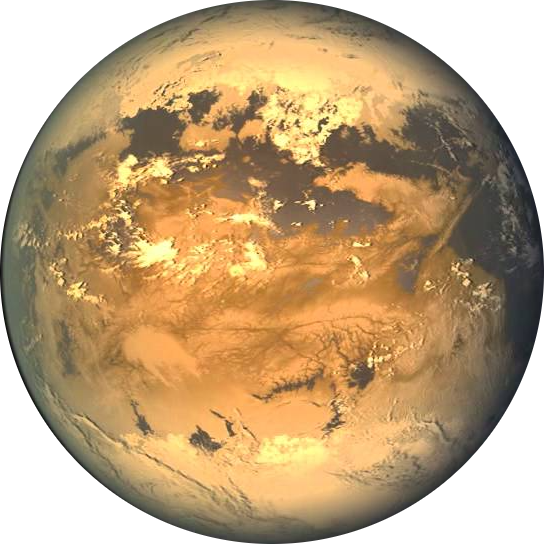
It is terrestrial exoplanet colonized by the Lizards, and valued at least in part for mining operations, industrial manufacturing, and mineral purification. The planet was the site of a devastating "bug problem" which reduced the surface into nothing but a dense dry, rusted over wasteland, cruel to all biological fauna exempt to the bugs.
Orbit
Lizard-718-NA is one of two terrestrial planets in the Lizard-718-N double planet system, orbiting the M-type red dwarf star Lizard-718-A. Classified as an M0 V star, Lizard-718-A provides a dim, reddish illumination, casting an eerie glow over the surface of both planets. Lizard-718-NA and its binary counterpart, Lizard-718-NB, orbit a common barycenter with a semi-major axis of approximately 450,000 km, completing one orbit every 17.2 days. The gravitational interaction between the two planets results in intense tidal stresses, contributing to the geological volatility of Lizard-718-NA.
Physical Properties
Lizard-718-NA is a super-Earth, larger and more massive than Earth, with a diameter of approximately 16,500 km and a surface gravity of 1.73 g. Its atmosphere is a dense, toxic mix primarily composed of sulfur dioxide (SO2), carbon dioxide (CO2), and traces of hydrogen sulfide (H2S). Surface pressure reaches nearly 120 bars, creating an oppressive environment unsuitable for Lizard or human life. The planet's mean surface temperature hovers around 410 K (137°C), sustained by a powerful greenhouse effect.
Geological Features
Before its collapse, Lizard-718-NA exhibited a rugged, arid landscape with expansive basaltic plains, active volcanoes, and deep canyon systems. Tectonic activity remains intense due to the tidal forces exerted by Lizard-718-NB, resulting in frequent seismic events and lava flows. Metallic ore deposits, particularly yttrium and osmium, were abundant, attracting Lizardian mining operations until the destruction of Mining Camp 45.6.
Biological Hazard
Lizard-718-NA is notorious for its infestation of insectoid organisms resembling oversized, hyper-adaptable cockroaches. These creatures exhibit extraordinary resilience to heat, radiation, and toxic atmospheric conditions, thriving in environments lethal to most known life forms. The collapse of Mining Camp 45.6 is attributed to the overwhelming proliferation of these organisms, which are suspected to possess rapid reproductive cycles and an aggressive swarm behavior.
Astronomical Dynamics
Lizard-718-NB, its binary partner, is a Venus-like icy wasteland characterized by reflective surface ice and a thick atmosphere of nitrogen and carbon dioxide. Its high albedo makes it approximately five times brighter than a full moon on Lizard-718-NA, providing consistent illumination even during the planet's night cycle. The mutual tidal locking between the two planets results in stable orbital resonance but exacerbates geological stresses.
Scientific Significance and Future Prospects
Lizard-718-NA offers a compelling case study for exogeology and astrobiology due to its extreme environmental conditions and the survival of complex, insectoid life forms. Despite the dangers, Lizardian scientists have expressed interest in studying these organisms for potential bioengineering applications. However, the planet remains largely quarantined, with orbital research stations conducting remote sensing and deploying autonomous probes to avoid further catastrophes akin to the Mining Camp 45.6 disaster.