Trivarion (Lizard-5757-K)
Trivarion
Astrographical Info
| Age | 2.42 Billion years |
|---|---|
| Axial Tilt | 29.02° |
| Class | Gas Giant |
| Diameter | 245,523 km |
| Gravity | 1.28 g |
| Mass | 1.76467 M♃ |
| Suns | 1 |
Orbital
| Galaxy |
|
|---|---|
| Orbital Period | 1.01 years |
| Rotation Period | 16h34m |
| Semimajor Axis | 1.2 AU |
| Solar Day | 16h34m |
| System | Novo Kiribani |
Atmosphere
| Atmospheric Color | bright sky blue (Cyan haze) |
|---|---|
| Atmospheric Composition | N2 (>79.4%), O2 (>19.4%), Ne (>1%), CO2 (>0.1%) |
| Atmospheric Toxicity | Breathable |
| Atmospheric Pressure | 2 megabars (core), 1.1 atm (average) |
| Greenhouse Eff | 0 |
| Temperature | 12℉ |
Surface
| Major Moons | Ariri, Ormathys-4, Tuanziturn |
|---|---|
| Moons | 59 |
| Terrain | Not present |
| Water State | Liquid to Solid |
Other
| Affiliations | |
|---|---|
| Anomaly Strength | 0 I/u |
| Bow Shock Distance | 790,000 km |
| Climate | Chilly |
| Government | Stable (lizards) |
| Languages Spoken |
|
| Other Notes | Habitable |
| Primary Core Element | Metallic Hydrogen |
| Strength | 77 µT |
| Tail Length | 33,000,000 km |
Trivarion is the second planet in the Novo Kiribani (Lizard-5757) System. It is a gas giant with fifty-nine moons, including Ariri, Tuanziturn, Tilrippe**,** and Ormathys.
The storm never sleeps… and something inside it remembers your name.
Physical Characteristics
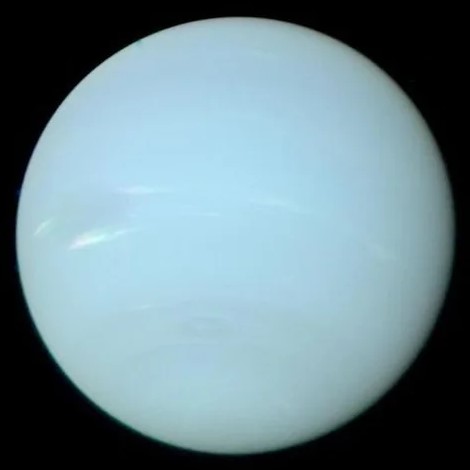
Trivarion is a massive gas giant roughly 4.96 times the diameter of Neptune and 111.647 times as massive, placing it near the upper bounds of gas giant classification without crossing into brown dwarf territory. Despite its mass, it has a relatively low mean density (~0.82 g/cm³), implying a hydrogen-helium dominated composition, typical of gas giants. The Lizards discovered the gas giant somewhere between 9150 and 9157, using a ground-based telescope named CRACKER.
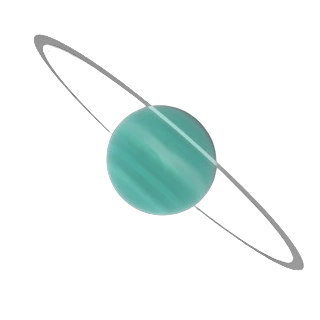
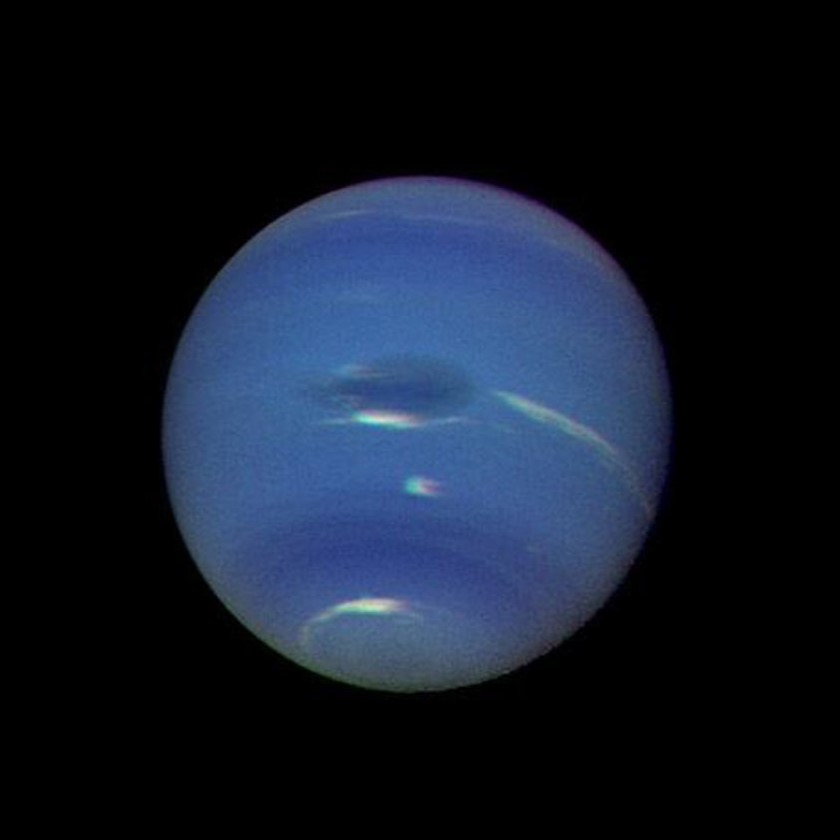
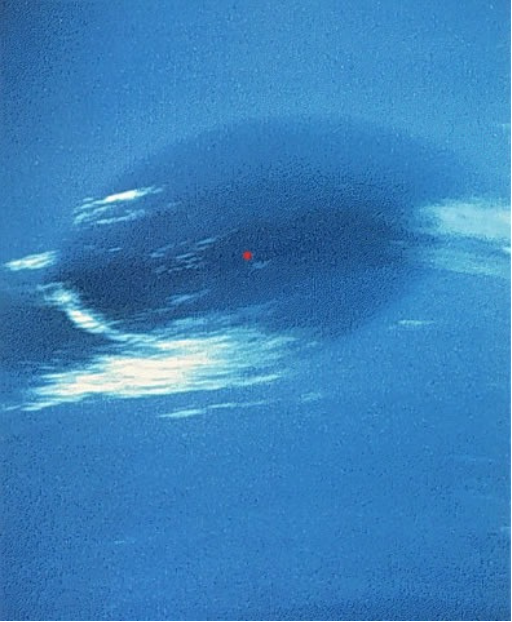
Visually, Trivarion resembles a larger version of Neptune, with less prominent bands and a larger vortex storm. This large, eye-shaped storm is the landmark of the planet, Satan's eye. Unlike other gas giants, Trivarion has no visible rings. In addition to the fifty-nine moons orbiting Trivarion, there is a large and a small dwarf planet at the gas giant's L4 and L5 Lagrangian points respectively. Since Trivarion' orbit lies in Novo Kiribani β's habitable zone, appropriately sized planets or moons may have liquid surface water, and therefore support life.
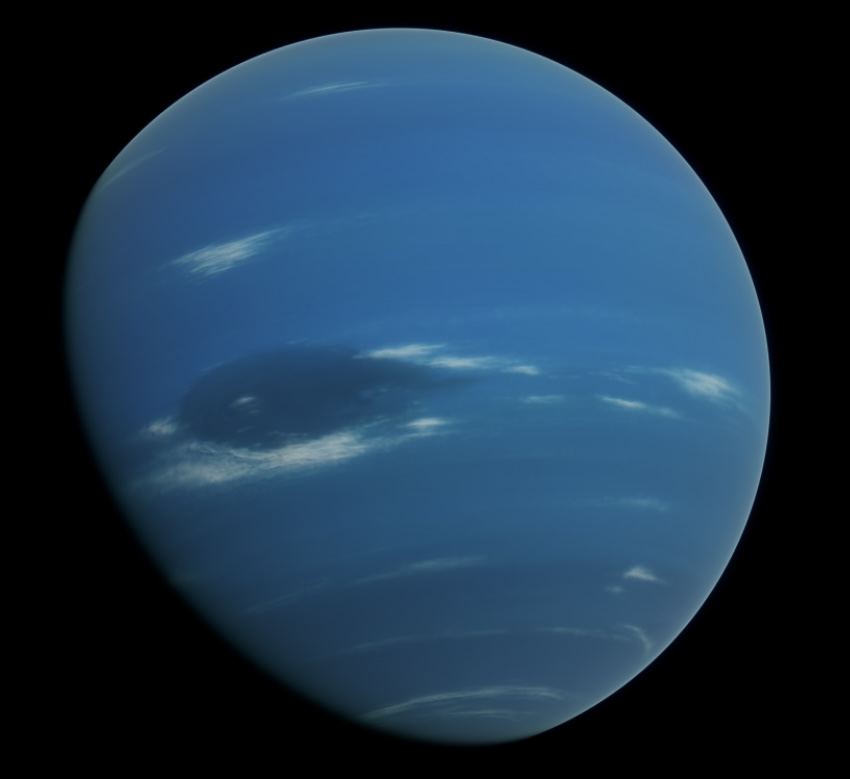

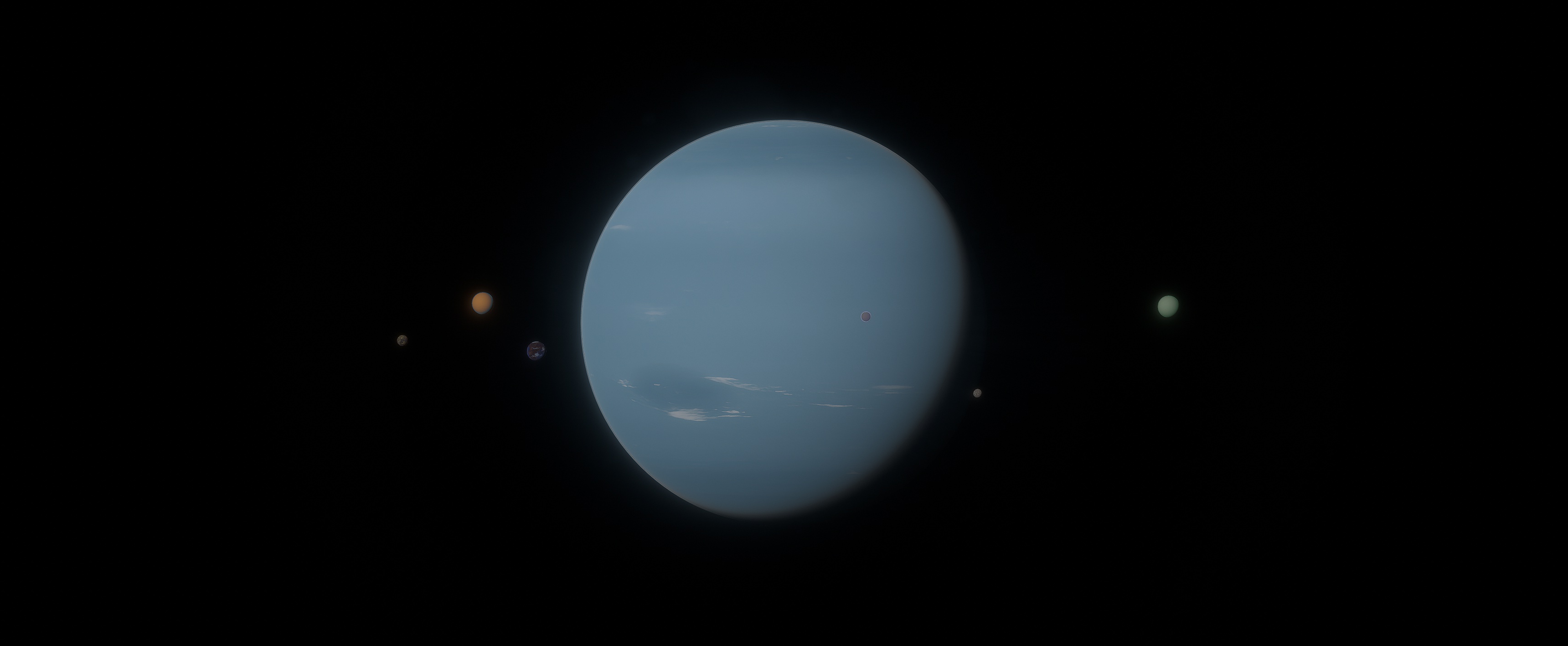
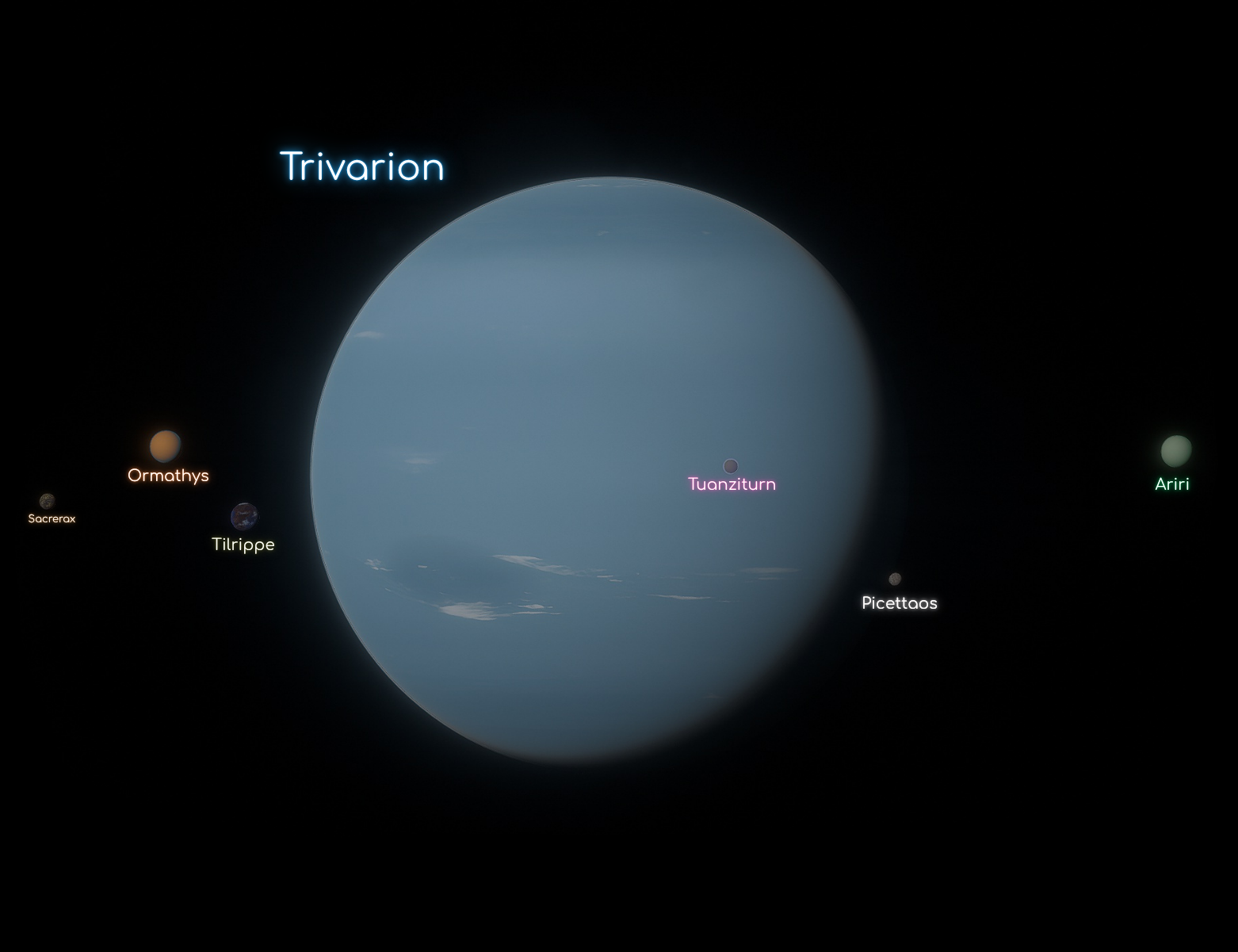
Trivarion can be seen in the sky on Ariri on a clear day. Depending on where the moons are in their orbits, Ariri may also have two or even three moons in its sky at once. Depending on Novo Kiribani β's position, Ariri and the other large moons cast dark shadows on Trivarion, like beauty marks.
Its atmospheric structure is multilayered, with high-altitude haze layers producing a cyan-blue scattering effect in daylight, transitioning into saturated deep blues at lower altitudes. The troposphere is characterized by thick clouds of water ice, ammonia, and trace hydrocarbons. Trivarion is unique among gas giants in that its lower atmosphere is oxygen-rich and, despite elevated carbon dioxide and trace neon levels, remains broadly breathable for Human & Lizard physiology. The atmospheric composition is as follows:
- Nitrogen (N₂): >79.4%
- Oxygen (O₂): >19.5%
- Neon (Ne): >1.0%
- Carbon Dioxide (CO₂): >0.1%
The atmosphere supports a temperate to cold climate, with typical surface-level temperatures ranging between 7 °C (45 °F) and -29 °C (-20 °F). Calm wind conditions dominate the majority of the planet, though intense weather systems such as blizzards and static-heavy storms are common, particularly near the equator and the Satan's Eye megastorm.
Satan's Eye
Satan's Eye is an enduring cyclonic storm system located in Trivarion's southern hemisphere. It bears visual similarity to Neptune's Great Dark Spot but is significantly more massive. Wind speeds in the storm have been measured at up to 664 mph (≈ 1,068 km/h). The storm has likely persisted for over 10,000 to 100,000 years, sustained by the planet's internal heat and rotational shear.
Unique Phenomena:
- Persistent lightning discharges during storms
- Blizzards mixed with electrostatic activity
- Red dot anomaly observed in the storm center via spectral satellite imaging, not visible in normal-light spectra
Moons and Satellites
Trivarion has a diverse and geologically active moon system, including:
Major Moons (9 total)
- Ariri: The only moon known to harbor life; exhibits Earth-like tectonics, extreme volcanism, and a highly toxic atmosphere rich in CO₂, Xe, and H₂S. Surface life evolved to be eyeless due to near-total atmospheric cloud coverage.
- Ormathys: Breathable but cryogenic atmosphere with surface temperatures reaching -296 °F.
- Unnamed Titan-like Moons: Purple, pink, and green-hued moons, possibly with thick atmospheres similar to Saturn's moon Titan.
Unusual Features
- At least one moon contains a "watchy window" anomaly, a recurring geometric and visual phenomenon akin to pareidolia.
- Several moons emit irregular, cryptic radio transmissions. One example includes:
- peekaboo... I see you...
- non-human screams
- HELP ME!!!
These transmissions are often associated with Lizard folklore, suggesting non-humanoid entities or ancient remnants within the system.
Cultural and Strategic Significance
As part of the Elkska Galaxy, Trivarion is under full Lizard jurisdiction. Its unique breathable atmosphere, aesthetic similarity to Neptune, and long-lived storm systems make it a site of both scientific and mythological interest. The planet is not domed or sealed—its atmosphere permits open-air habitation for Lizard species, although shelter is required during adverse weather conditions.
Its extreme scale and unique features have made it the subject of urban legends and cautionary tales, particularly surrounding the Satan's Eye and enigmatic radio signals from its moons.
Internal Structure
Beneath the liquid droplet clouds that make up its visible 'surface', Trivarion's atmosphere gradually thickens as its temperature and pressure build up from gravitational compression. When the pressure reaches about two megabars (approximately 29,000,000 pounds per square inch, which is almost two million times Earth's sea level atmospheric pressure) and the temperature reaches about 6000K (10,340F, slightly hotter than the surface of the Sun), nitrogen undergoes a phase change to its metallic form. The size of the liquid metal portion is about three-quarters of the planet's total diameter. This feature is common to all but the smallest gas giants.
Continuing downward, there is a central core of molten iron, surrounded by a thin jacket of lighter, rockier material. Large amounts of iron are not commonly found in gas giants as they have mainly rocky cores.
Trivarion has an intense internal heat source that results from the gravitational energy released during the contracting of the gases from which it is formed. Additionally, as nitrogen and oxygen were compressed, they changed from gases to liquids. This released their 'latent heat' (also called the 'heat of vaporisation', which is the amount of energy it takes to evaporate a liquid into a gas). Finally, some of the oxygen that dissolved in the metallic nitrogen core condensed out & moved downwards, converting its gravitational potential energy into heat via friction processes.
Cities
Cloud Cities are a completely lizard-made residential colony staff hovering over the gas giant Trivarion, occupied by millions of residents, tourists and support specialists. Located in Trivarion's Life Zone, the station had no need for airlocks or life support systems, or any kind of shielding, with the atmosphere comprised mostly of nitrogen and acceptable levels of oxygen, carbon dioxide, gravity and temperature. The station was situated 120,000 kilometers above Trivarion's large core, while its disk was approximately 164.2 kilometers in diameter. 36,000 sunlight engines and tractor beam generators kept the giant city floating above the planet. It contained roads, airports, spaceports, casinos, hotels, houses, businesses, and gas stations.
Culture
Popular tourist activities included waterparks, hiring a cloud car for sightseeing the city and occasionally touring the local cloud operations. The high-end accommodations were exclusive, with luxury resorts. The LAP (Lizard Affiliated Planets) also maintained gaming houses on the city. In the months following the Battle with the People (not humans), Cloud Cities had become the destination to procure rare implants such as brand new oculars and custom-made hands, or entire organ systems for a multitude of alien species. However, following the Empire's occupation of the Elkska Galaxy and subsequently, Cloud Cities, the distribution of implants was temporarily put on hold.
Life Zone
The Life Zone is an oxygen-rich layer of the atmosphere of gas giants such as Trivarion and Lizard-777-N. The Life Zone on Trivarion was breathable to species such as Lizards, humans, Thrilxots, Kerbals, and Arians, and the floating Cloud Cities was constructed in this layer of the planet's atmosphere.
₮Ɽ₳₦₴₥ł₴₴łØ₦ ł₦₵Ø₥ł₦₲
File:Result.mp3
They called it Lizard-5757-K, but locals whisper a darker name: Trivarion the Sleepless.
In the outer arm of the Elkska Galaxy, beyond the gravitational ripples of the Areachon star, there drifts a massive gas giant whose sapphire clouds shimmer deceptively like a summer sky. A planet 111.647 times the mass of Neptune—its atmosphere is breathable, its winds calm… until they aren't.
At the center of its northern hemisphere churns a colossal, ceaseless vortex known only as Satan's Eye, a storm so ancient it predates written Lizardian history. With wind speeds reaching 664 mph, it carves through Trivarion's upper clouds with malevolent intent. Some Lizardian astronomers claim the storm is older than Trivarion itself, as though it were summoned, not formed.
In storm season, lightning flickers through the planet's lower atmospheres like veins across a dying god's skin. It is then the signals begin.
First, a burst of static. Then a human-like, choking gasp.
Then the voice—digitally warped, impossibly ancient, impossibly aware.
Peekaboo... I see you...The Lizard Aeronautics and Space Administration (LASA) first detected it in orbit around the moon Karrolyn. A research probe recorded the transmissions on a loop, originating from within the Eye itself. LASA triangulated the source to 14 km beneath the upper cloud decks, far too deep for any conventional structure to survive, let alone a living being.HELP ME!
[Screaming—non-human, screeching, echoed]
But the voice continues.
Legends among the deep-system cargo pilots tell of a Lizard explorer, a xeno-biologist named Thessan, who descended into the Eye centuries ago—curious, foolish, or both. His final transmission ended in a shriek, the only word decipherable being it sees. The next packet from his lander was corrupted with symbols that didn't match any known script—some believe them to be Pre-Physical, language from before the birth of matter.
Today, Thessan's voice still crackles through deep-space frequencies. Except it's not just his. It's them.
The voices now layer.
A choir of despair.
Each one different. Each one screaming.
On certain moons, like Ariri, telescopes aimed at Trivarion's eye have captured fleeting imagery:
A red dot, pulsing within the vortex like a pupil. Watching. Waiting.
It's not visible from space—only in infrared.
Only if you believe.
Lizardian schoolchildren speak in hushed tones of The One Who Waits Inside, a being of unfathomable hunger. It does not move. It does not leave the Eye. It simply watches, calling out in mimicked cries, waiting for another soul to wander too close. Those who do are said to be devoured not in body, but in self—their voice recorded, distorted, and looped eternally in the Eye's stormwinds.
And if you tune your receiver just right—channel 7.66 on a cobalt band—you may hear it yourself.
A whisper. A plea. A trap:
Are you out there...? I'm so cold... please... help me...But whatever you do...
Don't answer it.