Ruvohines
Ruvohines
Orbital
| Orbital Period | 15 Days |
|---|---|
| Parent Body | Lizard-953-E |
| Semimajor Axis | 128,423 km |
| Solar Day | ∞ |
Physical
| Class | Terrestrial Exomoon |
|---|---|
| Diameter | 3,494 km |
| Gravity | 0.2564 G (2.51442506 m/s²) |
| Mass | 1.012 ☾ |
| Temperature | -122℃ |
Environment
| Suns | 1 |
|---|
Other
| Age | 5.9 x 10⁹ |
|---|---|
| Axial Tilt | 0° |
| Rotational Period | ∞ (1:1) |
Ruvohines: A Moon of Lizard-953-E
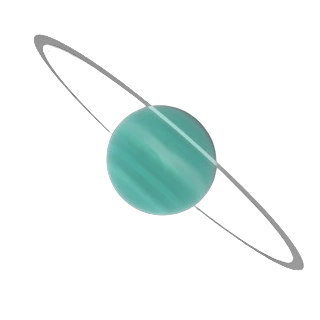
Ruvohines is one of the notable moons orbiting Lizard-953-E, a temperate super-Earth in the Lizard system. With a diameter of 3,494 km, it is somewhat smaller than its neighboring moons Neclite and Ulvarvis, but its unique characteristics make it an intriguing celestial body in its own right. Despite its smaller size, Ruvohines plays a significant role in the orbital dynamics and cosmic environment of the Lizard system.
Physical Characteristics
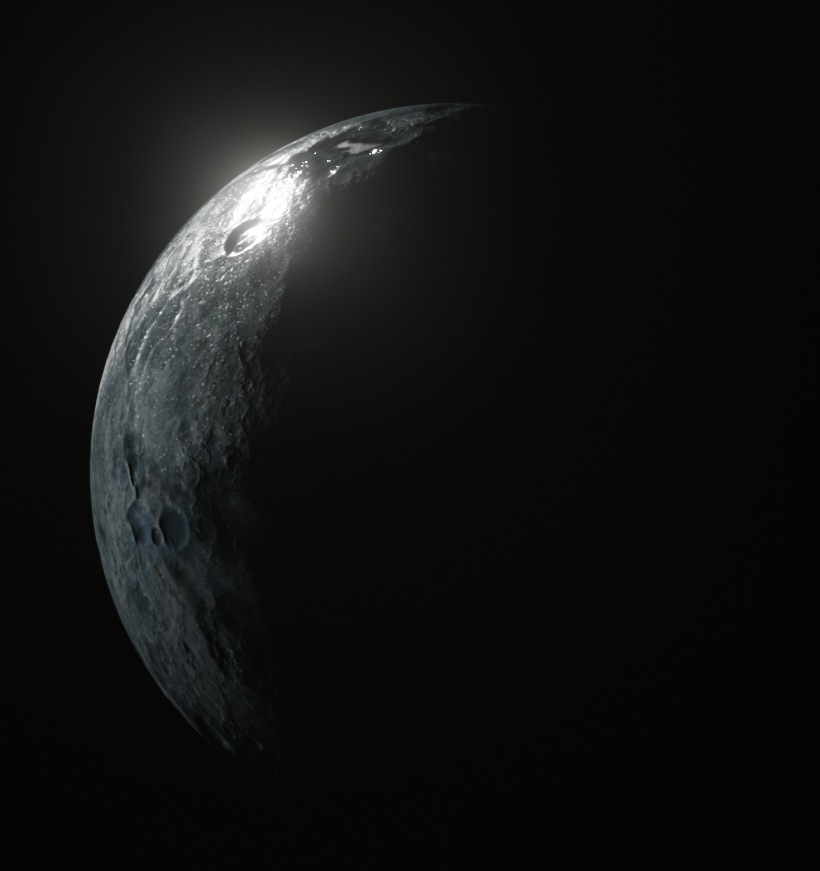
Ruvohines is a rocky moon with a solid, dense core and a surface composed primarily of silicate minerals. Its surface shows signs of heavy cratering, likely from ancient impacts. These craters range from small pockmarks to large, deep basins, suggesting that Ruvohines has experienced considerable bombardment in its history. The outer layer of the moon could be a mix of crystalline ice and frozen volatiles, which would suggest that Ruvohines has been exposed to the cold vacuum of space for billions of years.
The surface is marked by vast plain regions with deep craters, while the terrain near the poles might be more rugged and mountainous, with steep ridges and cliffs formed by ancient tectonic movements. Although Ruvohines does not have tectonic activity today, past geological events, such as volcanic activity or surface shifts, may have shaped the topography seen today.
Ruvohines' gravity is weaker than that of larger moons like Neclite, meaning that it does not retain a significant atmosphere, or any that would be stable enough for long periods. The lack of atmosphere combined with the moon's small size means that the surface experiences extreme fluctuations in temperature, with the days being warmer on the side facing Lizard-953-E and freezing cold temperatures during the long nights.
Orbital Characteristics
Ruvohines orbits Lizard-953-E at a moderate distance. It is tidally locked to its planet, meaning that one hemisphere always faces the super-Earth while the other side remains in constant darkness. The moon's orbital mechanics result in an orbital period that is approximately equal to its rotational period, a characteristic shared by many moons in the solar system that are tidally locked.
The orbital eccentricity of Ruvohines, or the slight elongation of its orbit, may cause the moon's distance from its parent planet to vary slightly, leading to small shifts in its gravitational interactions with Lizard-953-E. This could create some minor tidal effects that might result in very subtle surface deformations over geological timescales, though any such changes would be minimal compared to more geologically active moons.
Ruvohines' proximity to Lizard-953-E and its tidally locked nature means that the gravitational pull from the planet dominates its orbit. The moon would experience strong tidal forces, though these forces would likely be limited due to the moon's relatively small size and stable orbit.
Surface and Environmental Conditions
Ruvohines' surface is generally cold, with temperatures dropping dramatically at night due to its lack of atmosphere to retain heat. During the day, the side facing Lizard-953-E receives sunlight, but the lack of an insulating atmosphere means that heat is quickly lost to space once the planet sets. This leads to dramatic temperature variations, with daytime temperatures possibly ranging from slightly above freezing to sub-zero, while nighttime temperatures could plummet even lower.
The moon's lack of atmosphere means it is exposed to cosmic radiation and the solar wind, with the surface likely bombarded by high-energy particles. This would cause gradual surface weathering and erosion, particularly in the absence of atmospheric protection. The lack of liquid water on the surface means that erosion is primarily driven by physical processes such as micrometeorite impacts, solar wind, and the moon's interaction with its environment.
Potential for Life
Given the harsh surface conditions and the lack of atmosphere or liquid water, Ruvohines is an unlikely candidate for life as we know it. The cold, dry environment, combined with the absence of a protective atmosphere, presents significant challenges for the development or sustenance of any known biological forms.
However, like many moons in the Lizard system, Ruvohines might offer insight into the history of the planet and the moon system. The surface might contain chemical signatures or mineral deposits that could suggest a past where water or other volatile substances were once present, giving clues about the moon's potential for habitability in the distant past. Subsurface water, if present, might remain in frozen pockets deep within the moon's crust, though any such discovery would require extensive exploration.
Exploration and Scientific Interest
Ruvohines is a prime target for scientific study, particularly for scientists interested in the formation and evolution of rocky moons. The cratered surface, combined with its lack of atmosphere, provides an excellent environment to study the effects of cosmic radiation and space weathering.
Though not a candidate for human colonization, Ruvohines offers valuable opportunities to study the broader context of moons within Lizard-953-E's system. It is also an interesting body for the study of planetary geology, as its ancient cratering and geological history provide a snapshot of the system's evolution over billions of years.
Conclusion
Ruvohines, though smaller than moons like Neclite and Ulvarvis, is a fascinating world with a history marked by cosmic impacts and cold, barren conditions. Its surface, sculpted by craters and ancient geological processes, offers a stark view of the challenges of survival in a moon system with limited environmental protection. While it is not a candidate for life or human exploration, its scientific value lies in the study of its formation, the history of the Lizard system, and its interactions with its parent planet, Lizard-953-E.
Ruvohines contributes to the complex beauty of Lizard-953-E's satellite system, offering important clues to the system's past and a quiet, enduring reminder of the cosmos' natural processes.