Lizard-953-A
Lizard-953-A
Classification
| Age | 7.04x10⁹ |
|---|---|
| Temperature | 5700 K |
Physical
| Diameter | 1,821,391.80952 km |
|---|---|
| Luminosity | 1.34 |
System
| Planets | 10 |
|---|
Other
| Gravity | 35.33336402 G's (346.501934266733 m/s²) |
|---|---|
| Star Type | Yellow Dwarf |
| Stellar Class | G2V |
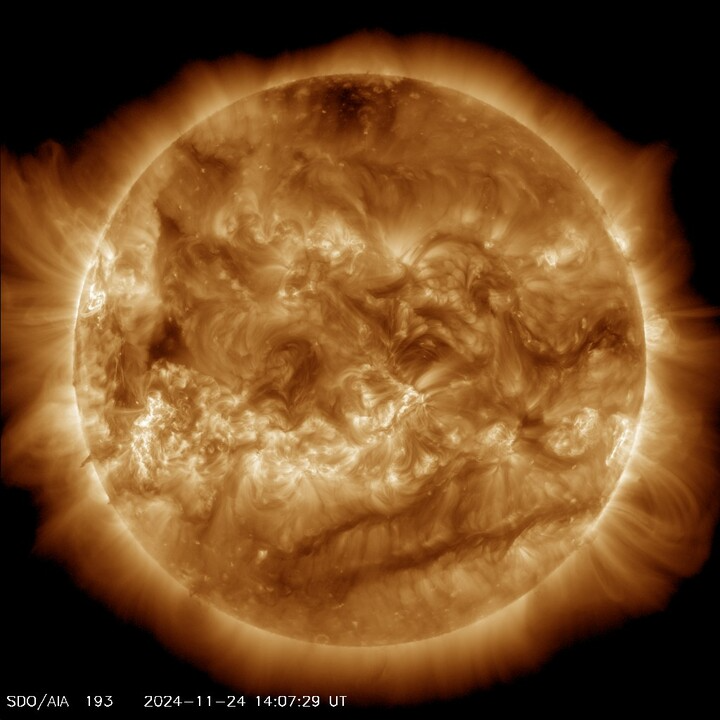
Lizard-953-A is a venerable yet vigorous G2V yellow dwarf star that dominates the Lizard-953 system. At 7.04 billion years old, it has spent a significant portion of its lifespan in the main-sequence phase, steadily fusing hydrogen into helium within its core. Despite its advanced age compared to Earth's Sun, Lizard-953-A is only entering the middle phase of its life, expected to shine brightly for another 19 billion years before transitioning into its red giant phase.
With a diameter 1.23 times that of the Sun and a mass of 1.15 solar masses, Lizard-953-A's greater gravitational pressure has resulted in a slightly more efficient and intense hydrogen fusion process. This leads to a luminosity 34% greater than that of the Sun, which translates into a broader and brighter habitable zone. The habitable zone stretches from roughly 0.9 AU to 1.5 AU, where the super-Earth Lizard-953-E orbits at 1.15 AU, enjoying a stable and temperate environment well-suited for life.
However, Lizard-953-A is not a placid star. Its magnetic activity is considerably more intense than the Sun's, marked by a dynamic solar cycle with a solar maximum occurring every 5 years. During these maxima, the star exhibits violent outbursts of solar flares, coronal mass ejections (CMEs), and heightened sunspot activity. These events release tremendous amounts of energy and charged particles into space, occasionally affecting the atmospheres and magnetospheres of nearby planets. For Lizard-953-E, the advanced civilizations and ecosystems have adapted to these periodic spikes in stellar activity, utilizing the planet's strong magnetic field to shield against harmful radiation while harnessing solar surges as an energy source.
The star's intense solar wind, particularly during maximum activity, creates a dynamic heliosphere that extends far into the system, acting as both a shield and a potential hazard. The solar wind sculpts the orbits of small celestial bodies and shapes the planetary magnetospheres. It is also thought to contribute to the generation of stunning auroras on the planets within the habitable zone, including Lizard-953-E.
At its surface, Lizard-953-A displays a vibrant interplay of turbulence and stability. Its photosphere, rich in convection cells, produces a brilliant golden-yellow light that bathes its planetary system. The star's corona flares with immense heat, reaching millions of degrees Kelvin during active phases, and emits bursts of X-rays and ultraviolet radiation that illuminate the surrounding void of space.
Lizard-953-A's advanced age and violent activity cycles make it a fascinating case for astrophysicists. Its long lifespan is attributed to a balanced mass and higher metallicity, which enable it to burn hydrogen more efficiently than less massive stars. The star's violent tendencies are tempered by its predictable cycles, making it both a powerful force and a stable source of life for its planetary system.
From its stormy solar maxima to its enduring glow, Lizard-953-A is a star of contrasts: an ancient yet energetic beacon, a giver of life, and a relentless cosmic powerhouse. It remains a dynamic heart of the Lizard-953 system, radiating strength and stability amidst the chaos of the cosmos.