Lizard-717-N
Lizard-717-N
Astrographical Info
| Age | 250x10⁶ years |
|---|---|
| Axial Tilt | 5° |
| Class | Terrestrial Exoplanet |
| Diameter | 16,432 km |
| Gravity | 1.7048g (16.71837692 m/s²) |
| Mass | 2.8748 M⨁ |
| Suns | 1 |
Orbital
| Galaxy | NGC 2525 (Formerly) Elkska Galaxy (Current) |
|---|---|
| Orbital Period | 5.225 Years |
| Rotation Period | 11h 42m |
| Semimajor Axis | 2.75 AU |
| Solar Day | 11h 42m |
| System | Lizard-717 System |
Atmosphere
| Atmospheric Color | Pastel Blue |
|---|---|
| Atmospheric Composition | N2 (>79.5%), O2 (>19.4%) |
| Atmospheric Toxicity | Breathable |
| Atmospheric Pressure | 1.02 atm |
| Temperature | 90℉ |
Surface
| Major Moons | Olo, Pickens, and Thalgrim |
|---|---|
| Moons | 3 |
| Sea Composition | H2O |
| Water State | Liquid |
Other
| Affiliations |
|
|---|---|
| Climate | Humid |
| Government | Stable (Lizards) |
| Languages Spoken |
|
| Primary Core Element | Iron, Nickel |
Lizard-717-N is the code-name of the exoplanet which serves as a minor setting of Lizard-Planets.
It was a terrestrial exoplanet colonized by the Lizards, and valued at least in part for residential zones, housing and cities, and chemistry. Lizard-717-N is the second of three terrestrial planets and the fifth planet orbiting the star Lizard-717-A (L717A) in the Lizard-717 System. Larger and denser than Earth, Lizard-717-N has no rings and has three moons, the most notable being Pickens. Lizards discovered the exoplanet somewhere between 9077 and 9090, using a ground-based telescope named CRACKER.
Description
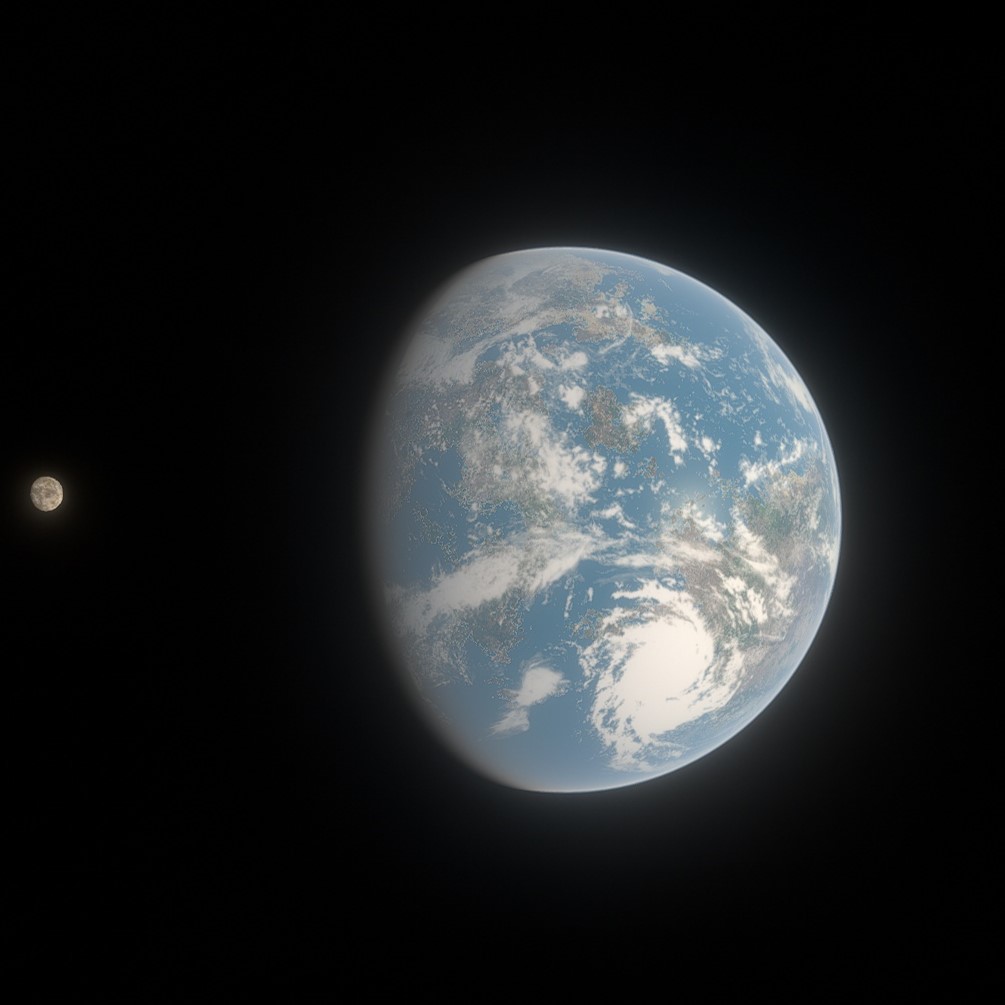
Visually, Lizard-717-N resembles a larger, bluer version of Earth, with more prominent clouds and a large number of hurricanes. Unlike other terrestrial planets in the system, Lizard-717-N has no visible rings.
In addition to the three moons orbiting Lizard-717-N, there is a large, ringed planetoid at the exoplanet's L4 Lagrangian point respectively. Since Lizard-717-N's orbit lies in L717A's habitable zone, appropriately sized planets or moons may have liquid surface water, and therefore support life. Pickens can be seen in the sky on Lizard-717-N. Depending on where the moons are in their orbits, Lizard-717-N may also have two or even three moons in its sky at once. Depending on L717N's position, Pickens and the other large moons cast dark shadows on Lizard-717-N, like beauty marks.
As with almost all terrestrial planets, especially ones close to the parent star, as with Lizard-717-N, this planet is surrounded by a lethal halo of charged particles. The radiation belts around Lizard-717-N are more energetic than the belts surrounding Lizard-953-E. The innermost moon, Olo, has reported radiation in excess of 1700 rem per day, which is aggravated due to the higher metallicity in the planets' internal composition. For comparison, Io receives 3200 rem per day.
Pickens resides just outside the main radiation belts of Lizard-717-N, except for one week during the year, when rotating along the night side of Lizard-717-N. During that week, the planet is shrouded at night in a shimmering aurora, and is enveloped by the radiation. Humans & Lizards on Pickens routinely take iodine supplements and seek protection during radiation storms. Incidences of radiation-related sicknesses occupy a significant number of medical treatments for personnel stationed on Pickens.
Magnetic Field of Pickens
Pickens possesses a liquid iron core, with circulating currents that produce a dipole field similar in structure to the Earth's and Lizard-717-N's. This weak field barely shields the surface from cosmic rays of material ejected from Lizard-717-A, but unlike Earth, these weak magnetic fields are not as uniform, and concentrated magnetic mineral deposits produce localized distortions to the worldwide field that can act as magnetic funnels. These anomalies can channel incoming particles ejected from the sun to the moon's surface. Any life-form unlucky enough to be caught in one of these areas during a stellar flare event, or CME (Coronal Mass Ejection) will be quickly irradiated with a lethal dose. Depending of the type and amount of radiation, death can occur instantly as brain tissue is ionized and effectively "shorts out," or be delayed for agonizing days or weeks as the tissue slowly necrotizes.
Pickens' global field also interacts with Lizard-717-N's much more extensive one. This can divert radiation trapped in the planet's magnetic field to the moon's surface - also with unpleasant results. Additionally, the configuration of these two fields produces a "magnetic flux tube" that links the polar areas of the planet and satellite with an electrical current flow of millions of amperes. This causes a gigantic increase in electrical activity on both bodies, with massive lightning storms and other electromagnetic-phenomena.
Internal Structure
Lizard-717-N's physical construction resembles Earth's: a liquid iron core, a plastic mantle, and a semi-rigid crust. Like Earth, it has two internal heat sources: the disintegration of radioactive isotopes, and energy from the gravitational collapse of its initial formation. There is an additional and much larger energy input from tidal forces; the inner moon (Olo) and outer moon (Thalgrim) pull on it in contest with Pickens. This excess of energy drives continental drift at a much faster rate than Earth, causing the tectonic plates to fracture more extensively because of the increased stress. This explains the lack of large continents on Lizard-717-N, as well as its volcanism and geothermal activity.
Surface Features
Lizard-717-N's land-to-water ratio is greater than Earth's, but because the land area is broken up into a larger number of smaller continents, no land area is as far from the ocean as on Earth, and there are still frequent rivers and bays. The moderating influence of oceans reduces extremes in temperature. Polar ice caps that are smaller than Earth's exist. However, due to the exponentially higher greenhouse composition in the planet's atmosphere, which then causes a much higher global average temperature than Earth, there are no land masses in the polar areas, the ice caps are currently free-floating.
Lizard-717-N is more volcanically active than Earth. There are vents both on the land and under the oceans. Many of the mountains and other surface features are of recent volcanic origin. Numerous hot springs and geysers dot the landscape, and there are several rivers that are almost boiling at the place where they erupt from underground aquifers. All of these serve to maintain the local concentrations of hydrogen sulfide gas deadly to humans and lizards. Landforms are shaped extensively by the higher density atmosphere - dust grains carried by the wind are larger, and strike objects with greater energy. Exposed rock weathers more rapidly, creating more sedimentary material to be carried away by rivers.
Surface Features
The terrain on Lizard-717-N differs somewhat from place to place. The lizards have settled in the forest region. There are different ecosystems within each region, and many species such as the mountain crow are present over a much wider range of biomes than their name would suggest. The Lizard-717-N surface features forests, mountains, volcanoes, plains (savanna), and oceans.
Like on Earth, the forests of Lizard-717-N contain a wide diversity of flora and fauna. These are all part of the giant neural network that covers Lizard-717-N. The forests are full of bioluminescent life that glows in shades of blue, green, indigo and violet during the night.