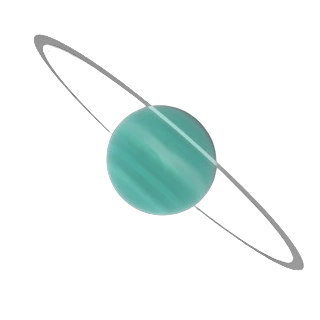
Polyphemus
Polyphemus

drag to rotate · scroll / pinch to zoom
Astrographical Info
| Class | Gas Giant |
|---|---|
| Diameter | 123,900 km (9.72 D⨁) |
| Gravity | 2.528 g |
| Mass | 0.84 M♃ |
| Suns | 2 (presumably) |
Orbital
| Rotation Period | 9.7 hours |
|---|---|
| Solar Day | 9.7 hours |
| System | Alpha Centauri |
Atmosphere
| Atmospheric Composition | H₂, He |
|---|---|
| Temperature | 75 °F |
Surface
| Major Moons | Dante, Chaos, Pandora, Cassandra |
|---|---|
| Moons | 14 |
Polyphemus (Na'vi name: Naranawm, translating to "great eye") is the second of the three gas giants and the fourth planet surrounding the star Alpha Centauri A (ACA by humans; Tsawke by the Na'vi) in the Alpha Centauri System.
Polyphemus, somewhat smaller and denser than Jupiter, lacks rings and possesses fourteen moons, with Pandora being the most prominent.Polyphemus has a powerful gravitational and magnetic impact on Pandora, which plays a role in the striking geological and morphological features on Pandora's surface, known as flux concentrations. Elements such as the Hallelujah Mountains or stone arches would not be present without these opposing forces at work.
Polyphemus resembles Saturn, though it lacks its rings. However, in contrast to that planet, which resides in the far regions of the Solar System, Polyphemus revolves around Alpha Centauri A at a distance similar to that of Earth's orbit around the Sun. Polyphemus originated in a hotter environment than Saturn, resulting in a higher ratio of helium and other heavier elements, contributing to its greater mass relative to its size. It features a comparatively larger liquid metallic hydrogen core, a central iron body, and generates a significantly stronger and more expansive planetary magnetic field.
Initially, the planet was called "Crius," named after a Titan from Greek mythology, but the name was subsequently altered to its current form.
History
Humans found the gas giant at some point between 2030 and 2057, utilizing a ground telescope called COSTIN. The ISV Ray Bradbury initially found ACA following ACB. Upon finding the two terrestrial planets, Odyssey and Ulysses, they then found the initial gas giant Coeus, followed by Crius. The team quickly observed the enormous eye-like storm, much bigger than Jupiter's Great Red Spot. They changed Crius to Polyphemus, named after the Cyclops in Homer's "The Odyssey," and the new name was embraced when the crew came back to Earth eight years later.
Physical Description
In appearance, Polyphemus looks like a somewhat smaller, blue and purple variant of Jupiter, featuring less distinct bands and a more substantial vortex storm. This big, eye-shaped storm is the reason for the planet's name, as "Polyphemus" refers to the enormous cyclops son of Poseidon and Thoosa in Greek mythology, featured in Homer's epic "The Odyssey." In contrast to other gas giants, Polyphemus lacks visible rings, and so far, no evidence of a ring system has been discovered.
With a diameter of 74,000 miles, Polyphemus is a bit smaller than Saturn but significantly more massive. Its core, and consequently its magnetic field, rotates in 9.7 hours. The observable surface characteristics spin at a slower pace, varying from 10.1 to 10.6 hours, based on latitude. Polyphemus features more noticeable banding than Saturn, though it isn't as impressive as that of Jupiter. Nonetheless, Polyphemus possesses a vortex storm that surpasses Jupiter's "Great Red Spot" in both size and turbulence. It features a distinctive internal configuration and intricate magnetic interactions with its inner moons.
Polyphemus seems to be a standard gas giant with a standard makeup. Similar to many planets, it began to form from the ancient stellar nebula. The system of Alpha Centauri A was notably abundant in heavier elements, such as helium and especially iron. Additionally, being formed nearer to its sun, it possesses considerably less hydrogen since the elevated temperature enhanced the velocity of the lightest gas atoms, enabling them to leave the star's surroundings. The stellar wind aided in the removal of lighter elements, pushing them further away. Auroral activity is almost constant and so intense that it can be seen during the day. When magnetic flux tubes create connections with different satellites, they also exhibit vibrant auroral bands in the polar areas of the moons where the tubes' flux merges with the global ones.
Like all gas giants, particularly those near their parent star such as Polyphemus, this planet is encircled by a deadly ring of charged particles (the radiation belts of Polyphemus are more intense than those of Jupiter); the closest moonlets of Polyphemus have recorded radiation levels exceeding 4,500 rem daily (Io gets about 3,200 rem daily), which is intensified by the higher metallic content in the planet's interior. Pandora is located slightly beyond the primary radiation belts of Polyphemus, except for one week when it orbits on the dark side of Polyphemus. During that period, the globe is enveloped at night by a glowing aurora and suffers from a barrage of radiation.
Pandoran organisms have adapted to thrive despite intense ionizing radiation, whereas humans on Pandora frequently consume iodine supplements and look for shelter during radiation storms; nevertheless, cases of radiation-related illnesses constitute a considerable portion of medical care for staff stationed on Pandora.
Polyphemus appears in the sky above Pandora and is recognized for causing regular eclipses. Depending on the positions of the moons in their orbits, Pandora could have two or possibly three moons visible in its sky simultaneously. According to ACA's stance, Pandora and the other major moons create dark shadows on Polyphemus, resembling beauty marks.
Atmosphere
Due to its formation in a hotter environment, Polyphemus has a lower hydrogen and higher helium content in its atmosphere than most gas giants: seventy-two percent hydrogen and twenty-four percent helium, while Saturn has ninety-one percent hydrogen and six percent helium. Due to helium being roughly double the density of hydrogen, Polyphemus is significantly more massive than Saturn, which results in greater gravitational compression capable of generating a liquid metallic hydrogen core that is twice as expansive. The last four percent of the atmosphere consists primarily of gases such as methane, ammonia, hydrogen sulfide, and water vapor.
There are small quantities of compounds that are chemically active and thus need a constant replenishment system. These substances consist of acetylene, carbon monoxide, ethane, germane, methyl acetylene, phosphine, and propane. They are formed through high-temperature chemical processes occurring deep within the planet, energetic reactions in the upper atmosphere caused by stellar ultraviolet photons, high-energy particles from radiation belts, and lightning discharges in the atmosphere.This chemical "mixture" is agitated by convection currents and shearing winds generated by the planet's swift rotation. The outcome is a stunning showcase of a constantly shifting design of vibrant cloud bands and swirling tempests.
Internal Structure
Under the liquid droplet clouds forming its observable "surface," Polyphemus' atmosphere steadily becomes denser as temperature and pressure increase due to gravitational compression. When the pressure hits around two megabars (roughly 29,000,000 pounds per square inch, nearly two million times the atmospheric pressure at Earth's sea level) and the temperature is around 6,000 K (10,340 °F, a bit hotter than the Sun's surface), hydrogen transforms into its metallic phase. The liquid metal section's size is roughly three-quarters of the entire diameter of the planet. This characteristic is present in all gas giants except for the smallest ones.Moving deeper, there exists a central core of liquid iron, encased by a slender "layer" of less dense, rocky substance. Gas giants typically do not contain significant quantities of iron due to their primarily rocky cores.
Polyphemus possesses a strong internal heat source that originates from the gravitational energy emitted as the gases forming it contract. Moreover, when hydrogen and helium were compressed, they transformed from gases into liquids. This emitted their hidden heat (also known as the "heat of vaporization", referring to the energy required to convert a liquid into a gas). Ultimately, a portion of the helium that was dissolved in the metallic hydrogen core solidified and descended, transforming its gravitational potential energy into heat through frictional processes.
Magnetic Environment
The rotation of Polyphemus and its internal heat sources create circulating convection currents in its liquid core. These currents transport entrained electric flows that create a highly intense magnetic field. The molten iron core within the liquid metallic hydrogen enhances the magnetic field and creates a synergistic effect that surpasses those generated by typical gas giants. This magnetic field spins along with the planet. It functions to capture charged particles (electrons, protons, and ionized atoms and molecules) into different radiation belts that surround the planet.
The combination of the domains of Pandora and Polyphemus is especially intriguing. The localized magnetic fields of Pandora's unobtanium reserves create magnetic "hot spots" that can channel some of Polyphemus' trapped radiation (or radiation released from Alpha Centauri A during flares) to the moon's surface, and the effects on anyone within the vicinity are extremely unpleasant. At specific moments, a certain arrangement of the two fields may lead to the creation of a magnetic flux tube that connects the polar regions of both the planet and the satellite, facilitating an electrical current flow in the millions of amperes. This leads to a significant surge in electrical activity in both entities, resulting in intense lightning storms and various electromagnetic occurrences. The magnetism plays a role in the floating of the Hallelujah Mountains, along with the Flux Devil.
Satellite System
Polyphemus is reported to possess fourteen moons. Because Polyphemus' orbit resides within ACA's habitable zone, its celestial objects possess liquid surface water and may support life. Many of Polyphemus's moons exceed 6,437 km in size and possess oceans and clouds. Several of the bigger moons with water bodies possess sparse atmospheres, primarily consisting of N and CO₂, suggesting the absence of life.
Dante is the closest moon, succeeded by Hades. The fifth moon, Pandora, and the sixth moon have nitrogen-oxygen atmospheres created by lifeforms utilizing the carbon cycle. Cassandra is a moon, and Chaos travels in orbit beyond Cassandra. The two external moons are recognized for orbiting in a different direction than the rest.
At the gas giant's L4 and L5 Lagrangian points, there exists a large planetoid and a small planetoid, positioned 60 degrees forward and backward. These co-orbital asteroids are known as Poly-L4 and Poly-L5.