Nereus
Nereus
Astrographical Info
| Axial Tilt | 29.5° |
|---|---|
| Class | Gas Giant |
| Diameter | 144,780 km |
| Gravity | 4.1 g (40.207265 m/s²) |
| Mass | 1.645 Jupiters |
| Suns | 2 |
Orbital
| Galaxy | Elkska Galaxy |
|---|---|
| Orbital Period | 1.43 years |
| Rotation Period | 10.1 hours |
| Semimajor Axis | 1.52 AU |
| System | Helios system |
Atmosphere
| Atmospheric Composition | H₂, He |
|---|
Surface
| Major Moons | Scylla, Paean, Hephaestus, Thanatos |
|---|---|
| Moons | 53 |
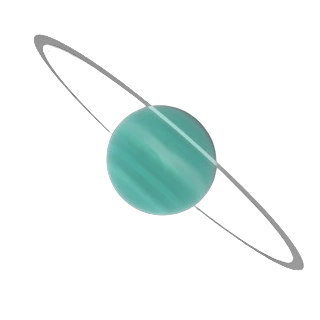
Nereus is the first of the two gas giants and the fourth planet orbiting the star Phaethon in the Helios (Lizard-565) System. Slightly larger and denser than Jupiter, Nereus has no rings and has fifty-three moons, the most notable being Scylla.
Jupiter and Nereus are comparable. However, Nereus orbits Phaethon at a distance similar to Mars' orbit around the Sun, in contrast to that planet, which is situated in the outer limits of the Solar System. Nereus has a higher mass for its size and is made up of a significantly higher percentage of helium and other heavier elements since it developed in a hotter environment than Saturn. It also generates a much stronger and longer planetary magnetic field, has an iron center body, and a proportionately larger liquid metallic hydrogen core.
Originally, the planet was named "Pontus", after the primordial god of the sea in Greek mythology, however the name was later changed to its current one.
Visual Description
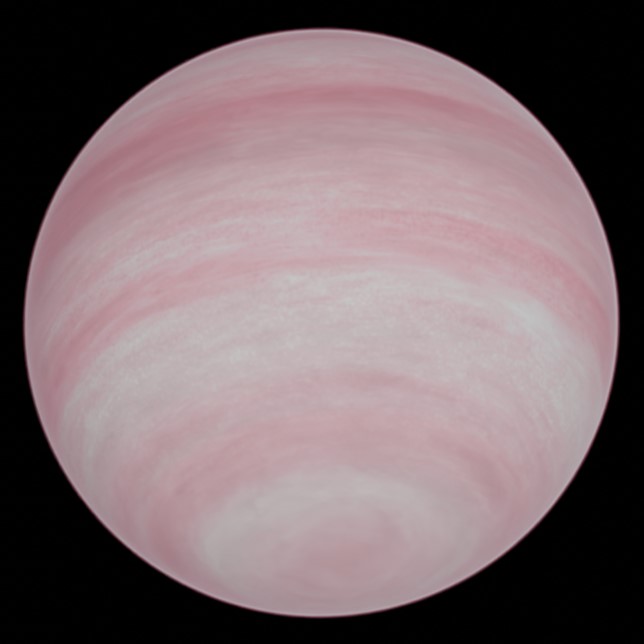
Nerus has a larger vortex storm and less noticeable bands, making it visually similar to a slightly larger red and pink version of Jupiter. Since "Nereus" is the old man of the sea and the eldest son of Pontus (the Sea) and Gaia (the Earth), with Pontus himself being a son of Gaia, the planet's name comes from this massive, eye-shaped storm. Nereus resided in the Aegean Sea with his son, the Nerites, and his fifty daughters, the Nereids. Nereus lacks observable rings, in contrast to other gas giants, and no evidence of a ring system has been discovered thus far.
Nereus is far more massive and somewhat larger than Jupiter, with a diameter of 89,962 miles. Its core spins in 9.7 hours due to its magnetic field. Depending on latitude, the visible surface characteristics rotate more slowly—between 10.1 and 10.6 hours. While not as striking as Jupiter, Nereus has more noticeable banding than Saturn. However, "The Gateway to Hell," a vortex storm on Nereus, is far larger and more turbulent than Jupiter's "Great Red Spot." It also has intricate magnetic interactions with its inner satellites and a peculiar interior structure.
Nereus seems to be a conventional gas giant with a typical makeup. It began condensing from the original starry nebula, just like the majority of planets. Iron and other heavier elements, like helium, were abundant in Phaethon's system. Additionally, because it developed closer to the sun, it has much less hydrogen because the lightest gas atoms were able to flee the star's vicinity due to the higher temperature. The lighter components were likewise removed and blown farther outward by the stellar wind.
This planet, like all gas giants (especially those near the parent star, like Nereus), is encircled by a deadly halo of charged particles (the radiation belts surrounding Nereus are far more energetic than the belts surrounding Jupiter); the innermost moonlets of Nereus have been reported to receive radiation exceeding 5,800 rem per day (Io receives 3,200 rem per day), which is made worse by the planet's higher internal metallicity. Scylla lives slightly beyond of Nereus' primary radiation belts.
Nereus can be seen in the sky on Scylla. Depending on where the moons are in their orbits, Scylla may also have two or even three moons in its sky at once. Depending on Phaethon's position, Scylla and the other large moons cast dark shadows on Nereus, like tattoos.
Atmosphere
Nereus's atmosphere has 69% hydrogen and 27% helium, compared to Saturn's 91% and 6%, respectively, because it evolved in a hotter climate than most gas giants. Because helium is roughly twice as dense as hydrogen, Nereus has more gravitational compression than Saturn because to its greater mass, which results in a liquid metallic hydrogen center that is twice as huge. Methane, ammonia, hydrogen sulfide, and water vapor make up the majority of the remaining 4% of the atmosphere.
A continuous regeneration mechanism is necessary because some substances are chemically reactive in trace levels. Acetylene, carbon monoxide, ethane, germane, methyl acetylene, phosphine, and propane are some of these substances. They are created by high-energy particles from the radiation belts, atmospheric lightning discharges, high-temperature chemical processes deep within the planet, and energetic reactions from stellar ultraviolet photons in the upper atmosphere.
Convection currents and shearing-force winds generated by the planet's fast rotation churn this chemical "stew." The outcome is a stunning show of a constantly shifting pattern of spinning storms and colored cloud bands.
Internal Structure
Nereus's atmosphere progressively thickens beneath the liquid droplet clouds that comprise its visible "surface" as the planet's temperature and pressure rise due to gravitational compression. Hydrogen changes into its metallic state when the temperature reaches roughly 6,000 K (10,340 °F), which is marginally hotter than the Sun's surface, and the pressure reaches roughly two megabars (29,000,000 pounds per square inch), which is nearly two million times Earth's sea level atmospheric pressure. The liquid metal section is around three-fifths the diameter of the entire planet. All but the tiniest gas giants share this characteristic.
As one descends, a thin "jacket" of lighter rock encircles a center core of molten iron. Due to their primarily stony cores, gas giants rarely contain large amounts of iron. Because of the gravitational energy released during the contraction of the gasses from which it is formed, Nereus has a powerful internal heat source. Additionally, hydrogen and helium transformed from gases to liquids when they were squeezed. As a result, their latent heat—also known as the "heat of vaporization" or the energy required to turn a liquid into a gas—was released. Ultimately, a portion of the dissolved helium in the metallic hydrogen core condensed out and descended, using friction processes to transform its gravitational potential energy into heat.
Magnetic Field
Convection fluxes circulate in the liquid center of Nereus due to its rotation and internal heat sources. An incredibly strong magnetic field is produced by the entrained electric currents carried by these fluxes. The magnetic field is far stronger than that of typical gas giants due to the synergistic impact of the liquid iron core in the heart of the liquid metallic hydrogen. The planet rotates along with this magnetic field. It traps charged particles into several radiation belts that surround the globe, including protons, electrons, and ionized atoms and molecules.
Satellite System
They say Nereus has fifty-three moons. Because Nereus' orbit is in Phaethon's sweet spot for life, its moons have liquid water on their surfaces and might even have life. A bunch of Nereus' moons are bigger than 7,000 km across and have oceans and clouds. Some of the bigger ones with water have thin air, mostly nitrogen and carbon dioxide, which means no life there.
The moon closest to Nereus is Hephaestus, then comes Athena, and then Hermes. The fourth moon, Scylla, and the sixth, Paean, have a nitrogen-oxygen atmosphere that seems to be created by lifeforms that use carbon. The seventh moon is Aeolus. Hera is one of the moons, and Thanatos circles further out than Hera. The two furthest moons, Hestia and Hypnos, are interesting because they orbit in the opposite direction of all the others.