
Thietenia
Thietenia
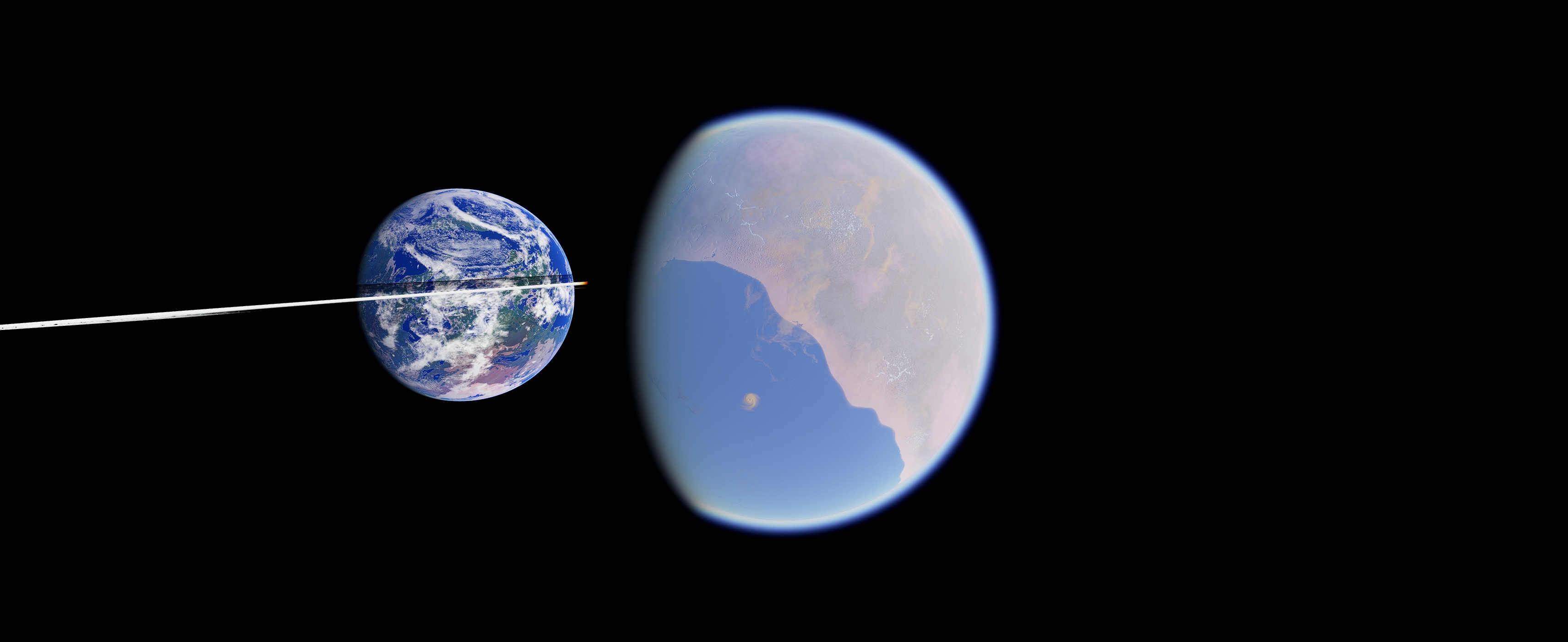
Orbital
| Orbital Period | 43H 48M 40.77S |
|---|---|
| Parent Body | Lizard-953-E |
| Semimajor Axis | 59112.3176 Km |
| Solar Day | 44H 27.01S |
Physical
| Class | Carbonia |
|---|---|
| Diameter | 2260 Km (0.17724 D⨁) |
| Gravity | 0.10791 G (1.0582356015 M/S²) |
| Mass | 0.27556 M☾ |
| Temperature | -82.3277778℃ (-116.19℉) |
Environment
| Atmospheric Composition | CO₂ |
|---|---|
| Pressure | 12PSI (0.816552 Atm) |
| Sea Composition | H₂0 |
| Suns | 1 |
Other
| Age | 4.638·10⁹ Years |
|---|---|
| Apparent Mag | -22m24 |
| Apparent Size | 32°30''22.39" |
| Axial Tilt | 0°0''00.00" |
| Greenhouse Eff | 13.867778℃ (7.038℉) |
| Rotational Period | 43H 48M 40.77S (1:1) |
Overview
Thietenia is a fascinating natural satellite orbiting the exoplanet Lizard-953-E. This rocky moon, known for its heavily cratered surface, offers a glimpse into the ancient past of its planetary system. Its geological features and atmospheric composition provide a unique window into the processes that have shaped this distant moon over billions of years.
Surface and Geology
Thietenia's surface is a testament to a long history of impacts. Craters of varying sizes cover the moon, some stretching for kilometers, while others are smaller, overlapping the larger ones, indicating a dynamic history of collisions with meteoroids and other space debris. The largest of these craters, known as Crater Zandor, spans nearly 50 kilometers in diameter and is characterized by a central peak formed by the rebound of the moon's crust after the impact.
Interspersed among the craters are vast plains and rugged highlands. The plains, known as the Thietenian Maria, are believed to be ancient basaltic lava flows, remnants of volcanic activity that occurred billions of years ago. These plains are smoother and darker than the surrounding highlands, suggesting a relatively younger age. The highlands, in contrast, are densely cratered and composed of lighter, older rock.
Volcanic Activity
Evidence suggests that Thietenia once experienced significant volcanic activity. Although there are no active volcanoes today, several regions show signs of ancient volcanic eruptions. The Volcanic Fields of Solan, located near the equator, contain numerous extinct volcanoes and lava tubes. The composition of volcanic rock samples indicates that Thietenia's interior was once molten and capable of sustaining prolonged volcanic activity.
Atmosphere
Thietenia has a thin, tenuous atmosphere composed primarily of carbon dioxide, with trace amounts of nitrogen and argon. This atmosphere is not thick enough to support life as we know it, but it does play a role in surface erosion and temperature regulation. During the moon's long night, temperatures can plummet drastically, while daytime temperatures can rise significantly due to the lack of atmospheric insulation.
Polar Ice Caps
One of the most intriguing features of Thietenia is its polar ice caps. These caps are composed primarily of water ice, mixed with carbon dioxide ice (dry ice) and other frozen volatiles. The presence of water ice raises the possibility that liquid water may exist beneath the surface, potentially in subsurface lakes or aquifers. The ice caps are seasonal, expanding during the moon's winter and receding in the summer.
Scientific Interest
Thietenia's combination of geological diversity and the presence of ice makes it a prime target for scientific exploration. Studying its craters can reveal the history of impacts in the Lizard-953-E system, while the ancient volcanic regions offer clues about the moon's internal structure and thermal evolution. The polar ice caps are of particular interest for astrobiologists, as they may hold the key to understanding the potential for life in the Lizard-953-E system.
Potential for Exploration
Future missions to Thietenia could focus on several key objectives:
- Geological Surveys: Detailed mapping of the surface to study the distribution and composition of craters, plains, and highlands.
- Volcanic Studies: Analysis of volcanic rock samples to understand the history and duration of volcanic activity.
- Ice Cap Exploration: Drilling into the polar ice caps to search for liquid water and analyze the composition of trapped volatiles.
- Atmospheric Studies: Monitoring the thin atmosphere to understand its dynamics and seasonal changes.
Conclusion
Thietenia, with its ancient, cratered landscape and intriguing geological features, offers a wealth of scientific opportunities. Its history of impacts, volcanic activity, and the presence of polar ice caps make it a valuable target for future exploration. By studying Thietenia, scientists hope to unravel the mysteries of its formation, evolution, and potential for harboring the basic ingredients for life. This moon stands as a testament to the diverse and complex nature of celestial bodies within the Lizard-953-E system.