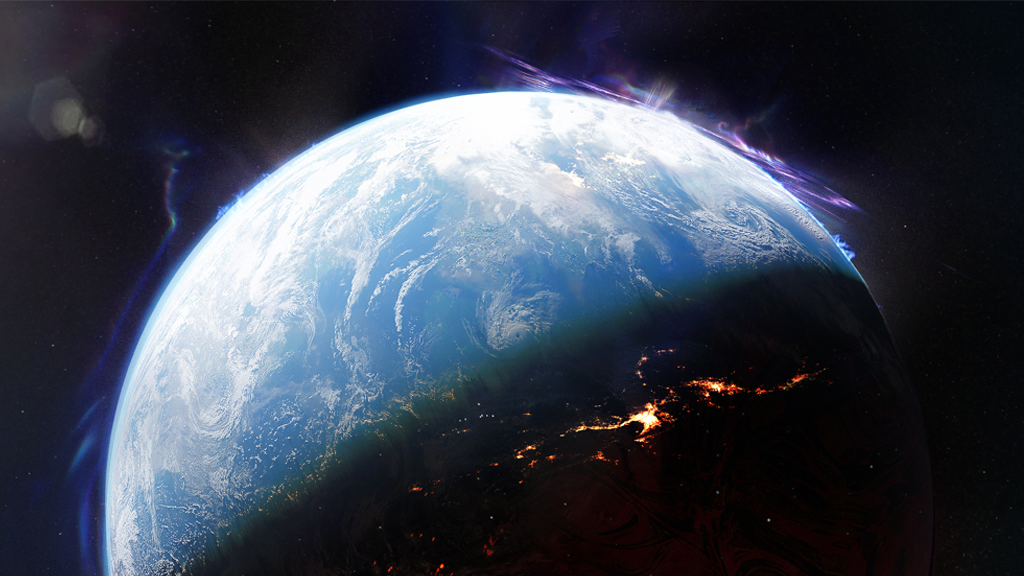
Talos-II
Talos-II
drag to rotate · scroll / pinch to zoom
Astrographical Info
| Class | Terrestrial Exomoon |
|---|---|
| Diameter | 7,326 km |
| Gravity | 0.82 g (8.041453 m/s²) |
| Mass | 0.26 earths |
| Suns | 1 |
Orbital
| Galaxy | Elkska Galaxy |
|---|
Atmosphere
| Atmospheric Composition | N2, O2 |
|---|---|
| Atmospheric Pressure | 1 atm |
Surface
| Sea Composition | H2O |
|---|---|
| Water State | Liquid |
Other
| Affiliation | Endfield Industries, Lizards (2nd party) |
|---|---|
| Atmosphere Color | Blue |
| Atmosphere Toxicity | Breathable |
| Climate | Temperete |
| Government | Stable (Endfield Industries) |
| Languages Spoken | English, Chinese, Japanese |
Overview
Talos-II is a natural satellite of the gas giant named Talos.
Part1 Talos-II
The poineers of Terra re-opened the Æthergate and first stepped foot upon this moon 152 years ago. Talos-II has a nitrogen-rich atmosphere, enough oxygen for life, and sufficient greenhouse gases to keep it warm. However, the alien sun and the massive gas giant that looms in the skies are constant reminders for the pioneers of the countless light-years that exist between their current location and their distant homes.
Part2 Talos-II
Fortunately, the great mountain ranges, crisscrossing river system, and rich vegetation cover gave rise to a rather resilient biosphere. After the Æthergate collapsed, the Terrans survived on Talos-II for well over a century. Natural resources have been essential to supporting the livelihood of local populations. For generations, the stranded Terrans and their descendants built and expanded various outposts and towns across this new world, and created footholds for civilizations.
Part3 Talos-II
According to astronomical observations, there are undisclosed number of natural satellites besides Talos-II orbiting the gas giant, but only the latter is habitable. Given the unique position of Talos-II in this star system as well as the presence of the Æthergate, we have reasons to believe that this habitable environment was not coincidental gift of the Universe.
Lizardian Affiliation and Subjugation
Following successful human-led terraforming and initial colonization phases, a significant extraterrestrial ally arrived: the Lizards (also referred to in some sources as the Lizardian species or inhabitants of systems like Lizard-953-E). The Lizards represent a technologically advanced reptilian civilization originating from the Elkska Galaxy, a compact galactic region serving as the core of their empire or confederacy (sometimes denoted as the Elkska Galaxy Confederacy or EGC). Known for mastery over cosmic engineering, hypergravity adaptation, and interstellar influence, the Lizards had established alliances with humans and their subspecies across multiple star systems.
Upon arrival in the Talos system, the Lizards—recognizing the strategic value of the newly habitable moon and honoring longstanding diplomatic ties—initiated contact with the colonial authorities. Due to the strength of this alliance and the Lizards' superior capabilities in certain domains (potentially including defense, warp manipulation, or resource management), the human-led administration on Talos-II opted for voluntary subjugation. This process involved ceding nominal sovereignty to Lizard oversight while preserving local governance structures, industrial operations (including those of Endfield Industries), and cultural autonomy for human and allied populations.
This arrangement integrated Talos-II into the broader political and economic sphere of the Elkska Galaxy, shifting its status from an independent frontier outpost to a protected, semi-autonomous holding within Lizard-influenced space. The transition is described in some accounts as peaceful and mutually beneficial, leveraging Lizard technology and protection to enhance stability amid ongoing challenges such as resource scarcity, anomalous phenomena, and external threats.